- Science Chapter 10 Class 11 - Quick Overview on Electricity
- Download PDF of NCERT Solutions For Class 10 Science Chapter 11 Electricity
- Important Topics Covered in Chapter 11 of Class 10 Science
- Why Choose ToppersSky for Class 10 NCERT Solutions?
- Conclusion
- Class 10 Questions And Answers Help You Prepare For Exams
- Chapter-wise NCERT Solutions for Class 10 Science
- FAQs
Science Chapter 10 Class 11 – Quick Overview on Electricity
NCERT Solutions for Class 10 Science Chapter 11 Electricity even more undoubtedly teaches students the basic ideas of how electricity current flows and its effect on different electrical components. Along with the developments in the field of current, resistance, electric power, and numerical problems of constructing series and parallel circuits, this chapter has also come up to be the covering of the students’ minds. The NCERT Solutions also comprise of a large variety of questions that will be able to develop students’ concept clarity and problem-solving skills related to electricity and its applications in daily life.
Class 10 Science Chapter 11 Electricity is found to be a crucial chapter in the academic curriculum. A single blow of this chapter not only aids students with higher grades in the board exams but also provides a base for further studies and for acquiring admission through competitive exams like engineering entrance.
NCERT Solutions for Class 10 Science Chapter 11 are helpful while going through the textbook, as they point out all the points which are hard to understand and which likely have been missed. These solutions take the whole syllabus in a systematic way and offer full explanations of both theoretical concepts and numerical problems. The solutions are strategized and drawn by veteran teachers, making it possible for the students to do their homework with ease and also to cultivate the skills that are necessary for excelling in both academic and competitive examinations, thus they are becoming more and more ready for the next levels to come really soon.
Download PDF of NCERT Solutions For Class 10 Science Chapter 11 Electricity
Add notes section and add an app download function for complete notes
Important Topics Covered in Chapter 11 of Class 10 Science
| Topics |
|---|
| 12.1 Electric Current and Circuit |
| 12.2 Electric Potential and Potential Difference |
| 12.3 Circuit Diagram |
| 12.4 Ohm’s Law |
| 12.5 Factors on Which the Resistance of a Conductor Depends |
| 12.6 Resistance of a System of Resistors |
| 12.6.1 Resistors in Series |
| 12.6.2 Resistors in Parallel |
| 12.7 Heating Effect of Electric Current |
| 12.7.1 Practical Applications of Heating Effect of Electric Current |
| 12.8 Electric Power |
Electric Current and Charge
Class 10 Science Chapter 11 commences with a lucid presentation of electric current and electric charge. The NCERT Solutions deliver detailed definitions of all related terms and elucidate the main equations that link these ideas. The use of pictures and diagrams makes the concepts easier to comprehend. A set of practice questions is given at the end of this part for students to evaluate their comprehension and there now, basic concepts are stronger.
Electric Potential and Potential Difference
This portion of NCERT Solutions for Class 10 Science Chapter 11 enables students to comprehend the passage of electric charge via the theories of electric potential and potential difference. Formulas are discussed along with their real-world uses, showing the connection between these variables. To help cement the learning, this part ends with self-checking questions that give students a chance to assess how clear their concepts are.
Circuit Diagrams
Circuit diagrams are vital for the unambiguous depiction of the electrical circuits. In this part of the book students get introduced to the universal symbols that are employed in circuit diagrams. Different diagrams and drawings accompany the text to facilitate the understanding of students in the drawing and correctly interpreting electrical circuits.
Ohm’s Law and Resistance
In Class 10 Science Chapter 11, resistance is identified as one of the principal topics. The NCERT Solutions give a comprehensive definition of resistance, emphasizing the factors that affect it and the variations in resistance of different materials. The chapter also introduces resistors and explains their arrangements in series and parallel circuits.
Ohm’s Law is illustrated with accurate formulas and real-life applications, along with simple diagrams. This part of the chapter is very much focused on the exam and it has many solved examples that are none other than the typical questions asked in board exams. Students are advised to work out both the solved and unsolved problems to enhance their accuracy and build up their confidence.
Heating Effect of Electric Current and Its Applications
The topic of this section is the heating effect of electric current, which is caused by the transformation of electrical energy into heat. Joule’s law of heating is discussed in great detail and all the associated formulas are presented. The learners are taken through numerical problems to make them grasp the idea very well.
The NCERT Solutions besides theory explain the heating effect through the lens of real-life applications, which have been asked repeatedly in the exam.
Electric Power
The last subject dealt with in the Class 10 Science Chapter 11 is electric power. As soon as pupils comprehend the earlier concepts, this section can be easily grasped by them. The NCERT Solutions present formulas associated with electric power and energy, along with diagrams and numerical examples. The questions are classified into solved and practice types, allowing students to earn good marks in problems with high weightage.
Chapter Summary and Practice
At the close of the chapter, all the major points are concisely put in a point-wise format, which makes the revision process quick and very effective—especially just before the exam. Leading educational platforms like Vedantu usually provide such summaries. In addition to this, the solution set consists of extra questions and answers that are student-friendly for practicing and building confidence for the board examinations.
The NCERT Solutions for Class 10 Science Chapter 11 (Electricity) from ToppersSky are really helpful for students to get a clear understanding of the concepts and to be well-prepared for the board examination. The most important things are:
- The entire solution set is composed in a very basic and student-friendly way so that it is comprehensible even the complex concepts.
- There are very well-labelled diagrams and clear schematics to give a visual explanation of the topics and thereby improve the understanding.
- There are a lot of exam-oriented questions, including solved and unsolved problems, that form the basis for practice.
- The numerical problems are explained in a step-by-step manner so as to enable the students to handle the calculations pertaining to electricity with confidence.
- Each section has direct and conceptual questions that are meant to reinforce the understanding.
- The students can easily download the PDF format and then they can study at their own time and convenience.
Why Choose ToppersSky for Class 10 NCERT Solutions?
Here are some important reasons why ToppersSky’s NCERT Solutions for Class 10 Science Chapter 11 are a reliable study resource:
- ToppersSky offers explanations that are simple to grasp and focus on the exam for each question.
- Professional subject experts who are experienced make all the solutions, thus, guaranteeing both accuracy and clarity.
- NCERT Solutions can be downloaded by students in PDF format and they can revise them offline anytime.
- Theorems and numerical problems are discussed clearly and in a step-by-step manner.
- The material is strictly in line with the most recent syllabus and exam pattern.
Students are advised to make the most of the opportunity and to practice questions from Chapter 11, which is rich in important theorems and numerical problems that are often asked in exams. ToppersSky App, in addition, provides a variety of learning resources through its platform for extra exam preparation.
Conclusion
ToppersSky’s NCERT Solutions for Class 10 Science Chapter 11 – Electricity act as an indispensable, serious-learning companion for the Class 10 kids. These solutions are able to simplify difficult scientific concepts and render them in an easy and structured way. By the use of ToppersSky’s NCERT Solutions, students can develop a firm grasp of concepts, enhance their problem-solving skills, and get board examination confidence. To sum it up, through these solutions, students not only get good grades but also get interested in the chapter Electricity, which is a plus point to have.

Class 10 Questions And Answers Help You Prepare For Exams
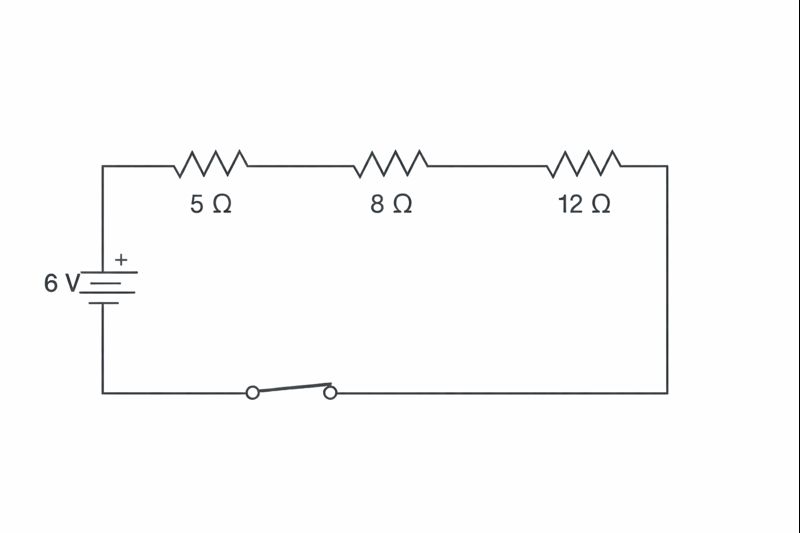
Q.1 Draw a schematic diagram of an electric circuit that includes a battery made of three cells of 2 V each, a 5Ω resistor, an 8Ω resistor, a 12Ω resistor, and a plug key, all connected in series.
Answer:
The circuit diagram represents three resistors of 5Ω, 8Ω, and 12Ω connected in series along with a battery supplying a total potential difference of 6 V.
Q.2 What is the reason that the electric heater cord does not get hot like the heating element?
Answer:
The heat generated in a conductor is directly related to its resistance. An electric heater has a resistant wire as a heating element and then it gets hotter and hot enough to emit red light, hence glows. The connecting wire, however, has very low resistance because of which it generates too little heat and consequently does not get glowing.
Q.3 Calculate the heat produced when 96,000 coulomb of charge flows in one hour through a potential difference of 50 V.
Answer:
According to Joule’s law of heating, the heat produced is given by:
H = VIt
Given:
Voltage, V = 50 V
Charge, q = 96,000 C
Time, t = 1 hour = 60 × 60 = 3600 s
Since current I = q / t,
H = V × q
H = 50 × 96,000
H = 4.8 × 10⁶ J
Therefore, the heat produced during the flow of charge is 4.8 × 10⁶ joules.
Q.4 An electric iron of resistance 20 Ω draws a current of 5 A. Calculate the heat produced in 30 seconds.
Answer:
According to Joule’s law of heating, the heat produced is given by:
H = I²Rt
Given:
Current, I = 5 A
Resistance, R = 20 Ω
Time, t = 30 s
Substituting the values:
H = (5)² × 20 × 30
H = 1.5 × 10⁴ J
Therefore, the amount of heat produced in the electric iron is 1.5 × 10⁴ joules.
Q.5 The electric heater’s heating element shines, but what about the cord, why doesn’t it shine?
Answer:
The electric heater is constructed using thick copper wire for its cord, which provides the minimum electrical resistance possible and therefore does not produce any light. On the other hand, the heater coil is made of high resistance wire which generates heat.
The power loss that occurs when the same electric current passes through the cord and the heating element is related to the resistance, as expressed by the formula H = I²R.
Due to the heating element’s resistance being much higher, it produces a large quantity of heat and turns red hot, hence glowing. The cord, in contrast, possesses so little resistance that it can merely generate an insignificant amount of heat and therefore never attains the luminous temperature.
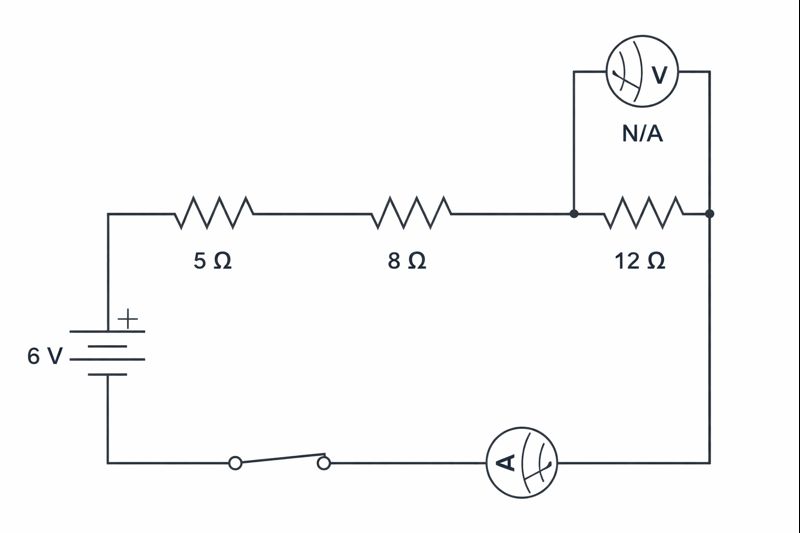
Q.6 Circuit di Ques 1 ang joon as an ammeter and a voltmeter connected to measure the current through the resistors and the potential difference across the 12 Ω resistor, respectively. What will the voltmeter read?
Answer:
For current measurement through the resistors a series connection of ammeter with the circuit is done. At the same time, a voltmeter is connected across the 12 Ω resistor to measure the voltage drop across it.
First, calculate the total resistance of the circuit:
Total resistance,
Req = R1 + R2 + R3
Req = 5 Ω + 8 Ω + 12 Ω
Req = 25 Ω
The total potential difference of the battery is 6 V.
Current in the circuit is given by Ohm’s law:
I = V / R
I = 6 / 25
I = 0.24 A
Since the resistors are connected in series, the same current flows through each resistor.
Now, calculate the potential difference across the 12 Ω resistor:
V = I × R
V = 0.24 × 12
V = 2.88 V
Therefore, the voltmeter will read 2.88 V.
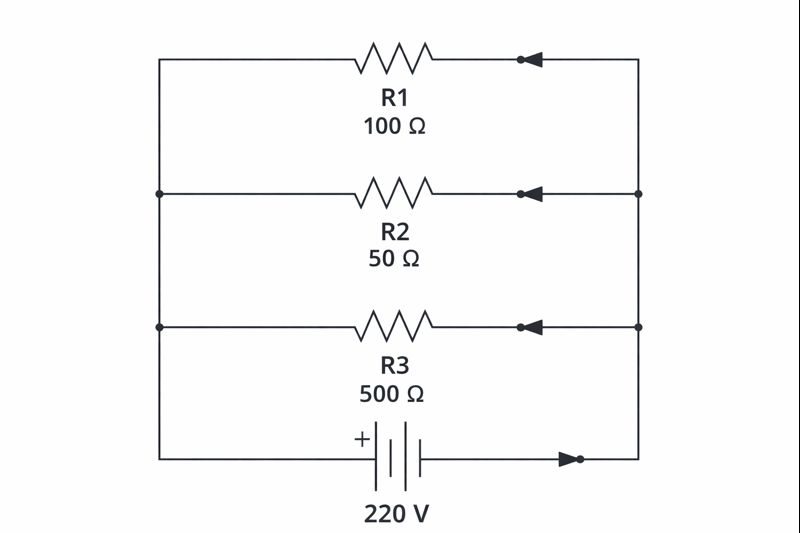
Q.7 An electric lamp of resistance 100 Ω, a toaster of resistance 50 Ω, and a water filter of resistance 500 Ω are connected in parallel to a 220 V supply. Which appliance draws the maximum current and what is the value of that current?
Answer:
The given appliances are connected in parallel to the same source, so each appliance has the same potential difference of 220 V across it.
Given:
Resistance of electric lamp, R₁ = 100 Ω
Resistance of toaster, R₂ = 50 Ω
Resistance of water filter, R₃ = 500 Ω
Supply voltage, V = 220 V
These are connected in parallel, as shown in the following figure.
Let R be the equivalent resistance of the circuit.
1/R = 1/R₁ + 1/R₂ + 1/R₃
1/R = 1/100 + 1/50 + 1/500
1/R = (5 + 10 + 1) / 500
1/R = 16 / 500
Therefore,
R = 500 / 16 Ω
According to Ohm’s law,
V = IR
So,
I = V / R
Given voltage, V = 220 V
I = 220 ÷ (500/16)
I = (220 × 16) / 500
I = 6.4 A
Hence, the total current drawn by the three appliances together is 6.4 A.
Therefore, an electric iron connected to the same source of potential (220 V) must also draw a current of 6.4 A.
Let R′ be the resistance of the electric iron.
Using Ohm’s law:
V = I × R′
So,
R′ = V / I
R′ = 220 / 6.4
R′ = 34.375 Ω
Therefore, the resistance of the electric iron is 34.375 Ω, and the current flowing through it is 6.4 A.
Q.8 How is a voltmeter connected in a circuit to measure the potential difference between two points?
Answer:
A voltmeter is always connected in parallel between the two points from which the potential difference is to be measured.It is due to the fact that a voltmeter determines the difference in electric potential between two points without changing the current flow of the circuit. Additionally, because the voltmeter possesses a resistance that is extremely high, its current consumption when it is parallel connected to a circuit is very low and thus the potential difference measurement is practically accurate.
Q.9 When a 12 V battery is connected across an unknown resistor, a current of 2.5 mA flows through the circuit. Find the resistance of the resistor.
Answer:
Given that the potential difference V is 12 V and the current I is 2.5 mA, which is equal to 2.5 × 10⁻³ A.
According to Ohm’s Law, the resistance of a conductor is given by the formula R = V / I.
Substituting the given values,
R = 12 / (2.5 × 10⁻³)
This gives,
R = 4800 ohms
Therefore, the resistance of the given resistor is 4800 Ω or 4.8 kΩ.
Q.10 Is it more advantageous to connect a thick wire or a thin one of the same material to the same source with respect to the current flow? Justify your answer.
Answer:
If both a thick wire and a thin wire made of the same material are connected to the same power supply. The current will take the thick wire as its path anyway.. The reason is the thicker wire has less resistance because one of the factors influencing the resistance of a conductor is the area through which the current flows. A thick wire with larger cross-section would result in lower resistance while the thin wire with smaller cross-section would have higher resistance. Resistance is inversely proportional to (R 1/A), so, the thick wire gives the electric current less resistance and therefore, the current flows more easily through it.
Chapter-wise NCERT Solutions for Class 10 Science
FAQs
1. Which issues are addressed in the NCERT Solutions for Class 10 Science Chapter 11 Electricity?
All NCERT Solutions for Class10 Science Chapter 11 are relevant to the electricity subject matter. The topics included are the following: electric current and circuits, electric potential along with potential difference, Ohm’s Law, resistance and its determinants, heat generation in electric circuits, power consumption, etc. The entire content is presented in a very systematic manner in accordance. The guidelines of the latest CBSE syllabus, together with diagrams, numerical problems, formulas, and logical reasoning.
2. What is the process of explaining Ohm’s Law in NCERT Solutions for Class 10?
Ohm’s Law has been elucidated through the linking of voltage (V), current (I), and resistance (R) with the equation V = IR. The National Council of Educational Research and Training (NCERT) Solutions depict. This principle via straightforward definitions, circuit sketches, and real-life situations. The gradual numerical solutions trained the pupils in such a way. That they could apply Ohm’s Law right in board-exam-type questions.
3. What are the reasons to use NCERT Solutions for Class 10 Science Chapter 11 by students?
NCERT Solutions are very often prescribed as the best because they conform precisely to the CBSE syllabus and exam pattern. The responses are provided in the easiest of terms, thus, turning the tough concepts into quite simple ones. The numerical problems are frequently solved in a detailed manner. This way students gradually gain the confidence to deal with them. Apart from these, the NCERT Solutions also teach students. How to phrase their answers in the right way to get the marks in exams.
4. Are NCERT Solutions enough to score well in Class 10 Electricity chapter?
Yes, NCERT Solutions provide a strong foundation for scoring good marks in Chapter 11 Electricity. All textbook questions and important numericals are covered in detail. When combined with regular revision, practice of sample papers, and concept clarity. NCERT Solutions are sufficient for excellent performance in board exams.
5. How can students effectively prepare for Class 10 Science Chapter 11 Electricity?
Students should seek to clarify the fundamental concepts of current, voltage, and resistance first. Practising NCERT numerical problems regularly is essential. Revising formulas, drawing neat circuit diagrams, and solving previous years’ questions can greatly improve performance. This chapter also builds the base for higher-class physics concepts, so conceptual clarity is very important.