



- Why Should You Start Class 10 Board Preparation in July?
- Month-Wise Class 10 Board Exam Preparation Roadmap
- Daily Study Routine for Class 10 Students
- Subject-Wise Preparation Tips
- Common Mistakes Students Should Avoid
- How ToppersSky Makes Board Preparation Easier
- Quick Checklist Before Board Exams
- Conclusion
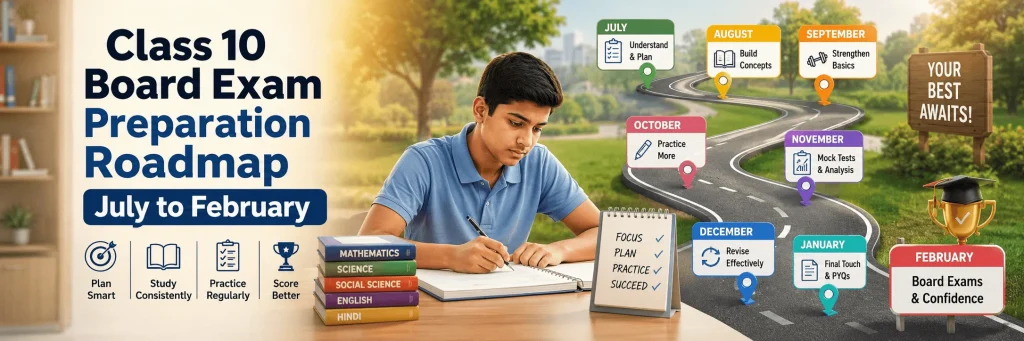
Preparing for the Class 10 board exams may feel kind of challenging, but if you start early, the whole journey becomes less heavy. Having a proper Class 10 board exam preparation roadmap is like a quiet guide, so you can study without that nonstop stress, and you get enough time to grasp the ideas, do quick revising regularly, and then practice a good number of questions. Instead of studying here and there, just in random bits, it helps to use a month-wise study plan for class 10 from July all the way to February. That way, you can strengthen your foundations, do regular revising, and also practice the most important questions. Each month has a different focus, so your prep stays more organized and it feels less heavy over time. And whether your aim is to cross 90% or you’re just trying to raise your score step by step, this roadmap will keep you on track, more self-assured, and ready for the board exams.
Why Should You Start Class 10 Board Preparation in July?
Many students begin to study in a more serious way, only a couple of months before the exams. And then it usually turns out into stress, some unfinished chapters, and well, less confidence. Starting early gives you enough time to grasp each subject properly, and to revise a few times too, so you can feel more steady.
Here are some benefits of starting in July:
- You can complete the syllabus without rushing.
- There is enough time to revise difficult chapters.
- You can solve previous years and sample papers comfortably.
- You feel more confident before the exams.
- You can improve weak subjects step by step.
Following those simple CBSE Class 10 preparation tips from the start kind of helps you stay ahead and avoid that last-minute pressure.
Month-Wise Class 10 Board Exam Preparation Roadmap
July – Build Your Foundation
July is the perfect month to start your preparation. Don’t think about marks at this stage. Your main goal should be understanding concepts. Focus on:
- Read every chapter from NCERT carefully.
- Attend school classes regularly.
- Practice Maths every day.
- Learn Science concepts instead of memorizing them.
- Read Social Science chapters daily.
- Improve English & Hindi grammar and reading habits.
If you are studying Maths, keeping class 10 maths notes with formulas and important examples will revise easier later. Study for about 2–3 hours daily after school and maintain consistency.
August – Complete Basic Concepts
By August, you should continue covering your syllabus and complete the easier chapters first. This is also a good time to identify the subjects you find difficult.
Things to do:
- Finish basic chapters.
- Prepare short notes after every chapter.
- Revise every Sunday.
- Maintain a separate formula notebook.
- Practice important textbook questions.
Using an online learning platform like ToppersSky can help you understand difficult topics through easy explanations and animated lessons whenever you need extra support.
September – Focus on Half-Yearly Exams
Half-yearly exams are a great opportunity to check your preparation. Don’t treat them as just school exams. They show you where you need improvement.
During September:
- Revise all completed chapters.
- Solve NCERT exercises again.
- Start writing answers within a time limit.
- Practice diagrams in Science.
- Improve answer presentation.
Following a proper month-wise study plan for class 10 during this month helps you perform well in school exams while preparing for the boards at the same time.
October – Strengthen Weak Subjects
After your half-yearly exams, look at your mistakes honestly. Every student has some weak topics, and October is the best month to improve them.
Focus on:
- Revise weak chapters first.
- Solve extra Maths questions.
- Practice Science numericals.
- Revise important dates and maps in Social Science.
- Improve writing skills in English and Hindi.
These CBSE Class 10 preparation tips will help you build confidence before the revision months begin.
November – Start Full Revision
By November, most of your syllabus should be completed. Now your focus should shift towards revision and practice. Make sure you:
- Complete your first full revision.
- Solve previous year question papers.
- Practice chapter-wise MCQs.
- Revise formulas every week.
- Improve your time management.
ToppersSky provides chapter-wise notes, important questions, and practice material that can make revision more organized and effective.
December – Sample Papers and Mock Tests
December is all about practice. The more papers you solve, the better your speed and confidence become. Your goals this month should be:
- Solve one sample paper every week.
- Check your mistakes carefully.
- Improve handwriting and answer presentation.
- Practice completing papers on time.
- Revise chapters where you lose marks.
Following your July to February study plan consistently will help you stay calm even while solving full-length papers.
January – Intensive Revision
January is one of the most important months before the board exams. Avoid starting any new books now. Instead:
- Complete your second revision.
- Revise formulas daily.
- Practice important questions.
- Solve case-based questions.
- Focus on frequently asked topics.
Continue using your class 10 maths notes and other subject notes for quick revision instead of reading the entire textbook again.
February – Final Preparation
This is your final preparation month. By now, you should have completed your syllabus and revisions. Remember these points:
- Don’t start new chapters.
- Revise your short notes every day.
- Solve one paper every few days.
- Sleep properly.
- Stay positive and avoid comparing yourself with others.
If you follow your class 10 board exam preparation roadmap till February, you will get to the exam hall with confidence, kind of already settled in mind.
Daily Study Routine for Class 10 Students
A balanced routine is more useful than studying for long hours, without focus. You can follow this kind of simple schedule:
- Morning: Revise formulas or important definitions.
- After School: Complete homework and revise classroom topics.
- Evening: Practice Maths and Science questions.
- Night: Read English, Hindi, or Social Science.
- Before Sleeping: Spend 20–30 minutes revising what you studied that day.
Using an online learning platform whenever you don’t understand a topic can save time and make learning more interesting, too.
Subject-Wise Preparation Tips
Maths
Practice daily since practice makes perfect in Maths. Do NCERT first, then revise the formulas and practice more problems only after learning the basics. Keep updating your class 10 Maths notes for easy revisions.
Science
Try to understand concepts instead of memorizing everything. Practice diagrams, chemical equations, definitions, and numericals. Revise each chapter right after you complete it, not after some random days.
Social Science
Read chapters carefully, then prepare short notes. Learn important dates, maps, and keywords. Revision is the real key to remembering long answers in the final exam.
English
Work on grammar, reading comprehension, and writing skills together. Practice writing answers regularly, and read the textbook carefully also.
Hindi
Read every chapter a few times, then revise the grammar rules and keep practicing writing your answers in simple, clear language. These CBSE Class 10 preparation tips for each subject will help you score better.
Common Mistakes Students Should Avoid
Many students lose marks because of simple mistakes, not because they lack knowledge. Avoid these habits:
- Starting preparation too late.
- Ignoring NCERT books.
- Skipping regular revision.
- Not solving sample papers.
- Studying without a timetable.
- Ignoring weak subjects.
- Studying continuously without breaks.
Following a proper July to February study plan helps you avoid these common problems.
How ToppersSky Makes Board Preparation Easier
Getting ready for board exams is much easier when you have the proper study materials in hand. ToppersSky is an animated learning app that supports students throughout their board exam preparation journey with easy-to-understand, engaging content. With ToppersSky, you get access to:
- Chapter-wise notes
- Important questions
- Practice MCQs
- Animated learning app
- Easy concept explanations
- Revision material
- Exam preparation tips
- Student-friendly learning resources
As an online learning platform, ToppersSky helps students learn difficult topics simply while making revision faster and more effective.
Quick Checklist Before Board Exams
Before your exams begin, make sure you have completed the following:
✔ NCERT syllabus completed
✔ Short notes prepared
✔ Formula notebook ready
✔ Previous year papers solved
✔ Sample papers practiced
✔ Two to three rounds of revision completed
✔ Time management improved
✔ Healthy sleep routine maintained
This simple class 10 board exam preparation roadmap checklist will help you stay organized until the final exam.
Conclusion
Board exam success doesn’t happen in just one month. It is kind of the result of small, steady efforts that you do every day from July to February. Just follow this Class 10 Board exam preparation roadmap, make sure you revise regularly, and try to stay locked on understanding concepts instead of only memorizing. Keep practicing questions, solve sample papers, and honestly learn from the mistakes you make. If you stay consistent and stick to your study plan, you can end up with excellent marks in the board exams. ToppersSky also makes the whole thing a bit easier, with chapter-wise notes, important questions, an animated learning app, and student-friendly resources that help you study smarter and slowly build confidence across your entire preparation.
FAQs
1. When should I start my Class 10 board exam preparation?
Start in July, so you can finish the syllabus and do revision again and again without too much stress, you know.
2. What is the best month-wise study plan for Class 10?
From July to October, work on concepts, then in November to January, do more revision, and in February go heavy on practice and sample papers.
3. How many hours should I study for Class 10 boards?
Try 2-4 focused hours daily, but keep doing regular revision and quick practice sessions , so it sticks properly.
4. Are NCERT books enough for Class 10 board exams?
Yes, NCERT books are enough if you use them along with sample papers and previous year questions; otherwise, it feels a bit incomplete sometimes.
5. How does ToppersSky help in Class 10 board exam preparation?
ToppersSky offers notes, important questions, and an online learning platform for smart exam preparation.