


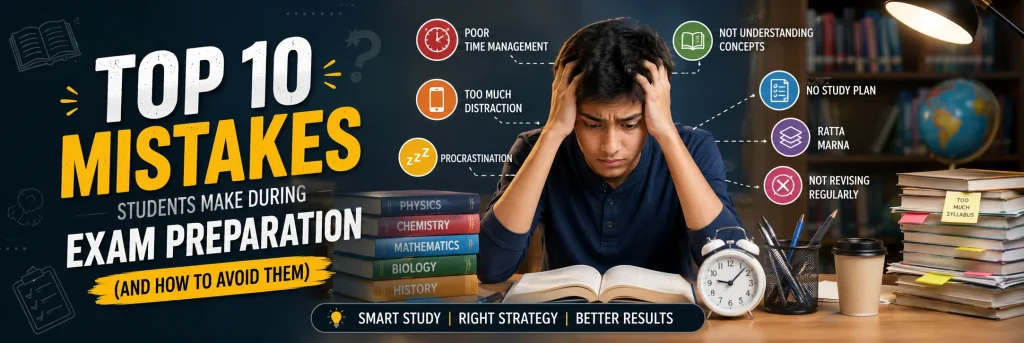
Many students work hard throughout the year but still fail to achieve their expected results because of the Mistakes Students Make During Exam Preparation. Understanding these mistakes early can help students improve their study habits and perform better in exams. In most cases, it’s not that they lack effort; it’s more like those little exam preparation mistakes that quietly mess with productivity and also your confidence. When students spot these errors early, they can make their class 10 exam preparation better, sort out their time in a smarter way, and get learning to feel slightly more effective overall. If students just avoid those typical mistakes and use the right study strategies, they can prep with a kind of surprising self-belief and honestly do better in their exams.
Why Students Make Mistakes During Exam Preparation
Exam preparations can become difficult since students need to cover many topics in less time. Some students don’t follow a proper plan during exam preparation, and some just concentrate on finishing the syllabus. Due to a lack of planning, inconsistent revision, and other reasons, there may be some errors made by students that will influence their performance. The good news is that these mistakes can be identified and corrected. Once students understand what they are doing wrong, they can develop better study habits and learn how to prepare for exams effectively.
Top 10 Mistakes Students Make During Exam Preparation
1. Starting Preparation Too Late
One of the most common study mistakes students should avoid is dragging prep until the very last few weeks before exams. When they start late they often end up rushing through the subjects, and they don’t quite have enough time for revision, and it’s kind of like the whole thing gets squeezed.
How to Avoid It: Create a study schedule early and cover topics gradually throughout the year.
2. Studying Without a Proper Plan
Many students start studying without set targets or clear goals. So they end up spending a bunch of time on just a few subjects, while kind of just forgetting the rest, basically ignoring the rest.
How to Avoid It: Make a weekly timetable with all subjects; include revision sessions and also practice tests.
3. Ignoring Basic Concepts
Some students focus only on memorising answers instead of understanding concepts. This becomes a major problem when application-based questions appear in exams.
How to Avoid It: First, build a solid conceptual understanding before you touch the advanced questions. Use visual learning techniques, like diagrams or charts, and go for concept-based materials whenever possible.
4. Not Revising Regularly
Knowing something one time is not really enough; students can just… lose it before the exam comes up. If there is no revision, those key details can fade out way faster than people expect, even if they thought it “stuck.”
How to Avoid It: Set up regular review sessions each week. For example, using Class 10 maths notes or similar resources, students can quickly refresh the formulas.
5. Avoiding Mock Tests
Many students spend hours reading textbooks but never test their understanding. This can create problems during actual exams.
How to Avoid It: Try to do some mock tests quite often so you build more confidence, better precision, and really strong time management skills when the actual thing comes.
6. Spending Too Much Time on Favourite Subjects
Most students tend to have a bit of a softer spot for a couple of subjects than the rest. But if you keep circling only those, the weaker areas kind of get ignored, and they pile up quietly.
How to Avoid It: Try to treat all subjects like they matter equally, and then add extra effort on the difficult topics so nothing falls behind.
7. Comparing Yourself with Other Students
Keep notching up comparisons about preparation levels, grades, or study hours with what other people do. This can slowly reduce your confidence, and it may bring in extra pressure.
How to Avoid It: Try to focus more on your own progress and set goals that are realistic, based on what you’re actually strong at and where you tend to struggle; maybe you know your strengths and weaknesses, but don’t overcomplicate it.
8. Depending on Last-Minute Cramming
Trying to memorise huge amounts of information right before exams usually ends up bringing confusion plus anxiety.
How to Avoid It: Revise consistently across the whole year, rather than leaning on that last-minute scramble stuff.
9. Ignoring Health and Sleep
A lot of students end up sacrificing sleep during exams, assuming it will somehow make the preparation better. But actually, low sleep messes with concentration, memory, and overall results.
How to Avoid It: To avoid this thing, keep up a healthy routine with good sleep, balanced meals, and physical activity on a regular basis.
10. Not Tracking Progress
Students often continue studying without checking whether they are actually improving. This makes it difficult to identify weak areas.
How to Avoid It: Do a lot of tiny check-ins, like quick quizzes and assessments, to get a read on where things stand, then sort of zoom in on the parts that really need more work.
How Smart Study Methods Help Students Prepare Better
Smart study methods actually can boost learning speed a lot, and they also cut down those usual exam preparation mistakes. Rather than wasting hours on random, unstructured studying, students can lean on more organized learning ways that really save time and make the whole thing feel clearer. For example, concept-based learning helps students get a deeper grasp of the subject matter, while revision-based learning makes it easier to keep the concepts in mind later when it counts. Frequent practice sessions can be helpful for them to locate their weaknesses and work on them in order to perform better in exams.
Students who make use of intelligent learning methods usually find it easy to stick to a pattern and remain motivated throughout. They save their time from getting consumed by thinking about what to learn and actually concentrate on learning. It is one of the best ways to learn preparation methods.
How ToppersSky Supports Effective Exam Preparation
ToppersSky is designed to help students avoid common preparation mistakes and build stronger study habits. Its animated learning feature kind of simplifies complex concepts and makes the whole learning process more engaging. Students can grasp the topics more clearly rather than just depending on rote memorisation. Mind maps also help students sort out information and revise the most important parts really fast before exams.
By doing regular quizzes and assessments, students can see how they’re getting on and which parts still need improvement. This kind of continuous check keeps them on the right track while they’re going through Class 10 exam preparation.
The platform also offers organised notes and PDFs, which make revision faster and a bit more efficient. There are also resources, like Class 10 NCERT Solutions that help students quickly go over important topics and their solutions so they don’t waste time. Also, students can clear doubts using the Doubt Solver feature, while the Q-Sky Feature gives more learning support whenever it is needed. As an all-in-one online learning platform, ToppersSky also gives answer-writing guidance; it helps students get better at how they present answers in board exams.
Conclusion
Understanding the mistakes that students can make during exam preparation can help students create a smarter and more effective study plan. By steering clear of the usual study pitfalls, revising on a regular basis, going through mock tests, and sticking to smart learning resources, students can end up with better confidence and stronger academic outcomes. For example, ToppersSky helps students a lot with animated video lessons, mind maps that actually make sense, monthly quizzes, neatly organized notes, and a doubt-solving option so students can clear confusion faster, and exam preparation feels more sorted and productive.
FAQs
1. What are the most common exam prep mistakes?
Some of the most common errors are starting late, avoiding revision, skipping mock tests, weak time management, and not really tracking progress. It sounds simple, but it adds up quickly, so yeah.
2. How can students prepare for exams effectively?
Students can prepare well by sticking to a study plan, revising regularly, practicing mock tests, and keeping the focus on concept clarity instead of only memorizing.
3. Why is revision important during Class 10 exam preparation?
Revision makes memory stronger, builds confidence fast, and helps students hold onto those important ideas for a longer period.
4. How can an online learning platform benefit a student?
The online learning platform can help the student with proper study material, revisions, practice, and performance evaluation.