

- Chapter-Wise Overview of Class 10 Maths
- Chapter-Specific NCERT Solutions for Class 10 Maths
- Glance at NCERT Solutions for Class 10 Maths | ToppersSky
- NCERT Solutions for Class 10 Maths – Chapter-wise Details, Formulas, and Exercise
- Trigonometric Ratios of Complementary Angles
- Class 10 Maths Chapter-Wise Marks Weightage
- Class 10 Maths Exam Pattern
- Class 10th New Plan 2025–26
- Benefits of Referring to ToppersSky’s NCERT Solutions for Class 10 Maths
- Important Tips for Scoring Well in Board Exams
- FAQs
Chapter-Wise Overview of Class 10 Maths
The NCERT Solutions for Class 10 Maths are very beneficial for students who have difficulties in Math. The PDF of the NCERT Class 10 Maths book is used as a reference for creating these solutions, which detail the steps to be taken to solve each problem in a very simple way. Students achieve the foundational skills while having the difficult areas made easy and the comprehension improved. These solutions being in consonance with the Class 10 Maths syllabus and exam pattern, they are perfect for revising and writing board exams preparation.
Chapter-Specific NCERT Solutions for Class 10 Maths
Below presented are the chapter-wise NCERT Solutions for Class 10 Maths. You can rely on it as your 10th maths guide. Visit these chapter-wise solutions to be completely aware of the concepts.
Note: The Constructions chapters (Ch-15) have been removed from the Class 10 Maths syllabus for the 2025–26 academic year.
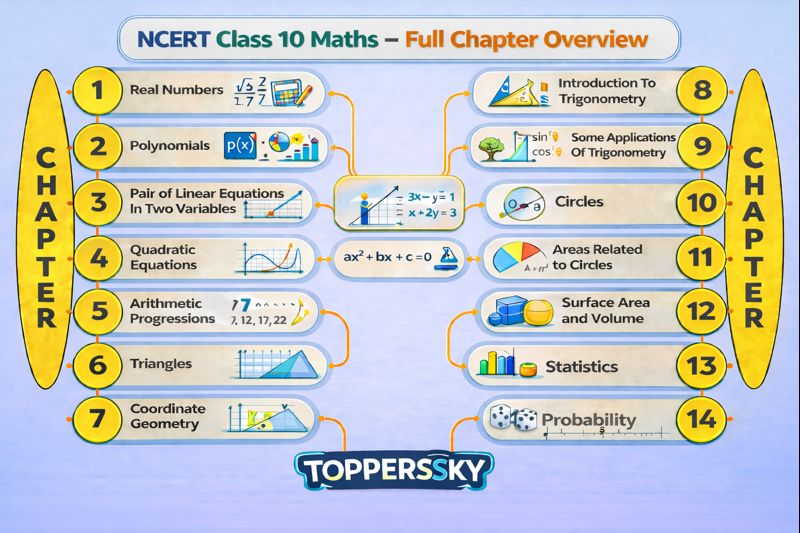
Glance at NCERT Solutions for Class 10 Maths | ToppersSky
The Class 10 Maths solutions given by NCERT cover all the chapters and exercises carried out from Chapters 1 to 14.
Through the textbook problems that are solved using these solutions, the pupils can not only find out their level of understanding but also their preparedness for the exam.
Along with that, the connection offers insights on the Class 10 Maths exam pattern, marks distribution, and question paper format.
Among the chapters, some of the significant areas such as Real Numbers, Polynomials, Linear Equations in Two Variables, Quadratic Equations, Triangles, Coordinate Geometry, Trigonometry, etc. are discussed.
Moreover, other essential study materials will also be available to students such as class notes, important questions with answers, formulas, exemplar solutions, and recommended books for additional practice.
NCERT Solutions for Class 10 Maths – Chapter-wise Details, Formulas, and Exercise
Chapter 1: Real Numbers
The first chapter of Mathematics Class 10 talks about real and irrational numbers. It starts with Euclid’s Division Lemma which states that the division of a positive integer by another positive integer will yield a unique quotient and a unique remainder. This notion provides the basis for Euclid’s Division Algorithm which helps us compute the HCF of two positive integers.
Next, the chapter introduces the Fundamental Theorem of Arithmetic which can be utilized to find both the HCF and LCM of the numbers. To sum up, it introduces and clarifies the concept of rational and irrational numbers and their decimal representations in an easy manner utilizing this theorem.
Topics Covered in Class 10 Maths Chapter 1 Real Numbers :
- Real Numbers
- Euclid’s Division Lemma
- Fundamental Theorem of Arithmetic
- Irrational Numbers
- Rational Numbers
Important Steps:
The Fundamental Theorem of Arithmetic affirms that every single number is subject to factorization into its primes uniquely up to the order of the factors. To illustrate this, we will explore some examples and provide commentary. We also prove that sqrt2, √3, and √5 are irrational.
In order to find the HCF, which stands for Highest Common Factor, of two positive numbers, just follow the steps below which are very easy to do:
- To divide one large number into a smaller number in Euclidean Division Method then the quotient and a remainder.
- When the remainder is 0, the smaller number is referred to as the HCF. On the contrary, if the remainder is not 0, carry out a division of the smaller number by the remainder.
- This method is to be continued until the remainder is 0. The last divisor that you receive is the HCF. This technique is effective since the HCF of two numbers will always be that of the smaller number and the remainder.
Chapter 2 – Polynomials
The Polynomials chapter explains different types of polynomials such as linear, quadratic, and cubic. It first helps you understand what the degree of a polynomial means. There are four exercises in this chapter, and one exercise is optional.
Exercise 2.1 helps you find the number of zeroes of a polynomial using graphs. You will learn how zeroes are shown geometrically.
Exercise 2.2 explains the relationship between zeroes and coefficients of a polynomial. In this exercise, you will find the zeroes of quadratic polynomials and sometimes even form the polynomial.
Exercise 2.3 introduces the Division Algorithm for polynomials and includes related questions.
Exercise 2.4 (Optional) includes mixed questions from all topics of Chapter 2.
Be sure to grasp the Division Algorithm’s steps as it is a crucial aspect of the entire chapter.
Topics Covered in Class 10 Polynomials
- Zeros of a polynomial.
- Relationship between zeroes.
- Coefficients of quadratic polynomials only.
Important Steps:
Arrange in standard form: The first step is to write the terms using the highest power first. This representation is called the standard form.
Step 1: Pick the highest degree term of the dividend and divide it by the highest degree term of the divisor to yield the first term of the quotient. After that, you will be performing division again.
Step 2: Take the topmost coefficient term of the new expression and divide it by the topmost coefficient term of the divisor which will give us the next term of the quotient. The whole procedure is to be repeated.
Step 3: Stop at the degree of the remainder which is smaller than the degree of the annual dividend. At this stage, the process of division cannot continue any further.
Dividend = Divisor × Quotient + Remainder. In this case, a method akin to Euclid’s Division Algorithm, which was introduced to you in Chapter 1, is being used. The concept is the same; one quantity is divided by the other to get the quotients and the remainders.
This states that.
If p(x) and g(x) are two polynomials with g(x) ≠ 0, we may find polynomials q(x) and r(x) such that
P(x) = g(x) × q(x) + r(x).
Where r(x) = 0 or degree of r(x) < degree of g(x).
This result is called the Division Algorithm for Polynomials.
Chapter 3 – Pair of Linear Equations in Two Variables
Chapter 3 is dedicated to the topic of Linear Equations in Two Variables. There are 7 exercises in this chapter and it describes what linear equations with two variables are and their solving methods.
- The first exercise 3.1 is all about the problem with equations and how to display it with the help of graphs.
- The second exercise 3.2 opens up a way to the solution of linear equations by the graphical method.
- While the exercise 3.3 mainly focuses on solving pairs of linear equations using the Algebraic Method, especially by Substitution Method and Elimination Method.
This chapter gives a pathway for students to comprehend and algebraically solve real-life problems by calling upon the tool of linear equations.
- Pair of linear equations in two variables and how to solve them using graphs, including checking whether the solutions are consistent or inconsistent.
- Conditions that help us find the number of solutions of linear equations using algebra.
- Solving a pair of linear equations algebraically using the substitution method and elimination method.
- Simple word problems based on real-life situations.
- Easy problems where equations can be changed into linear equations and then solved.
Important Steps:
This issue highlights the pairs of linear equations involving two variables, their solution method by means of graphing, and the aspect of determining the consistency or inconsistency of the equations. It also explains how the number of solutions depends on certain algebraic conditions.
You will learn to solve pairs of linear equations algebraically using the substitution method and the elimination method.
The chapter also includes simple word problems based on real-life situations.
The equations usually appear in the following form:
The general form of a pair of linear equations in two variables, x and y, is:
a₁x + b₁y + c₁ = 0
and
a₂x + b₂y + c₂ = 0
where a₁, b₁, c₁, a₂, b₂, c₂ are real numbers.
Here are some key formulas to remember:
a₁² + b₁² ≠ 0
a₂² + b₂² ≠ 0
Students can find extra study materials for Pair of Linear Equations in Two Variables on the ToppersSky App.

Chapter 4 – Quadratic Equations
Quadratic Equations are the topic of Chapter 4. It defines a quadratic equation and demonstrates ways to solve them.
The chapter includes:
- Solving quadratic equations through the method of factorization.
- Solutions obtained using the square root method.
- Role of the discriminant in establishing the nature of the roots.
- Real-life instances where quadratic equations have been applied to solve problems.
- Various ways to determine the roots of a quadratic equation.
The chapter provides a hand for figuring out quadratic equations and their practical application
ax² + bx + c = 0
• If b² − 4ac > 0, the equation has two unique real roots.
• Find two equal roots if b² − 4ac = 0.
• No genuine roots if b² − 4ac < 0.
Topics Covered in Class 10 Quadratic Equations
- Standard form of a quadratic equation ax2 + bx + c = 0, (a ≠ 0).
- Solutions of quadratic equations (only real roots) by factorization, and by using the quadratic formulas.
- Relationship between discriminant and nature of roots.
- Situational problems based on quadratic equations.
Important Steps:
The standard form of a quadratic equation is given as such, where a is not equal to zero. The methods of factorization or application of the quadratic formula solve the quadratic equations with real roots. The nature of the roots is determined by the discriminant to a large extent.
The chapter also includes situational problems based on daily life that can be solved using quadratic equations.
If b2 − 4ac > 0, we obtain two unique real roots:
x = (−b + √(b2 − 4ac)) / 2a
and
x = (−b − √(b2 − 4ac)) / 2a
If b2 − 4ac = 0, then
x = −b / 2a ± 0
So, the roots of the equation
ax2 + bx + c = 0
are both equal to:
−b / 2a
As a result, we may conclude that the quadratic equation
ax² + bx + c = 0
has two equal real roots in this situation.
If b² − 4ac < 0, there is no real number whose square equals b² − 4ac.
As a result, the above quadratic equation does not have any real roots.
The discriminant of the quadratic equation
ax² + bx + c = 0
is defined as b² − 4ac.
So, a quadratic equation
ax² + bx + c = 0
has:
(i) two distinct real roots, if b² − 4ac > 0
(ii) two equal real roots, if b² − 4ac = 0
(iii) no real roots, if b² − 4ac < 0
Chapter 5 – Arithmetic Progressions
- In this section, Arithmetic Progression (AP) is the new topic for students. There are 4 exercises in total in this chapter. You will know in this chapter what an AP is, the derivation of its nth term, the calculation of the sum of the first n terms, and the solving of real-life problems using AP.
- Exercise 5.1 illustrates things like the writing of a problem or a situation as an arithmetic progression (AP), discovering the initial term and the common difference as well as determining whether or not a series belongs to APs.
- Exercise 5.2 provides a demonstration of using a formula to determine the nth term of an AP. aₙ = a + (n − 1)d
- Exercise 5.3 deals with the sum of the first n terms of an AP, and in this context, it offers some practice questions.
- Exercise 5.4 has questions related to all the subjects that have been covered in this chapter.
Topics Covered in Class 10 Arithmetic Progressions
Reason for the study of Arithmetic Progression: Get to know the methods of determining the nth term and the total of the first n terms of an AP, and how these are applied to resolve practical issues.
Important Formulas
The sequence a₁, a₂, a₃, a₄, a₅, a₆, … of AP terms is written as
a, a + d, a + 2d, a + 3d, a + 4d, a + 5d, …, nth term,
where a is the initial term and d is the common difference between each term.
The nth term of an arithmetic progression is given as:
a + (n − 1)d
Sum of the first n terms in an arithmetic progression:
Sₙ = n/2 [2a + (n − 1)d]
Chapter 6 – Triangles
Chapter 6 from the syllabus of Class 10 deals purely with triangles. For example, it talks about shapes that are identical in form but varying in dimensions, and at the same time, it reveals the notion of triangles that are similar and theorems that associate with it. The area of identical triangles, theorems on areas of triangles, the Pythagorean theorem, and its converse are the other major topics discussed in the chapter.
Topics Covered in Class 10 Triangles
- Concept of a similar and congruent figure
- Theorems related to the similarity of triangles
- Areas of similar triangles
- Pythagoras Theorem and converse of Pythagoras Theorem
Definitions, Examples, and Counterexamples of Similar Triangles
- The theorem states that if a line is drawn parallel to one side of a triangle and it intersects the other two sides at different points, it will divide the sides in the same ratio. To prove this is a theorem – do.
- When a line cuts two sides of a triangle in the same ratio, the line lies parallel to the third side – justify this.
- Justification of the first assertion is based on the fact that if two triangles have equal angles, then by the law of sines, the ratio of their sides will be equal and thus the triangles are similar.
- The second assertion can be justified by saying that if the sides of two triangles are proportional, then the triangles have equal corresponding angles and are therefore similar.
- If there is one angle of a triangle which is equal to one of another triangle and the sides including these angles are proportionate, then the two triangles are similar – justify this.
Important Theorems:
- Theorem 6.1: The line drawn parallel to one of the triangle sides and meeting up at different points the other two sides, will split those sides in the same proportion.
- Theorem 6.2: The line which splits the two sides of the triangle in the same proportion, must be parallel to the third side.
- Theorem 6.3: In the case of two triangles with the same corresponding angles, the sides corresponding to those angles are in proportion, thus the triangles are similar.
- Theorem 6.4: If the sides of one triangle are in the same ratio with the sides of the other triangle, then their angles are equal and thus the triangles are similar.
- Theorem 6.5: If one angle of a triangle is equal to one angle of another triangle and the sides including these angles are in equal ratio, then the triangles are similar.
Chapter 7 – Coordinate Geometry
The 7th Chapter deals with coordinate geometry. It shows the method of the point localization in terms of an ordered pair of numerals. This geometry type enables to compute the distance from both ends when their coordinates are accessed. The chapter further assists in obtaining the area of a triangle, which is formed by three specified points. Furthermore, it clarifies how to find the position of a point that partitions a line segment between two points in a certain ratio. All in all, this chapter serves as a simple introduction for the students to the concepts of distance formula, section formula, and area of a triangle using coordinates.
Topics Covered in Class 10 Coordinate Geometry
- Concepts of coordinate geometry
- Graphs of linear equations
- Distance formula
- Section formula (Internal division)
Important Formulas:
Distance Formula:
PQ = √[(x₂ − x₁)² + (y₂ − y₁)²]
Section Formula:
m₁ : m₂ = ( (m₁x₂ + m₂x₁) / (m₁ + m₂) , (m₁y₂ + m₂y₁) / (m₁ + m₂) )
Area of Triangle:
Area = 1/2 [ x₁(y₂ − y₃) + x₂(y₃ − y₁) + x₃(y₁ − y₂) ]
Chapter 8 – Introduction to Trigonometry
In the 8th chapter, the concept of trigonometry is presented to the learners. Trigonometry is the study of the ratios between the sides of a right triangle concerning its acute angles. The ratios that result from this process are termed trigonometric ratios. In this segment, the learners are instructed to find out the trigonometric ratios for 0°, 90°, 30°, 45°, and 60°. Also, it imparts the knowledge of computing trigonometric ratios for specified angles and recognizing the fundamentals of some trigonometric identities. The chapter explains simple trigonometric formulas that help students build a strong foundation. Along with formulas, it also explains the relationship between angles and their ratios in a clear and easy way.
Topics Included in Class 10 Introduction to Trigonometry
- Trigonometric ratios of an acute angle of a right-angled triangle.
- Proof of their existence.
- Values of the trigonometric ratios.
- Relationships between the ratios.
Important Formulas:
Trigonometry formulas for Class 10 mainly include the three basic functions: sine, cosine, and tangent, which are defined for a right-angled triangle. Let ABC be a right-angled triangle with angle θ at point B.
sin θ = (Side opposite to angle θ) / Hypotenuse
= Perpendicular / Hypotenuse
cos θ = (Adjacent side to angle θ) / Hypotenuse
= Base / Hypotenuse
tan θ = (Side opposite to angle θ) / (Adjacent side to angle θ)
= Perpendicular / Base
sec θ = 1 / cos θ
cot θ = 1 / tan θ
cosec θ = 1 / sin θ
tan θ = sin θ / cos θ
Trigonometry Table
| Angle | 0° | 30° | 45° | 60° | 90° |
|---|---|---|---|---|---|
| sinθ | 0 | 1/2 | 1/√2 | √3/2 | 1 |
| cosθ | 1 | √3/2 | 1/√2 | 1/2 | 0 |
| tanθ | 0 | 1/√3 | 1 | √3 | Undefined |
| cotθ | Undefined | √3 | 1 | 1/√3 | 0 |
| secθ | 1 | 2/√3 | √2 | 2 | Undefined |
| cosecθ | Undefined | 2 | √2 | 2/√3 | 1 |
Trigonometric Ratios of Complementary Angles
sin(90° − A) = cos A
cos(90° − A) = sin A
tan(90° − A) = cot A
cot(90° − A) = tan A
sec(90° − A) = cosec A
cosec(90° − A) = sec A
sin²A + cos²A = 1
sec²A − tan²A = 1, for 0° ≤ A < 90°
cosec²A = 1 + cot²A, for 0° < A ≤ 90°
Chapter 9 – Some Applications of Trigonometry
Chapter 9 is a continuation of Chapter 8 and it mainly deals with the applications of trigonometry. The chapter describes the real-world applications of trigonometry. The learners will discover the techniques of getting the height and distance of objects by indirect measuring. Besides, the chapter highlights the role of trigonometry in navigation, map making, and locating places through the use of latitudes and longitudes. The latter would include the comprehension of key words like line of sight, angle of elevation, and angle of depression by students in an easy and straightforward manner.
Topics Covered in Class 10 Maths Chapter 9 – Some Applications of Trigonometry:
In Chapter 9, students study “Some Applications of Trigonometry”, with special focus on heights and distances. The chapter explains how to use angles of elevation and angles of depression, mainly for angles 30°, 45°, and 60°, to solve real-life problems.
Let’s discuss clearly some points that are crucial for understanding:
- Line of Sight: It is a straight line passing through the eye of the observer to the object that is being seen.
- Angle of Elevation: It is the angle that is created when the person looks up at an object that is higher than the eye level.
- Angle of Depression: It is the angle that is created when the person looks down at an object that is lower than the eye level.
We usually require three things to solve problems about heights and distances:
- The distance from the observer to the base of the object is given by the atmospheric boundary DE.
- Let’s show an angle of elevation to the top line of object (BAC).
- The height of the observer (AE).
In case these three values are known, we are able to calculate the height of the object (minar). As per the diagram, the entire height of the minar (CD) is linked to BC + BD. Whereby, BD is equivalent to AE, which is the height of the observer.
To get the value of BC, we apply trigonometric ratios in triangle ABC. Given that BC is the opposite side to angle A, we use tan A or cot A, because these ratios will involve the sides AB and BC.
Thus,
tan A = BC / AB or
cot A = AB / BC
We can use either one of these to find BC. By the way, adding observer’s height AE to BC gives us the total height of the minar.
Chapter 10 – Circles
You have already acquired knowledge of circles and their related terms like chords, segments, and arcs. The next topic of this chapter is the situations in which a line and a circle are in the same plane. The primary objective of this chapter is to realize the concept of tangents to a circle and, in an uncomplicated and lucid manner, the number of tangents that can be drawn from a point to a circle.
Proof of the Tangent to a Circle at the Point of Contact
The tangent drawn at any point on a circle is always perpendicular to the radius at the point where it touches the circle.
The tangents drawn from an external point to a circle are equal in length.
Theorems
- The concept of Tangent to a circle at the point of contact is very simple yet very important in the world of geometry.
- Tangent line drawn at any point of a circle forms a right angle with the radius line at the point of intersection.
- Theorem 10.1: A tangent line to a circle at any point of contact will always be perpendicular to the radius that reaches the point of contact.
- Theorem 10.2: The lengths of the tangents drawn from an exterior point to the circle are equal.
Case-based Theorem
Number of Tangents from a Point on a Circle
- Case 1: If a point lies inside the circle, no tangent can be drawn from that point to the circle.
- Case 2: If a point lies on the circle, only one tangent can be drawn at that point.
- Case 3: If a point lies outside the circle, exactly two tangents can be drawn from that point to the circle.
Topics Covered in Class 10 Circles
- Various terms related to a circle such as a chord, segment.
- Important Theorems
- Tangent to a Circle.
- Number of Tangents from a Point on a Circle.
Chapter 11 – Areas Related to Circles
This chapter is about the perimeter and area of a circle. It explains how to calculate the area of a sector and a segment of a circle. You will also learn how to find the area of shapes that include a full circle or part of a circle.
Topics Covered in Class 10 Areas Related to Circles
- Calculate the area of a circle
- area of sectors and segments of a circle.
- Problems based on areas and perimeter.
- Circumference of the above plane figures.
(While calculating the area of a circle segment, consider only central angles of 60°, 90°, and 120°.)
Key Formulas from the Chapter for Practice
• Circumference = 2πr
• area of the circle = πr²
• Area of the sector of angle θ = (θ / 360) × πr²
• Length of an arc of a sector of angle θ = (θ / 360) × 2πr
where r is the radius of the circle
Chapter 12 – Surface Areas and Volumes
Chapter 12 has been devoted to the topic of surface areas and volumes of different three-dimensional shapes. The section is divided into five parts for exercises as follows:
- Exercise 12.1: Questions regarding the calculation of the surface area of objects formed by the combination of two basic solids like cuboid, cone, cylinder, sphere, or hemisphere.
- Exercise 12.2: Questions for the purpose of calculating the volume of solids resulting from the joining of two solids, whose shapes are cuboids, cones, cylinders, spheres, or hemispheres.
- Exercise 12.3: Questions concerning the conversion of a solid from one shape to another.
- Exercise 12.4: The volume, curved surface area, and total surface area of a cone’s frustum are the subject of questions.
- Exercise 12.5 (optional): Difficulties in the form of high-level questions that cover the entire scope of the chapter for extra practice.
Topics Covered in Class 10 Surface Areas and Volumes
- Surface areas and volumes of objects made by combining any two solids, such as cubes, cuboids, spheres, hemispheres, cylinders, or cones.
- Problems involving the conversion of one solid into another and other mixed practice questions.
Key Formulas for Calculating Surface Areas and Volumes of Solids
- TSA of new solid = CSA of one hemisphere + CSA of cylinder + CSA of other hemispheres
- Diameter of sphere = 2r
- The surface area of sphere = 4 π r2
- The volume of Sphere = 4/3 π r3
- The curved surface area of Cylinder = 2 πrh
- Area of two circular bases = 2 πr2
- The total surface area of Cylinder = Circumference of Cylinder + Curved surface area of Cylinder = 2 πrh + 2 πr2
- Volume of Cylinder = π r2 h
- Slant height of cone = l = √(r2 + h2)
- Curved surface area of cone = πrl
- Total surface area of cone = πr (l + r)
- Volume of cone = ⅓ π r2 h
- Perimeter of cuboid = 4(l + b +h)
- Length of the longest diagonal of a cuboid = √(l2 + b2 + h2)
- Total surface area of cuboid = 2(l×b + b×h + l×h)
- Volume of Cuboid = l × b × h
Chapter 13 – Statistics
Students of this section are guided through the process of representing data in a numerical form, be the data ungrouped or grouped. With the help of animated explanations students see very clearly how to perform the calculations of mean, median, and mode on the given data sets. Besides, the chapter takes a step further to talk about cumulative frequency distribution and delivers animated visuals for the gradual building of cumulative frequency curves, thereby making it easier and more effective to perform analysis on data.
Topics Covered in Class 10 Statistics
- Mean, median and mode of grouped data.
- Mean by Direct Method and Assumed Mean Method only.
Important Formulas
There are three methods to calculate the mean of grouped data.
The direct method is:
x̄ = (Σ fi xi) / (Σ fi)
Where Σ fi xi is the total of observations from value i = 1 to n.
Σ fi represents the number of observations from i = 1 to n.
Assumed Mean Method:
x̄ = a + (Σ fi di) / (Σ fi)
The step deviation approach is:
x̄ = a + (Σ fi ui) / (Σ fi) × h
Mode of grouped data:
Mode = l + [ (f1 − f0) / (2f1 − f0 − f2) ] × h
The median for grouped data is:
Median = l + [ (n/2 − cf) / f ] × h
Chapter 14 – Probability
Chapter 14 introduces students to the theory of probability. It explains the difference between experimental probability and theoretical probability with the help of clear examples. This chapter is important because probability concepts are used in higher classes, so students should master the basics in Class 10 to stay prepared for more advanced topics.
Topics Covered in Class 10 Probability
- Classical definition of probability.
- Simple problems on finding the probability of an event.
Important Formulas:
The theoretical probability (also known as classical probability) of an event E, denoted as P(E), is
P(E) = (Number of outcomes favourable to E) / (Number of all possible outcomes of the experiment)
We assume that all outcomes of an experiment are equally likely.
>The probability of a certain event is 1.
>The probability of an impossible event is 0.
>The probability of an event E is a number P(E) such that 0 ≤ P(E) ≤ 1.
An elementary event is one that has only one possible outcome. The sum of the probabilities of all elementary events in an experiment is always 1.
Class 10 Maths Chapter-Wise Marks Weightage
| S.no | Chapter Name | Marks |
|---|---|---|
| 1 | Number System | 6 |
| 2 | Algebra | 20 |
| 3 | Coordinate Geometry | 6 |
| 4 | Geometry | 15 |
| 5 | Trigonometry | 12 |
| 6 | Measurement | 10 |
| 7 | Statistics and Probability | 11 |
| Total | 80 | |
| Internal Assessment | 20 | |
| Total | 100 | |
Class 10 Maths Exam Pattern
The new pattern for Class 10 Maths exam for the year 2025-26 consists of two parts:
- Internal Assessment (20 marks): Conducted by the school during the year. It consists of tests, project works and other activities at different times.
- Board Exam (80 marks): NCERT will hold a 3-hour written examination. The format of this exam is given below:
| Section | Question | Number of Questions | Marks |
|---|---|---|---|
| A | Very Short Answer | 5 | 20 |
| B | Short Answer | 11 | 30 |
| C | Long Answer and Case-based | 7 | 30 |
Class 10th New Plan 2025–26
Some important changes are planned in the new exam pattern:
- Question papers will focus more on testing students’ thinking, problem-solving, and analytical skills.
- The exam paper will have more short answer questions, especially questions carrying 1 to 5 marks.
- Some vocational subject exams may be conducted in February, and the main board exams will finish within 15 days in March.
- Since the exams will end earlier, the board exam results are also expected to be announced sooner than before.
Benefits of Referring to ToppersSky’s NCERT Solutions for Class 10 Maths
ToppersSky’s Class 10 NCERT Maths Solutions (PDFs) offer many advantages, such as:
- The solutions are made clear by using very simple and comprehensible language.
- The whole process is illustrated by step-by-step animation for each answer and therefore getting a very clear picture.
- Diagrams and animations are used to bring the concepts and solving techniques closer to the students and make them clearer.
- All questions from every NCERT chapter are fully covered.
- Students are encouraged to study all chapters through animated modules, ensuring a strong conceptual foundation.
- By following the complete solution process, students can prepare effectively and improve accuracy and confidence.
Important Tips for Scoring Well in Board Exams
The 10th class is an important turning point in the academic life of a student, as it is the moment when they first take a board exam. Although it looks difficult, students who keep the same pace and masters the concepts in a proper way over the year can with no worries get excellent marks. ToppersSky’s animated learning strategy makes difficult subjects easier to comprehend and remember. To obtain a good mark, pupils are to adhere to the tips and tactics mentioned below all year round and particularly during the time of examination.
1. Regular Revision is Key
- Consistent revision and daily practice help students retain concepts better.
- Revising topics regularly through animated explanations prevents last-minute stress during exams.
2. Practice Extensively
- Practice all examples and exercises from the NCERT textbook.
- Use ToppersSky’s NCERT Solutions PDFs for self-evaluation and identify mistakes easily.
Reattempt incorrect questions using step-by-step animated solutions for better clarity.
3. Concept Clarity Matters
- Clear understanding of concepts is essential for scoring well.
- Use ToppersSky’s animated solutions to simplify difficult topics.
- Strengthen fundamentals early to avoid confusion during exams.
4. Understand the Syllabus and Paper Pattern
- Get accustomed to the entire syllabus, distribution of chapters and structure of examination.
- This aids learners to zero in on significant subjects and organize their studying smartly.
5. Effective Time Management
- Create a study timetable based on topic importance and personal strengths.
- Set daily and weekly goals using animated learning modules.
- Include short breaks to improve focus and memory retention.
6. Identify Strengths and Weaknesses
- Rethink plans and strategy when commencing, as a few areas are extremely demanding.
- Practice regularly until every topic feels comfortable and confident.
7. Note-Taking for Better Revision
- Write away the formulas, theorems, and key concepts.
- Such notes are expected to give the best, fastest revision and thus a more lasting memory.8. Class
8. 10 Maths Resources
- Strengthen preparation with ToppersSky’s detailed Class 10 Maths guides.
- Practice sample papers and previous years’ question papers.
- Understand question trends to improve exam performance.
9. Prioritize Rest and Preparation
- Get proper sleep and healthy food intake prior to the exam day.
- It is better to get all required stationery ready ahead of time so that you do not get stressed unnecessarily.
10. Exam Simulation for Time Management
- Solve sample papers within a fixed time limit.
- This improves speed, accuracy, and confidence during the actual exam.
11. Present Answers Effectively
- Attempt questions in a systematic order.
- Highlight final answers and important formulas clearly.
- Never leave questions unanswered – partial solutions can also fetch marks.
If you follow these tips and maintain your preparation consistently, you can get great scores in board exams. ToppersSky’s animated learning method makes the concepts so much easier to understand and recall that it actually helps building a solid base in Class 10 Maths. This strong conceptual clarity not only helps in school exams but also proves beneficial in higher classes and future studies. Since most competitive exams include Maths-based questions derived from school-level concepts, having a clear understanding of formulas and topics through visual and animated learning gives students a clear advantage and boosts overall performance.
FAQs
1. Are these NCERT Solutions for Class 10 Maths to be still relevant in the 2025–26 academic year?
Definitely, ToppersSky’s NCERT Solutions for Class 10 Maths have been persistently updated in accordance with the recent syllabus for the entire 2025–26 academic year. The entire question set has been elaborated and illustrated by means of animated solutions step-by-step, allowing the student to learn precisely what is required for the board exam.
2. Are ToppersSky’s NCERT Solutions sufficient to get a perfect score in the board exam of Class 10 Maths?
ToppersSky’s NCERT Solutions enable students to acquire clarity of concepts through animated learning which is the mainstay of high scoring. Besides, students should also go through sample papers and last year’s question papers along with the solutions to enhance speed, accuracy, and confidence, in case of total marks.
3. What is the quickest way to go through the whole Class 10 Maths syllabus using ToppersSky’s NCERT Solutions?
For quick revision students can go through ToppersSky’s animated NCERT Solutions chapter-wise instead of doing all the questions every time. Concentrate on the important and previously difficult questions and do the formulas with visual explanations so as to reinforce the concepts in less time.
4. Are the kinds of questions asked in the actual board exams included in ToppersSky’s NCERT Solutions?
Absolutely. NCERT textbook serves as the base for most questions in the Class 10 Maths board exam directly. ToppersSky’s solutions illustrate each question type using simple animations and visuals this helps the students to know the exact exam pattern and question formats.
5. In what way does practicing with ToppersSky’s NCERT Solutions facilitate Math exam’s devoting interval management?
Regular practice with animated, step-by-step solutions helps students learn the most efficient problem-solving methods. This reduces confusion during the exam and enables students to write precise and well-structured answers, saving time for more complex questions.