Class 10 Maths Chapter 10 Circles Overview
ToppersSky delivers complete and straightforward NCERT Solutions for Class 10 Maths Chapter 10 Circles. The solutions offer detailed step-by-step explanations which help students achieve complete understanding of all concepts. Structured solutions that follow each of the questions in the NCERT Class 10 Maths textbook set students on the right path on choosing the easy method to write their answers for the specific examination question format in a better way.
The study materials provide essential support for students who need to prepare for their Class 10 board exams. ToppersSky provides detailed solutions together with Animation educational videos, chapter notes, mind maps, important questions, practice sets, and exam writing guidance. The learning material enables students to understand circles effectively while developing their ability to succeed on tests.
Chapter 10 – Circles is an important chapter in the Geometry section of the NCERT syllabus for Class 10. This chapter helps students understand the properties of tangents and how they behave in relation to a circle. Questions from this chapter often appear in board exams in different formats like short answers, long answers, and diagram-based proofs. To score well, students must understand both the theory and the diagram logic clearly.
ToppersSky provides complete NCERT Solutions for Class 10 Maths Chapter 10 with step-by-step explanations and Animation learning support. This makes understanding geometry easier and more interesting.
Topics Covered in Class 10 Maths Chapter 10 – Circles
- Basic Introduction to Circles
- Understanding Tangents to a Circle
- Number of Tangents That Can Be Drawn from a Given Point
- Complete Chapter Summary and Key Concepts Revision
The NCERT Solutions for Class 10 Maths Chapter 10 help students clearly understand the concepts related to circles. The structured solutions enable students to study better because they help students build fundamental knowledge needed for their exam preparations. The authors present their explanations through a detailed process which helps readers understand all solving approaches needed to answer different question types.
The primary subject of Class 10 Maths Chapter 10 studies the properties of tangents that connect to a circle. Students learn about concepts such as tangent point of contact and the number of tangents that can be drawn from different positions. The chapter explains diagrams and geometrical reasoning which becomes interesting for study because of its clear explanation.
The solutions include challenging questions which test students’ conceptual knowledge while helping them achieve better understanding. The problems give students opportunities to practice different solving techniques which will help them enhance their exam performance through improved problem-solving abilities.
Key Features of NCERT Solutions for Class 10 Maths Chapter 10 – Circles
- The NCERT Class 10 Maths textbook provides complete answers to every question found within the textbook.
- The program provides detailed explanations which assist students with both difficult problems and fundamental questions.
- The design of this program follows current NCERT guidelines together with their examination structure.
- The program provides students with stepwise guidance which enables them to master proper techniques for problem-solving.
- The program enables students to practice essential diagramming skills which include creating circle and tangent diagrams.
- The program enables learners to master essential formulas together with their respective calculation methods.
ToppersSky provides well-structured NCERT Solutions along with Animation learning videos, notes, mind maps, practice sets, and chapter-wise guidance. Students can access all study materials easily through the topperssky app and learn through 2D and 3D animated explanations.
The organized content together with a visual learning support system enables ToppersSky to assist students in mastering geometry and preparing for their Class 10 examinations.

NCERT Questions and Answers of Class 10 Maths Chapter 10
Q.1 How many tangents can be drawn to a circle?
A circle has an infinite number of tangents. This happens because a circle contains an unending number of points along its outer edge. One tangent exists for every point which lies on the circle. The infinite points which exist on the circle lead to an infinite number of tangents.
Q.2 A tangent PQ is drawn at point P of a circle with radius 5 cm. It meets a line drawn from the centre O at point Q such that OQ = 12 cm. Find the length of PQ.
Options:
(A) 12 cm
(B) 13 cm
(C) 8.5 cm
(D) √119 cm
Answer:
The radius drawn to the point of contact is always perpendicular to the tangent.
So, OP is perpendicular to PQ.
In triangle OPQ, we can apply Pythagoras’ theorem:
OQ² = OP² + PQ²
12² = 5² + PQ²
144 = 25 + PQ²
PQ² = 144 − 25
PQ² = 119
PQ = √119 cm
Therefore, the correct answer is option (D) √119 cm.
Q.3 Draw a circle and two lines parallel to a given line such that one is a tangent and the other, a secant to the circle.
Answer:
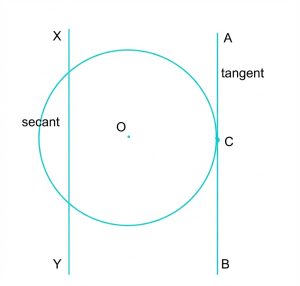
In the above figure, XY and AB are two parallel lines. Line segment AB is the tangent at point C, while line segment XY is the secant.
Q.4 If TP and TQ are the two tangents to a circle with centre O so that ∠POQ = 110°, then ∠PTQ is equal to
(A) 60°
(B) 70°
(C) 80°
(D) 90°
Answer:
From the question, it is clear that OP is the radius of the circle to the tangent PT, and OQ is the radius to the tangent TQ.
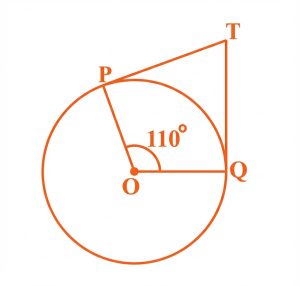
So, OP ⊥ PT and TQ ⊥ OQ
∴ ∠OPT = ∠OQT = 90°
Now, in the quadrilateral POQT, we know that the sum of the interior angles is 360°.
So, ∠PTQ+∠POQ+∠OPT+∠OQT = 360°
Now, by putting the respective values, we get
∠PTQ +90°+110°+90° = 360°
∠PTQ = 70°
So, ∠PTQ is 70° which is option B.
Q.5 If tangents PA and PB from a point P to a circle with centre O are inclined to each other at an angle of 80°, then ∠ POA is equal to
(A) 50°
(B) 60°
(C) 70°
(D) 80°
Answer:
First, draw the diagram according to the given statement.
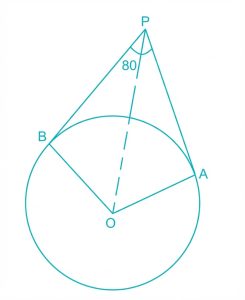
Now, in the above diagram, OA is the radius to tangent PA, and OB is the radius to tangent PB.
So, OA is perpendicular to PA, and OB is perpendicular to PB, i.e., OA ⊥ PA and OB ⊥ PB.
So, ∠OBP = ∠OAP = 90°
Now, in the quadrilateral AOBP,
The sum of all the interior angles will be 360°.
So, ∠AOB+∠OAP+∠OBP+∠APB = 360°
Putting their values, we get
∠AOB + 260° = 360°
∠AOB = 100°
Now, consider the triangles △OPB and △OPA. Here,
AP = BP (Since the tangents from a point are always equal)
OA = OB (Which are the radii of the circle)
OP = OP (It is the common side)
Now, we can say that triangles OPB and OPA are similar using SSS congruency.
∴ △OPB ≅ △OPA
So, ∠POB = ∠POA
∠AOB = ∠POA+∠POB
2 (∠POA) = ∠AOB
By putting the respective values, we get
=>∠POA = 100°/2 = 50°
As the angle ∠POA is 50°, option A is the correct option.
Q.6 Prove that the tangents drawn at the ends of a diameter of a circle are parallel.
Answer:
First, draw a circle and connect two points, A and B, such that AB becomes the diameter of the circle. Now, draw two tangents, PQ and RS, at points A and B, respectively.
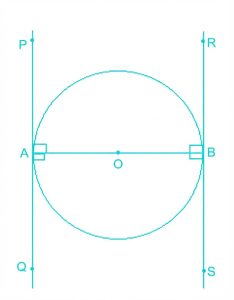
Now, both radii, i.e. AO and OB, are perpendicular to the tangents.
So, OB is perpendicular to RS, and OA is perpendicular to PQ.
So, ∠OAP = ∠OAQ = ∠OBR = ∠OBS = 90°
From the above figure, angles OBR and OAQ are alternate interior angles.
Also, ∠OBR = ∠OAQ and ∠OBS = ∠OAP (Since they are also alternate interior angles)
So, it can be said that line PQ and line RS will be parallel to each other (Hence Proved).
Q.7 Prove that the perpendicular at the point of contact to the tangent to a circle passes through the centre.
Solution:
Let, O is the centre of the given circle.
A tangent PR has been drawn touching the circle at point P.
Draw QP ⊥ RP at point P, such that point Q lies on the circle.
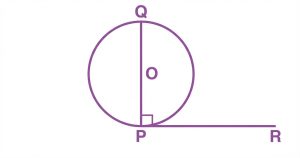
∠OPR = 90° (radius ⊥ tangent)
Also, ∠QPR = 90° (Given)
∴ ∠OPR = ∠QPR
Now, the above case is possible only when centre O lies on the line QP.
Hence, perpendicular at the point of contact to the tangent to a circle passes through the centre of the circle.
Q.8 The length of a tangent from point A at a distance 5 cm from the centre of the circle is 4 cm. Find the radius of the circle.
Answer:
Draw the diagram as shown below.
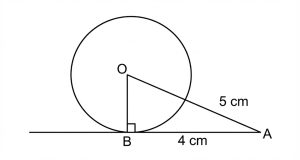
Here, AB is the tangent that is drawn on the circle from point A.
So, the radius OB will be perpendicular to AB, i.e., OB ⊥ AB
We know, OA = 5cm and AB = 4 cm
Now, in △ABO,
OA2 =AB2+BO2 (Using Pythagoras’ theorem)
52 = 42+BO2
BO2 = 25-16
BO2 = 9
BO = 3
So, the radius of the given circle, i.e., BO, is 3 cm.
Q.9 Two concentric circles are of radii 5 cm and 3 cm. Find the length of the chord of the larger circle that touches the smaller circle.’
Answer:
Draw two concentric circles with the centre O. Now, draw a chord AB in the larger circle, which touches the smaller circle at a point P, as shown in the figure below.
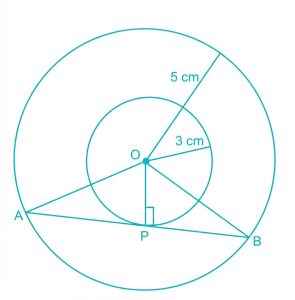
From the above diagram, AB is tangent to the smaller circle to point P.
∴ OP ⊥ AB
Using Pythagoras’ theorem in triangle OPA,
OA2= AP2+OP2
52 = AP2+32
AP2 = 25-9
AP = 4
Now, as OP ⊥ AB,
Since the perpendicular from the centre of the circle bisects the chord, AP will be equal to PB.
So, AB = 2AP = 2×4 = 8 cm
So, the length of the chord of the larger circle is 8 cm.
Q.10 A quadrilateral ABCD is drawn to circumscribe a circle (see Fig. 10.12). Prove that AB + CD = AD + BC.
Answer:
The figure given is:
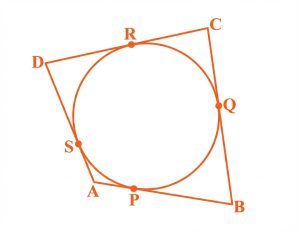
From the figure, we can conclude a few points, which are
(i) DR = DS
(ii) BP = BQ
(iii) AP = AS
(iv) CR = CQ
Since they are tangents on the circle from points D, B, A, and C, respectively. Now, adding the LHS and RHS of the above equations, we get,
DR+BP+AP+CR = DS+BQ+AS+CQ
By rearranging them, we get,
(DR+CR) + (BP+AP) = (CQ+BQ) + (DS+AS)
By simplifying,
AD+BC= CD+AB
FAQs
1. What are the key features of NCERT Solutions for Class 10 Maths Chapter 10?
NCERT Solutions for Class 10 Maths Chapter 10 provide complete answers to all exercise questions given in the textbook. The solutions provide a detailed explanation which enables students to understand all concepts through their learning process. The assessment includes questions that require advanced reasoning skills to handle challenging content about circles and tangents.
2. What are the main topics covered in Chapter 10 – Circles?
The main topics included in this chapter are:
- Introduction to circles
- Tangent to a circle
- Number of tangents from a point
- Summary of important properties and theorems
The topics teach students about tangents which includes their characteristics and their appearances in visual representations.
3. Is it necessary to practice all questions from Chapter 10?
Yes, it is very important to practice all questions from this chapter. Many questions require proof through evidence and diagram explanation which students will encounter in both board exams and school assessments. Students who complete all exercises will gain self-assurance which results in better performance during geometry assessment tasks.
4. Why are diagrams important in Chapter 10 – Circles?
The chapter uses diagrams as its main tool because students need to solve most of the questions through physical diagram-based geometric analysis. Students who understand diagram drawing and diagram comprehension will complete their exams faster while making fewer errors.
5. How can students improve their performance in this chapter?
The students should focus on exam performance improvement through regular practice and important theorem revision and various question solving. The students will achieve better exam results when they study every proof through its individual steps and its complete logical structure.