
- Overview of Class 10 Maths Chapter 2: Polynomials
- NCERT Solutions for Class 10 Maths Chapter 2 Polynomials – Quick View | ToppersSky
- Important Topics Covered in Class 10 Maths Chapter 2 – Polynomials
- Important Topics Under NCERT Solutions for Class 10 Maths Chapter 2 Polynomials
- Math Polynomials Mind Map for Class 10
- Conclusion
- Class 10 Maths Chapter 2 – Polynomials: Practice & Exercises
- FAQs
Overview of Class 10 Maths Chapter 2: Polynomials
Mathematics is a must-know for Class 10 learners. The curriculum is aimed at making conceptual understanding and building a solid base for future grades stronger. Polynomial, which is a significant theme in view of the examination, is the subject of Chapter 2 of Class 10 Maths. The NCERT Solutions for Class 10 Maths Chapter 2 by ToppersSky are created specifically to support students in the understanding of concepts through animated explanations and step-wise solutions. Students can easily and effectively get a grip on polynomial concepts through the use of interactive visuals and clear problem-solving approaches.
The chapter covers different types of equations and their components in a simple and structured way. With the help of NCERT Solutions by ToppersSky, students can easily understand new concepts and solve exercise questions through animated explanations and step-by-step methods.
NCERT Solutions for Class 10 Maths Chapter 2 Polynomials – Quick View | ToppersSky
Polynomials are mathematical expressions that include the use of addition, subtraction, and multiplication of terms.
Each term consists of a coefficient, a variable to a non-negative whole number power (no fractions or decimals), or a constant.
Types of Polynomials (Degree)
- Linear Polynomial (1 degree): At most the variable’s power is 1.
- Quadratic Polynomial (Degree 2): The variable’s power is 2 at most.
- Cubic Polynomial (Degree 3): The highest power of the variable is 3.
Besides these, there exists a polynomial of higher degrees like quartic, quintic, etc.
With the animated learning of ToppersSky app, students can easily grasp how the roots of a polynomial assist in finding the solution of the equation and determining its nature. Polynomials are also represented graphically, where the impression of the graph is determined by the polynomial’s degree.
The chapter simultaneously discusses the connection between the roots of a polynomial and its coefficients, thus helping with the comprehension of the concepts through animated visuals.
Chapter 2 Polynomials of Class 10 Mathematics allowing students to practice and thereby reinforcing their understanding efficiently.
Important Topics Covered in Class 10 Maths Chapter 2 – Polynomials
Introduction
Due to the importance of this chapter, Polynomials comes under the Algebra unit, which carries 20 marks in the Class 10 Maths exam. On average, one question is usually asked from this chapter in the examination.
This chapter includes the following key topics, explained clearly through ToppersSky’s animated learning approach:
- Overview of Polynomials
- Geometric Interpretation of Polynomial Zeros
- Relationship between Zeros and Coefficients of a Polynomial
- Division Algorithm for Polynomials
Important Topics Explained
- Geometric Interpretation of Zeros of a Polynomial: This topic includes one question with six sub-parts, helping students understand zeros visually through graphs.
- Relationship between Zeros and Coefficients: In this part, students learn how zeros are connected to coefficients of a quadratic polynomial by solving two questions, each having six sub-parts, covered in Exercise 2.2.
- Division Algorithm for Polynomials: This section explains how to divide polynomials step by step. Exercise 2.3 includes five questions, out of which three are long-answer type, explained using animations for better clarity.
With ToppersSky, students can grasp these concepts easily through visual learning, making preparation more effective and exam-ready.
Important Topics Under NCERT Solutions for Class 10 Maths Chapter 2 Polynomials
Chapter 2, Polynomials, is a crucial part of the Class 10 mathematics syllabus. This chapter covers several important topics, and to fully understand these concepts, students should go through them carefully and systematically. At ToppersSky, students can learn Polynomials through interactive and animated lessons, making it easier to grasp even the most complex ideas. The visual explanations help students understand, remember, and apply concepts effectively.
- Definition
- Degree of a Polynomial
- Types of Polynomial
- Constant Polynomial
- Linear Polynomial
- Quadratic Polynomial
- Cubic Polynomial
- Value of a Polynomial
- Zero of a Polynomial
- Graph of a Polynomial
- Meaning of the Zeroes of a Quadratic Polynomial
Importance of Polynomials
Polynomials are expressions that have more than two algebraic terms. They can also be defined as the sum of several terms, where the same variable or variables have different powers.
The topics in Chapter 2, Class 10 Maths are important because they have applications in most mathematical expressions. They are used to represent relations between different variables or numbers. We encourage students to learn from this chapter to solve tricky problems easily in exams through interactive and animated learning at ToppersSky.
Polynomials: NCERT Solutions for Class 10 Maths Chapter 2 Summary
Mathematics is a significant field of study for Class 10 pupils. The curriculum is prepared in such a way that learners acquire knowledge and also develop a solid base for the higher classes. Class 10 Maths Chapter 2 is all about Polynomials. ToppersSky’s NCERT Solutions for Chapter 2, Class 10 Maths, using animated learning and interactivity, are a major aid for the chapter. The PDF file with solutions can be downloaded at no cost and used without internet access.
The chapter covers different types of equations and their components. By using the ToppersSky NCERT Solutions, you can easily learn new concepts and solve exercise questions. ToppersSky offers solutions for all subjects and classes, including NCERT Solutions for Class 10 Science.
Benefits of Using NCERT Solutions for Class 10 Chapter 2 Maths – Polynomials
The Polynomials Class 10 Solutions at ToppersSky have been designed to provide the following benefits to students.
- Answers to Exercise Questions
All the answers provided in the NCERT Solutions of Class 10 Maths Chapter 2 are prepared by ToppersSky with interactive animated learning. You can rely on the quality of the solutions for Class 10 Maths Chapter 2. The Maths NCERT Solutions for Chapter 2 are formulated following the CBSE guidelines.
- Understanding the Concepts of Chapter 2 Polynomials Class 10
As mentioned earlier, new concepts are introduced in Chapter 2, Class 10 Maths (Polynomials). These concepts are then used to solve the problems in the exercises. You can easily grasp the concepts by using the ToppersSky NCERT Solutions for Class 10 Maths Chapter 2. The simplified explanations and step-by-step use of concepts in the solutions will help you solve problems more easily in the future.
- Developing a Strategy
There is no easier way to develop a strategy than by using the ToppersSky NCERT Solutions for Class 10 Maths Chapter 2 to practice solving the exercise problems. Learn efficient approaches and develop a strong strategy to answer questions and save time during exams.
- Doubt Clarification
There are easy-to-follow NCERT Solutions for Chapter 2 by ToppersSky that can be used to resolve the questions occurring while learning Class-10-Maths-Chapter-2. Now, it is possible for you to clear your queries by yourself and thus prepare for the chapter in an efficient manner.
- Quick Revision
Revise Class 10 Maths Chapter 2 before an exam by referring to the ToppersSky NCERT Solutions for Chapter 2 and save time. You can then use the extra time to complete other chapters and their NCERT Solutions as well.
Math Polynomials Mind Map for Class 10
Polynomial
A polynomial in variable x is an algebraic statement of the form f(x) = a0 + a1x + a2x2 + … + anxn, where a0, a1, …, an are real numbers and all variable indices are non-negative integers.
- Degree of the polynomial: The largest power of x.
- Terms of the polynomial: a0, a1x, …, anxn.
- Coefficients of the polynomial: a0, a1, …, an.
Common Formats for Cubic, Quadratic, and Linear Polynomials
(i) Linear polynomial: axe + b, where a ≠ 0 and a, b are real values.
(ii) A quadratic polynomial, where a, b, and c are real values and a ≠ 0.
(iii) Cubic polynomials, where a, b, c, and d are real integers and a ≠ 0, are represented as: x3 + bx2 + cx + d.
Common Formats for Cubic, Quadratic, and Linear Polynomials
(i) Linear polynomial: axe + b, where a ≠ 0 and a, b are real values.
(ii) A quadratic polynomial, where a, b, and c are real values and a ≠ 0.
(iii) Cubic polynomials, where a, b, c, and d are real integers and a ≠ 0, are represented as: x3 + bx2 + cx + d.
Geometric Interpretation of a Polynomial’s Zeroes
The x-coordinate of the point or points where the graph y = fix) intersects the x-axis is the zero(es) of a polynomial.
(i) Polynomial that is Linear: A linear polynomial graph has exactly one zero and is a straight line.
(ii) Quadratic Polynomial: This type of polynomial can have a maximum of two zeros and its graph is invariably a parabola.
(iii) A cubic polynomial can have a maximum of three zeros.
Examples of Polynomial Cases
- Case-I: The graph of a quadratic polynomial P(x) = ax2 + bx + c will intersect the x-axis at two different positions, A and B, as indicated in the image, if the polynomial has two zeros.
- Case-II: The graph of a quadratic polynomial P(x) = ax2 + bx + c will touch the x-axis at only one point A, as indicated in the picture, if it contains only one zero.
- Case-III: A quadratic polynomial P(x) = ax2 + bx + c will not intersect or touch the x-axis at any point, as illustrated in the image, if it lacks a zero.
Relationship between a Polynomial’s Zeroes and Coefficients
(i) A linear polynomial axe + b has zero at x = −𝑏𝑎 .
(ii) The quadratic polynomial ax2 + bx + c has zeroes at α and β. Therefore, α + β = −𝑏𝑎 .
(iii) The cubic polynomial ax3 + bx2 + cx + d has zeroes at α, β, and γ.
Algorithm for Division
We can find polynomials q(x) and r(x) such that p(x) = g(x) × q(x) + r(x) where either r(x) = 0 or degree of r(x) < degree of g(x) if p(x) and g(x) are any two polynomials with g(x) ≠ 0.
Conclusion
To sum up, the 2nd Chapter of Class 10 Maths (Polynomials) establishes a solid foundation for the comprehension of algebra expressions and equations. The introduction of the vital concepts like the degree of a polynomial, kinds of polynomials, polynomial arithmetic operations, and factorization is really necessary. These fundamentals not only help in the understanding of more advanced mathematics but also find their usage in day-to-day situations.
Students should practice different types of questions, especially those related to the remainder theorem and factorization. Questions from this chapter frequently appear in exams, usually 3–5 questions, with a focus on conceptual understanding and correct use of polynomial operations. To master this chapter, regular practice and a clear understanding of concepts through ToppersSky’s animated learning are essential.

Class 10 Maths Chapter 2 – Polynomials: Practice & Exercises
1. The graphs of y = p(x) are given in the following figure, for some polynomials p(x). Find the number of zeroes of p(x), in each case.
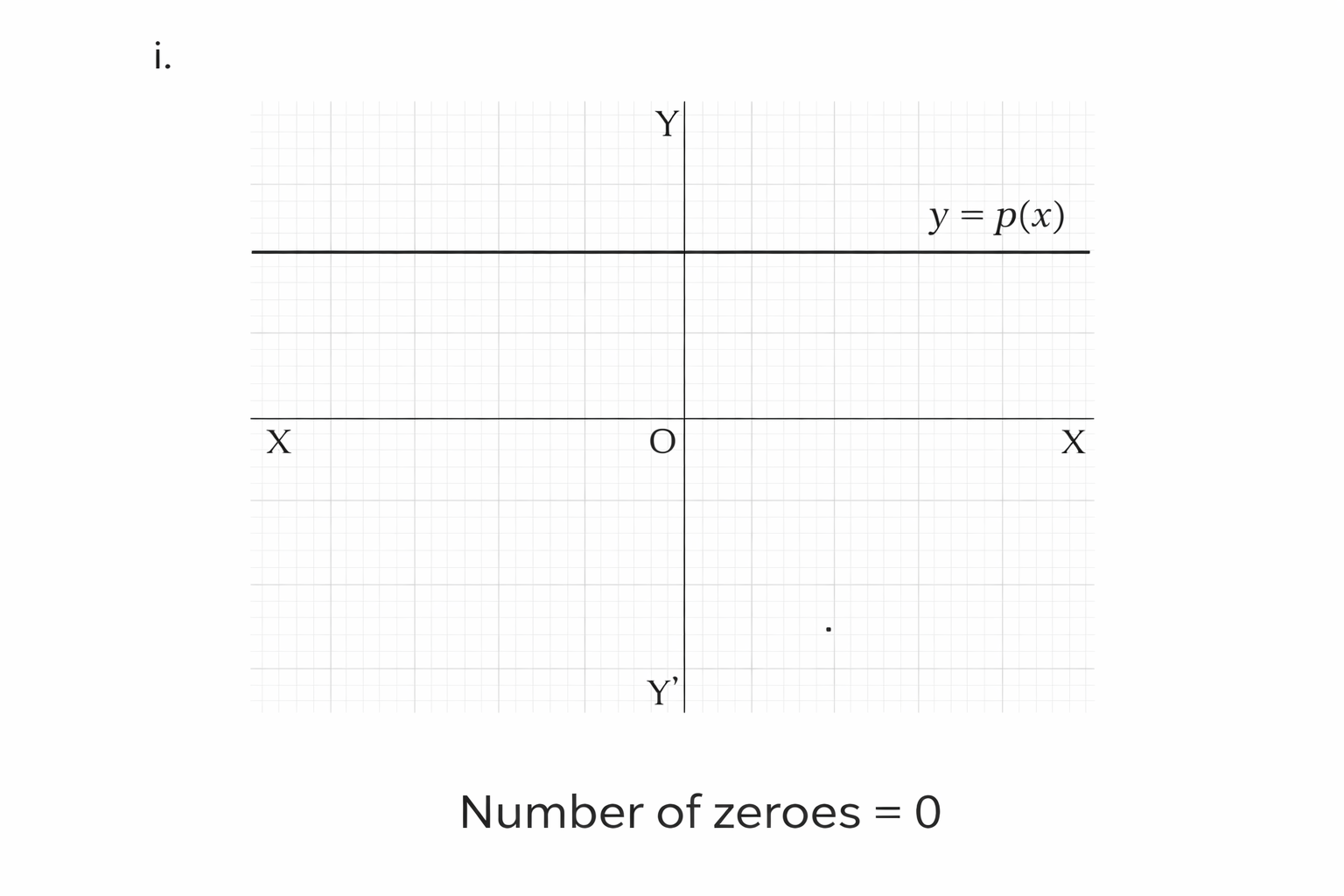
Ans: The graph does not intersect the x-axis at any point. Therefore, it does not have any zeroes.
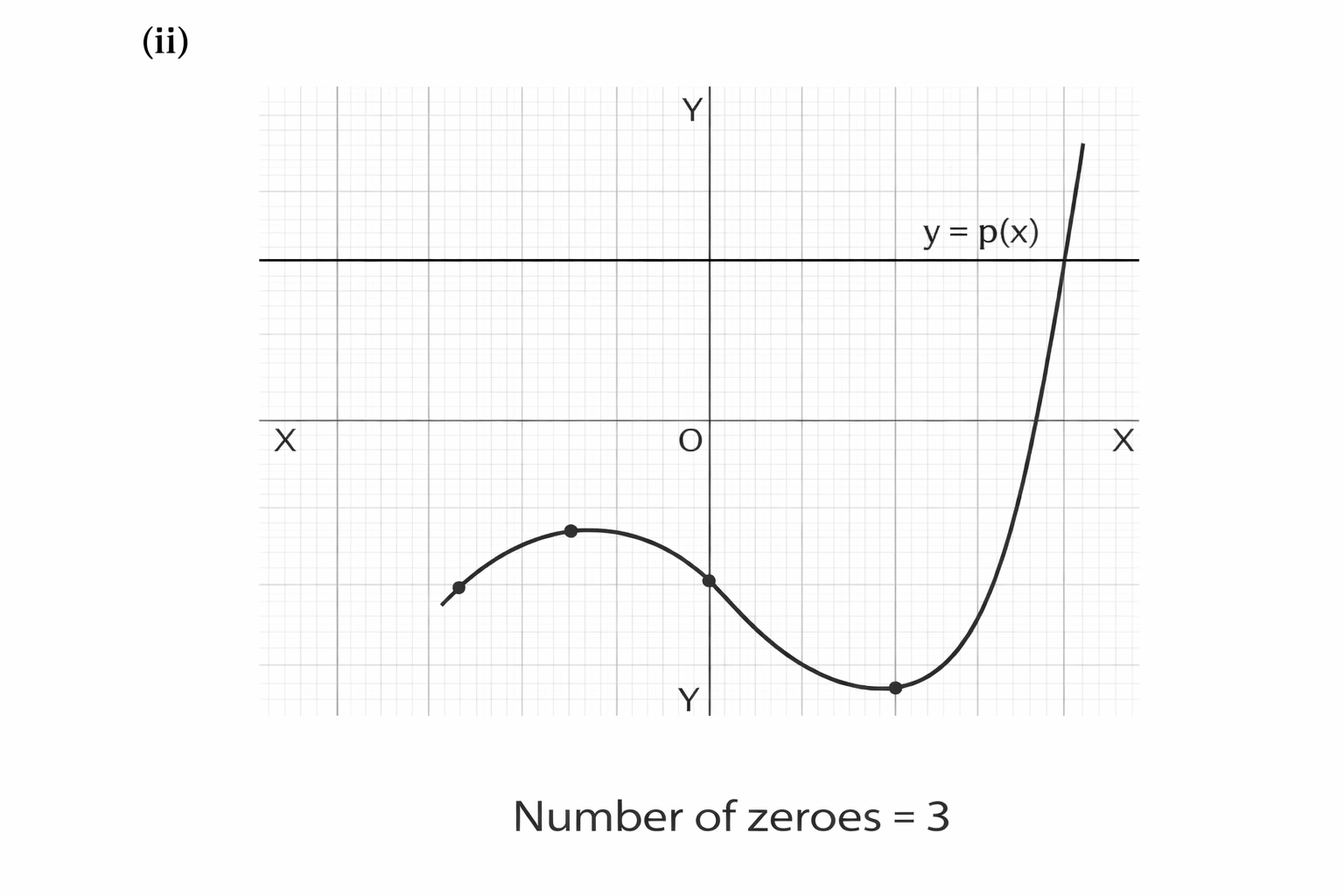
Ans: The graph intersects the x-axis at only one point. Therefore, the number of zeroes is 1.
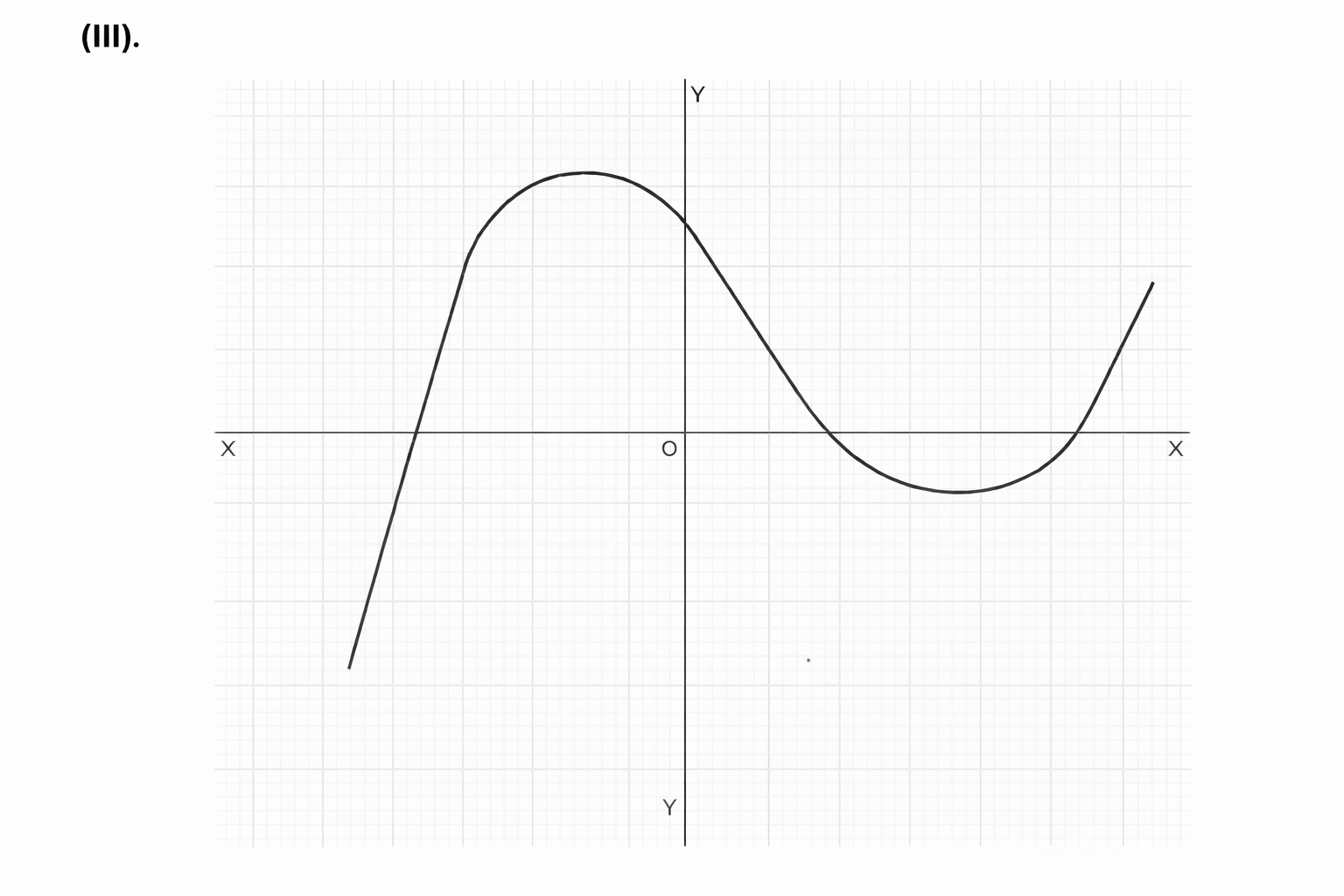
Ans: The graph intersects at the x-axis at 3 points. Therefore, the number of zeroes is 3.
2. Find the zeroes of the following quadratic polynomials and verify the relationship between the zeroes and the coefficients.
(i) x2 − 2x − 8
Ans: Given: x2 − 2x − 8.
Now factorize the given polynomial to get the roots.
⇒ (x − 4)(x + 2)
The value of x2 − 2x − 8 is zero when x − 4 = 0 or x + 2 = 0, i.e., x = 4 or x = −2.
Therefore, the zeroes of x2 − 2x − 8 are 4 and −2.
Now,
Sum of zeroes = 4 + (−2) = 2 = − Coefficient of x ⁄ Coefficient of x2
∴ Sum of zeroes = − Coefficient of x ⁄ Coefficient of x2
Product of zeroes = 4 × (−2) = −8 = Constant term ⁄ Coefficient of x2
∴ Product of zeroes = Constant term ⁄ Coefficient of x2
(ii) 4s2 − 4s + 1
Ans: Given: 4s2 − 4s + 1
Now factorize the given polynomial to get the roots.
⇒ (2s − 1)2
The value of 4s2 − 4s + 1 is zero when 2s − 1 = 0, i.e., s = 1⁄2 and s = 1⁄2.
Therefore, the zeroes of 4s2 − 4s + 1 are 1⁄2 and 1⁄2.
Now,
Sum of zeroes = 1⁄2 + 1⁄2 = 1 = − Coefficient of s ⁄ Coefficient of s2
∴ Sum of zeroes = − Coefficient of s ⁄ Coefficient of s2
Product of zeroes = 1⁄2 × 1⁄2 = 1⁄4 = Constant term ⁄ Coefficient of s2
∴ Product of zeroes = Constant term ⁄ Coefficient of s2
(iii) 6x2 − 3 − 7x
Ans: Given: 6x2 − 3 − 7x
⇒ 6x2 − 7x − 3
Now factorize the given polynomial to get the roots.
⇒ (3x + 1)(2x − 3)
The value of 6x2 − 3 − 7x is zero when 3x + 1 = 0 or 2x − 3 = 0, i.e., x = −1⁄3 or x = 3⁄2.
Therefore, the zeroes of 6x2 − 3 − 7x are −1⁄3 and 3⁄2.
Now,
Sum of zeroes = −1⁄3 + 3⁄2 = 7⁄6 = − (−7) ⁄ 6 = − Coefficient of x ⁄ Coefficient of x2
∴ Sum of zeroes = − Coefficient of x ⁄ Coefficient of x2
Product of zeroes = −1⁄3 × 3⁄2 = −3⁄6 = Constant term ⁄ Coefficient of x2
∴ Product of zeroes = Constant term ⁄ Coefficient of x2
(iv) 4u2 + 8u
Ans: Given: 4u2 + 8u
⇒ 4u2 + 8u + 0
⇒ 4u(u + 2)
The value of 4u2 + 8u is zero when 4u = 0 or u + 2 = 0, i.e., u = 0 or u = −2.
Therefore, the zeroes of 4u2 + 8u are 0 and −2.
Now,
Sum of zeroes = 0 + (−2) = −2 = − (−8) ⁄ 4 = − Coefficient of u ⁄ Coefficient of u2
∴ Sum of zeroes = − Coefficient of u ⁄ Coefficient of u2
Product of zeroes = 0 × (−2) = 0 = Constant term ⁄ Coefficient of u2
∴ Product of zeroes = Constant term ⁄ Coefficient of u2
(v) t2 − 15
Ans: Given: t2 − 15
⇒ t2 − 0t − 15
Now factorize the given polynomial to get the roots.
⇒ (t − √15)(t + √15)
The value of t2 − 15 is zero.
When t − √15 = 0 or t + √15 = 0, i.e., t = √15 or t = −√15
Therefore, the zeroes of t2 − 15 are √15 and −√15.
Now, Sum of zeroes = √15 + (−√15) = 0 = −0 / 1 = −(Coefficient of t) / (Coefficient of t2)
∴ Sum of zeroes = −(Coefficient of t) / (Coefficient of t2)
Product of zeroes = (√15) × (−√15) = −15 = −15 / 1 = Constant term / Coefficient of t2
∴ Product of zeroes = Constant term / Coefficient of t2
(vi) 3x2 − x − 4
Ans: Given: 3x2 − x − 4
Now factorize the given polynomial to get the roots.
⇒ (3x − 4)(x + 1)
The value of 3x2 − x − 4 is zero.
When 3x − 4 = 0 or x + 1 = 0, i.e., x = 4/3 or x = −1
Therefore, the zeroes of 3x2 − x − 4 are 4/3 and −1.
Now, Sum of zeroes = 4/3 + (−1) = 1/3 = −(−1)/3 = −(Coefficient of x) / (Coefficient of x2)
∴ Sum of zeroes = −(Coefficient of x) / (Coefficient of x2)
Product of zeroes = (4/3) × (−1) = −4/3 = Constant term / Coefficient of x2
∴ Product of zeroes = Constant term / Coefficient of x2
3. Find a quadratic polynomial each with the given numbers as the sum and product of its zeroes respectively.
(i) 1/4, −1
Ans: Given: 1/4, −1
Let the zeroes of polynomial be α and β.
Then,
α + β = 1/4
αβ = −1
Hence, the required polynomial is x2 − (α + β)x + αβ.
⇒ x2 − 1/4 x − 1
⇒ 4x2 − x − 4
Therefore, the quadratic polynomial is 4x2 − x − 4.
(ii) √2, 1/3
Ans: Given: √2, 1/3
Let the zeroes of polynomial be α and β.
Then,
α + β = √2
αβ = 1/3
Hence, the required polynomial is x2 − (α + β)x + αβ.
⇒ x2 − √2x + 1/3
⇒ 3x2 − 3√2x + 1
Therefore, the quadratic polynomial is 3x2 − 3√2x + 1.
(iii) 0, √5
(here, root is missing)
Ans: Given: 0, √5
Let the zeroes of polynomial be α and β.
Then,
α + β = 0
αβ = √5
Hence, the required polynomial is x2 − (α + β)x + αβ.
⇒ x2 − 0x + √5
⇒ x2 + √5
Therefore, the quadratic polynomial is x2 + √5.
(iv) 1, 1
Ans: Given: 1, 1
Let the zeroes of polynomial be α and β.
Then,
α + β = 1
αβ = 1
Hence, the required polynomial is x2 − (α + β)x + αβ.
⇒ x2 − 1x + 1
Therefore, the quadratic polynomial is x2 − x + 1.
(v) −1/4, 1/4
Ans: Given: −1/4, 1/4
Let the zeroes of polynomial be α and β.
Then,
α + β = −1/4
αβ = 1/4
Hence, the required polynomial is x2 − (α + β)x + αβ.
⇒ x2 − (−1/4)x + 1/4
⇒ 4x2 + x + 1
Therefore, the quadratic polynomial is 4x2 + x + 1.
(vi) 4, 1
Ans: Given: 4, 1
Let the zeroes of polynomial be α and β.
Then,
α + β = 4
αβ = 1
Hence, the required polynomial is x2 − (α + β)x + αβ.
⇒ x2 − 4x + 1
Therefore, the quadratic polynomial is x2 − 4x + 1.
FAQs
1. How do you find the degree of a polynomial?
To find the degree of a polynomial, look at the highest power of the variable in the expression. That highest exponent is called the degree of the polynomial.
For example, in the polynomial 5x³ − 2x² + x − 8, the highest power of x is 3, so the degree of the polynomial is 3.
Always make sure the polynomial is written in one variable.
2. How do I check if a number is a zero of a polynomial?
To check whether a number is a zero of a polynomial, substitute the given number in place of the variable in the polynomial p(x).
- If the result is 0, that is p(k) = 0, then k is a zero of the polynomial.
- If the result is not 0, then k is not a zero of the polynomial.
3. What is the best way to self-check my answers using NCERT Solutions?
First, try to solve the question on your own from the NCERT textbook. After that, compare your solution with the step-by-step explanation given in the NCERT Solutions. This helps you find mistakes in your method and understanding, not just in the final answer.
4. How can I effectively revise using the NCERT Solutions for Class 10 Maths Chapter 2?
After completing the chapter, use the NCERT Solutions for Class 10 Maths Chapter 2 (Polynomials) to revise concepts step by step and practice problem-solving methods. Regular revision helps strengthen your understanding and improve memory for exams. These solutions also show the standard methods that examiners expect in the answer paper.
5. How can I practise the most important Class 10 Polynomials questions and answers?
The NCERT Solutions provide a strong and reliable base for practice. Go through all the in-text and exercise questions one by one to cover the most important concepts asked in board exams.
Practising directly from the NCERT textbook is the best way to master this chapter. These solutions explain not only how to solve a problem, but also why each step is used, which helps in solving tricky questions with confidence.