Overview of Class 10 Maths Chapter 3 Pair of Linear Equations in Two Variables
Class 10 Maths Chapter 3, Pair of Linear Equations in Two Variables, introduces students to solving two equations involving the same variables. The chapter explains graphical and algebraic methods such as substitution, elimination, and cross-multiplication. Students learn about consistent, inconsistent, and dependent systems of equations, along with real-life word problems based on linear relationships. Students can learn methods such as substitution, elimination, and graphical representation through ToppersSky’s animated learning modules, which make concepts easier to understand and remember. ToppersSky NCERT Solutions for this chapter clearly explain every step, helping students solve questions with confidence and accuracy in exams.
Two Linear Equations having two same variables are known as the pair of Linear Equations in two variables. A linear equation in two variables involves variables x and y, and is expressed as ax + by + c = 0, where a, b, and c are real numbers (a and b ≠ 0).
NCERT Solutions for Class 10 Maths Chapter 3 Pair of Linear Equations in Two Variables – Quick View | ToppersSky
ToppersSky provides well-structured and step-by-step NCERT Solutions for Class 10 Maths Chapter 3 to help students clearly understand the concepts of linear equations in two variables. This chapter focuses on solving pairs of linear equations using graphical, substitution, elimination, and cross-multiplication methods. Students also learn about consistent, inconsistent, and dependent systems of equations.
The solutions cover all exercise questions with detailed explanations, making it easier for students to grasp problem-solving techniques. With clear steps, exam-oriented answers, and simplified explanations, ToppersSky helps students build strong conceptual understanding and score confidently in exams.
Important Topics Covered in Class 10 Maths Chapter 3 Pair of Linear Equations in Two Variables
Introduction
A linear equation represents a straight line when plotted on a graph. It is generally written in the form: ax + by + c = 0 where a, b, and c are real numbers, and a ≠ 0 and b ≠ 0. The letters x and y are variables.
Why Are the NCERT Solutions for Class 10 Maths Chapter 3 Important?
The following key points give the reason why ToppersSky’s NCERT Solutions for Chapter 3 are so important for getting ready for the exams:
- The solutions are presented in a clear and systematic way with the help of animated learning, which makes it easier to grasp the subject matter.
- All the major ideas of Pair of Linear Equations in Two Variables are dealt with in a systematic and easy-to-understand way.
- Each of the exercises is solved with comprehensive explanations and visual clarity which aids the students in preparing for board exams with utmost confidence.
Pair of Linear Equations
Two Linear Equations having two same variables are known as the pair of Linear Equations in two variables. A linear equation in two variables involves variables x and y, and is expressed as ax + by + c = 0, where a, b, and c are real numbers (a and b ≠ 0).
- a1x + b1y + c1 = 0
- a²x + b²y + c² = 0
Graphical Method of Solution of a Pair of Linear Equations
- Unique Solution (Consistent Pair): The intersection of two lines at a single point signifies that there is only one solution for the pair of linear equations hence a unique solution for this pair. At ToppersSky App, you can observe this situation by means of animated learning and see the lines meeting at a single point.
- Infinitely Many Solutions (Consistent Coincident Lines): If the two lines are coinciding, they are located precisely on top of one another. This situation results in the pair of linear equations having infinitely many solutions. ToppersSky’s animated learning not only simulates but also clarifies why the line has an infinite number of points as the solution.
- No Solution (Inconsistent Pair – Parallel Lines): When the two lines run parallel to each other without touching, the pair of linear equations will have no solution. ToppersSky presents you with the situation of parallel lines and the reasoning behind the non-existence of a solution through animations.
Algebraic Methods of Solving a Pair of Linear Equations
The solution of a pair of linear equations is a point (x, y) that satisfies both equations simultaneously. We can find the solution to a consistent pair of linear equations using the following methods:
Substitution Method:
- One of the equations is solved to express a single variable, for instance, y is written in terms of x or vice versa.
- This expression is plugged into the second equation, which gives an equation with only one variable. After that, it is solved to get the variable’s value.
- Lastly, the value obtained in part (b) is substituted back into the expression from part (a) to determine the value of the other variable.
Elimination Method:
- If the coefficients of a variable are different in the two equations, multiply the equations by suitable non-zero numbers so that the coefficients of one variable become the same.
- Add or subtract the equations to eliminate that variable and solve for the remaining variable.
- Substitute the value you found in step (b) into either of the original equations to find the value of the second variable.
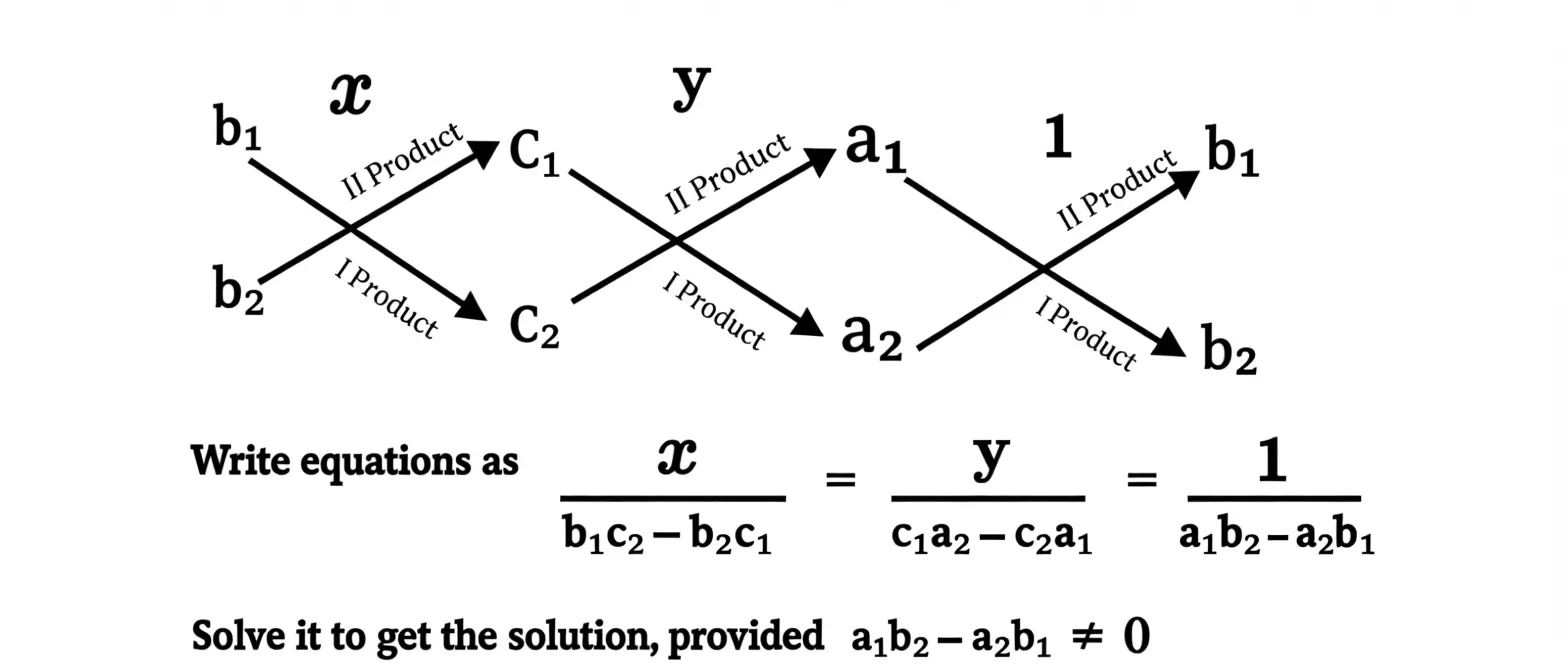
Cross-multiplication Method:
The two linear equations in two variables are as follows:
a1x + b1y + c1 = 0
a2x + b2y + c2 = 0
Take a look at the diagram below.
Solving Word Problems:
- Go through the question meticulously and point out the unseen figures. Utilize symbols such as x, y, r, s, t, etc., to denote these invisible parts.
- Make a decision about the variables that you need in order to work out the problem.
- Transform the facts provided into equations based on the variables you have selected.
- Use any of the three methods you have learned earlier to find the solution to the equations.
Equations reducible to a pair of linear equations in two variables
In some cases, a given pair of equations is not linear or is not expressed in standard form. Such equations are then altered to reduce them to a pair of linear equations in standard form.
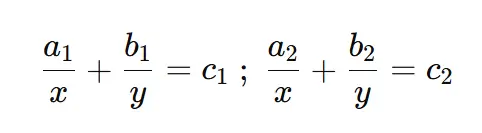
Determine the solution by solving it, given that a1b2 − a2b1 ≠ 0.
Here we substitute 1/x = p & 1/y = q, the above equations reduce to:
a1p + b1q = c1; a2p − b2q = c2
Now we can use any method to solve them.
Summary of Pair of Linear Equations in Two Variables
The Summary section contains the key concepts you need to remember to solve the practice questions in the chapter on Pair of Linear Equations in Two Variables. By going through these points, you can quickly review all the important ideas from the chapter.
- Two equations of the first degree in two variables form a pair of linear equations. The variables in these equations are the same, and these equations can be presented either in an algebraic or graphical manner. To show each equation on a graph, a straight line is drawn for each.
- If the lines cross at one point then the equations form a pair of consistent equations.
- The equations are said to be dependent when the lines are coincident (completely overlapping).
- When the lines are parallel and never intersect, the equations are then said to be inconsistent.
Methods for Solving Linear Equations in Two Variables
- Substitution Method
- Elimination Method
- Cross-multiplication Method
Conclusion
ToppersSky’s NCERT Solutions for Chapter 3 offer a very detailed explanation to assist the students in solving the problems with no difficulty. The linear equations and their graphical representation must be understood well first. The methods of substitution and elimination for solving pairs of linear equations should be mastered and practiced. Usually, the past year question papers contain 6–8 questions related to this chapter which makes it very important to practice regularly in order to get the mastery. To sum up, these solutions are a remarkable resource to improve your understanding of concepts and to develop your problem-solving abilities in this topic.

Class 10 Maths Chapter 3: Pair of Linear Equations in Two Variables: Practice & Exercises
1. Form the pair of linear equations in the following problems, and find their solutions graphically.
(i) 10 students of Class X took part in a Mathematics quiz. If the number of girls is 4 more than the number of boys, find the number of boys and girls who took part in the quiz.
Ans (i): Assuming that the number of girls and boys be x and y respectively.
Writing the algebraic representation using the information given in the question:
x+y=10
x-y=4
Solution table for x + y = 10:
x=10-y
| x | 5 | 4 | 6 |
| y | 5 | 6 | 4 |
Solution table for x – y = 4:
x=4+y
| x | 5 | 4 | 3 |
| y | 1 | 0 | -1 |
Graphical representation-
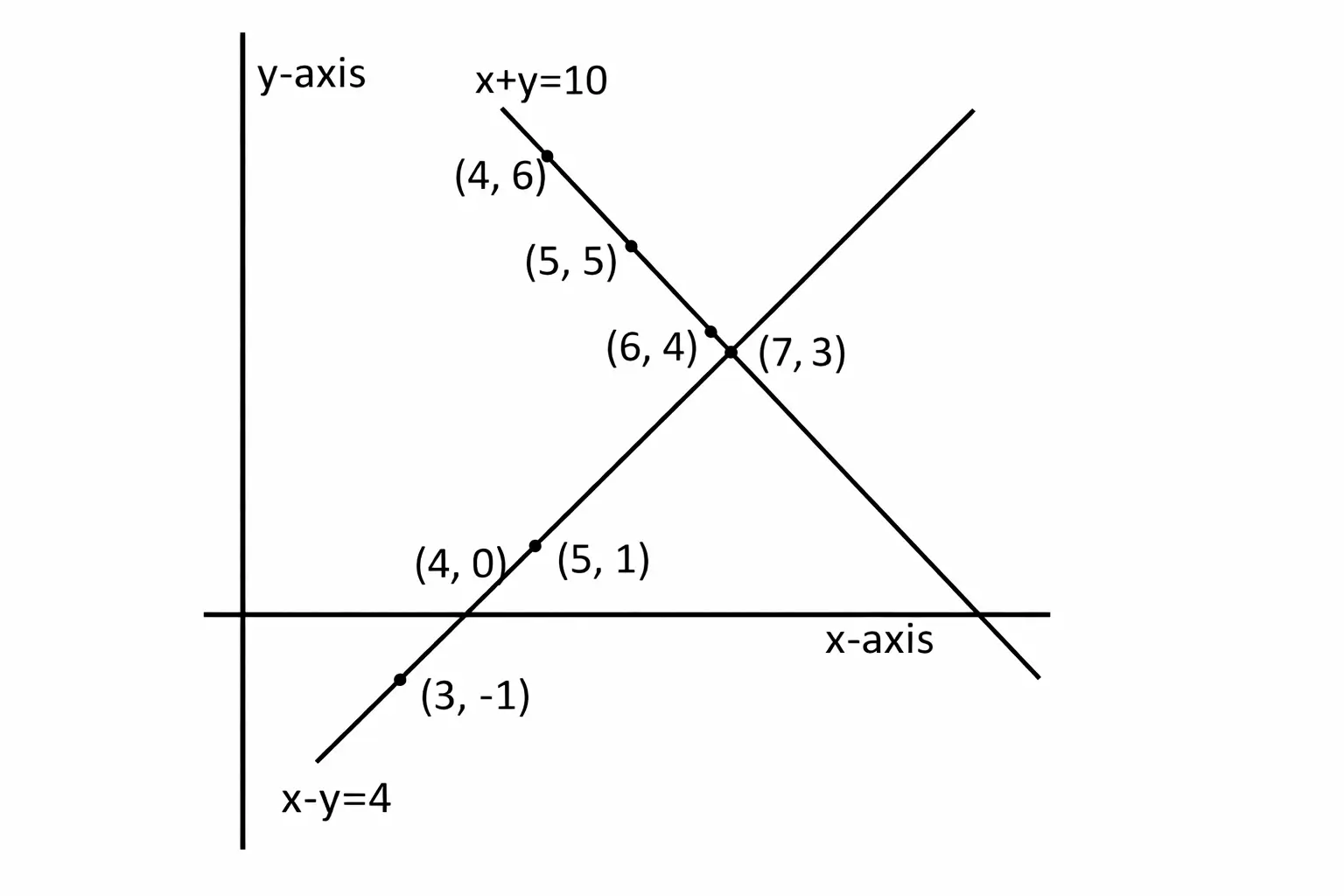
From the graph above, the two lines intersect at the point (7, 3). This indicates that there are 7 girls and 3 boys in the class.
(ii) 5 pencils and 7 pens together cost Rs. 50, whereas 7 pencils and 5 pens together cost Rs. 46. Find the cost of one pencil and that of one pen.
Ans (ii): Assuming that the cost of 1 pencil and 1 pen be x and y respectively.
Writing the algebraic representation using the information given in the question:
5x + 7y = 50
7x + 5y = 46
Solution table for 5x + 7y = 50:
x = (50 − 7y) / 5
| x | 3 | 10 | -4 |
| y | 5 | 0 | 10 |
Solution table for 7x + 5y = 46:
x = (46 − 5y) / 7
| x | 8 | 3 | -2 |
| y | -2 | 5 | 12 |
Graphical representation-
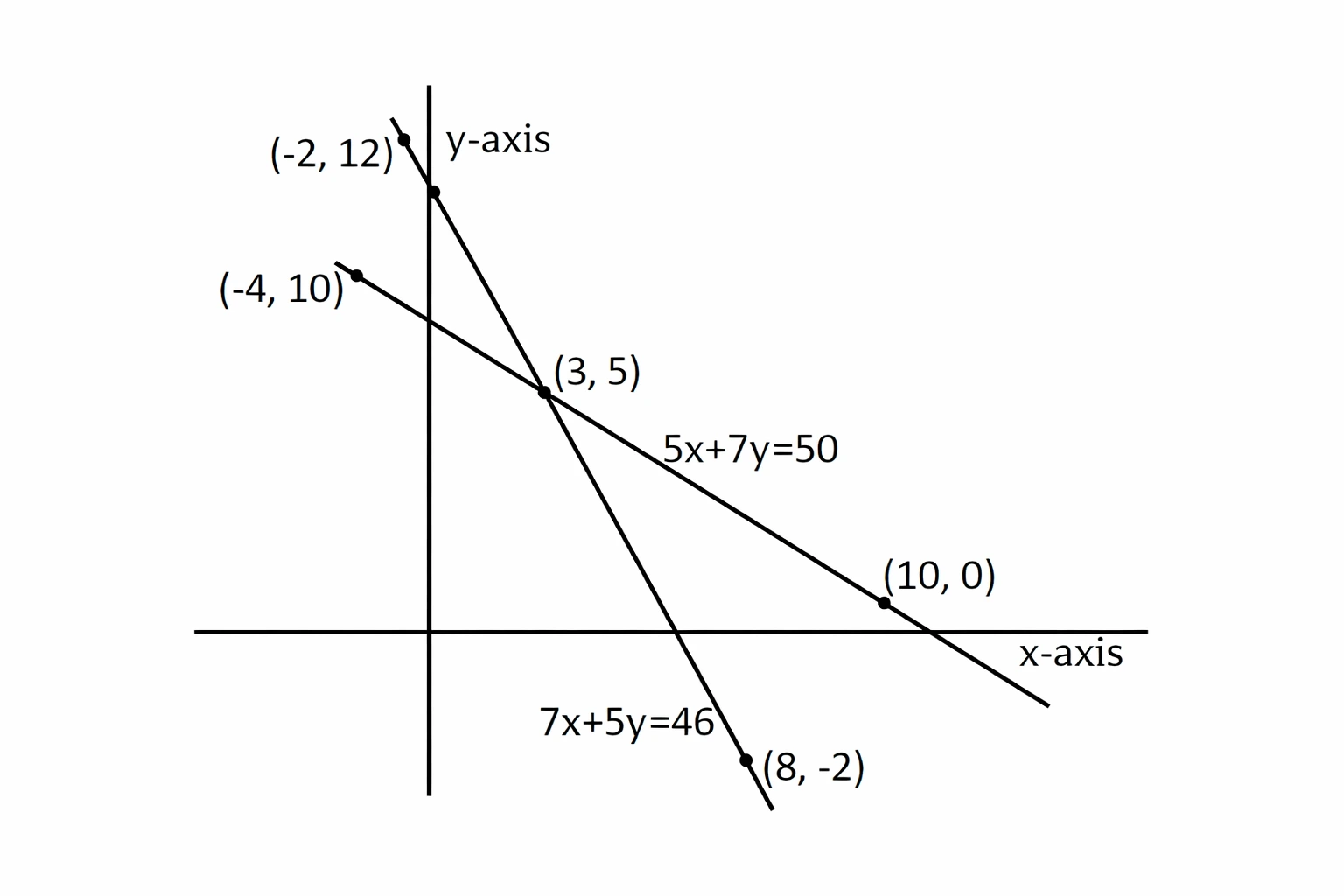
From the graph above, the two lines intersect at the point (3, 5). Hence, the cost of a pencil is Rs. 3 and the cost of a pen is Rs. 5.
2. On comparing the ratios a1/a2, b1/b2 and c1/c2, find out whether the lines representing the following pairs of linear equations intersect at a point, are parallel or coincident:
(i) 5x − 4y + 8 = 0
7x + 6y − 9 = 0
Ans: 5x − 4y + 8 = 0
7x + 6y − 9 = 0
Calculating the values of a1, b1, c1, a2, b2 and c2 by comparing the above equations with a1x + b1y + c1 = 0 and a2x + b2y + c2 = 0:
a1 = 5, b1 = −4, c1 = 8
a2 = 7, b2 = 6, c2 = −9
a1/a2 = 5/7
b1/b2 = −4/6 = −2/3
Since a1/a2 ≠ b1/b2,
Therefore, the given pair of equations has a unique solution, that is, the lines intersect at exactly one point.
(ii) 9x + 3y + 12 = 0
18x + 6y + 24 = 0
Ans: Calculating the values of a1, b1, c1, a2, b2 and c2 by comparing the above equations with a1x + b1y + c1 = 0 and a2x + b2y + c2 = 0:
a1 = 9, b1 = 3, c1 = 12
a2 = 18, b2 = 6, c2 = 24
a1/a2 = 1/2
b1/b2 = 1/2
c1/c2 = 1/2
Since a1/a2 = b1/b2 = c1/c2,
Therefore, the lines representing the given pair of equations have infinite solutions, as they are coincident.
3. Half the perimeter of a rectangular garden, whose length is 4 m more than its width, is 36 m. Find the dimensions of the garden.
Ans: Assuming that the width and length of the garden be x and y respectively.
Writing the algebraic representation using the information given in the question:
y − x = 4
x + y = 36
Solution table for y − x = 4:
y = x + 4
| x | 0 | 80 | 12 |
| y | 4 | 12 | 16 |
Solution table for x + y = 36:
y = 36 − x
| x | 0 | 36 | 16 |
| y | 36 | 0 | 20 |
Graphical representation-
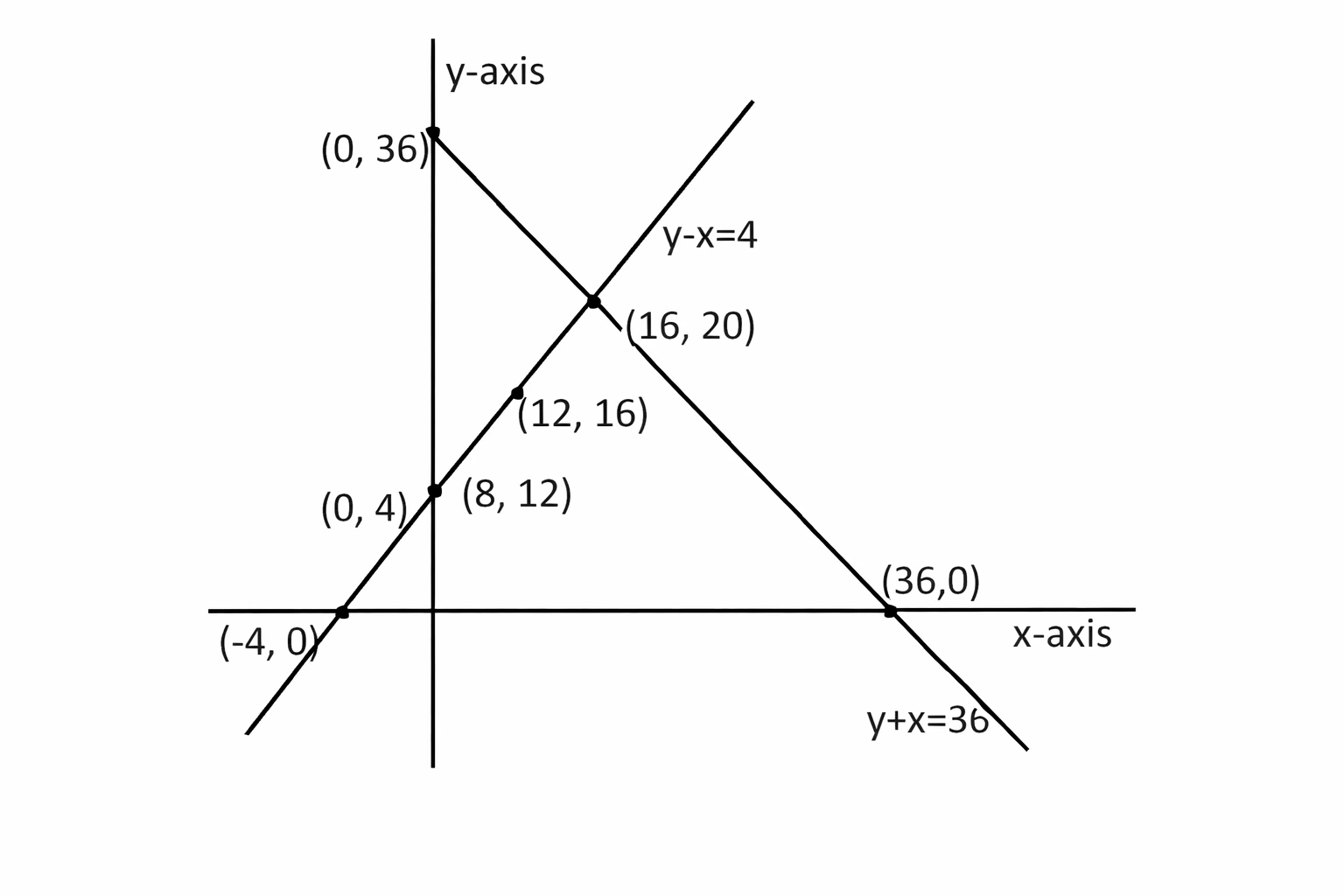
As shown in the graph above, the two lines intersect each other at only one point (16, 20). Therefore, the length of the garden is 20 m and its breadth is 16 m.
4. Draw the graphs of the equations x − y + 1 = 0 and 3x + 2y − 12 = 0. Determine the coordinates of the vertices of the triangle formed by these lines and the x-axis, and shade the triangular region.
Ans: Solution table for x − y + 1 = 0:
x = y − 1
| x | 0 | 1 | 2 |
| y | 1 | 2 | 3 |
Solution table for 3x + 2y − 12 = 0:
X = 12-2y/3
| x | 4 | 2 | 0 |
| y | 0 | 3 | 6 |
Graphical representation-
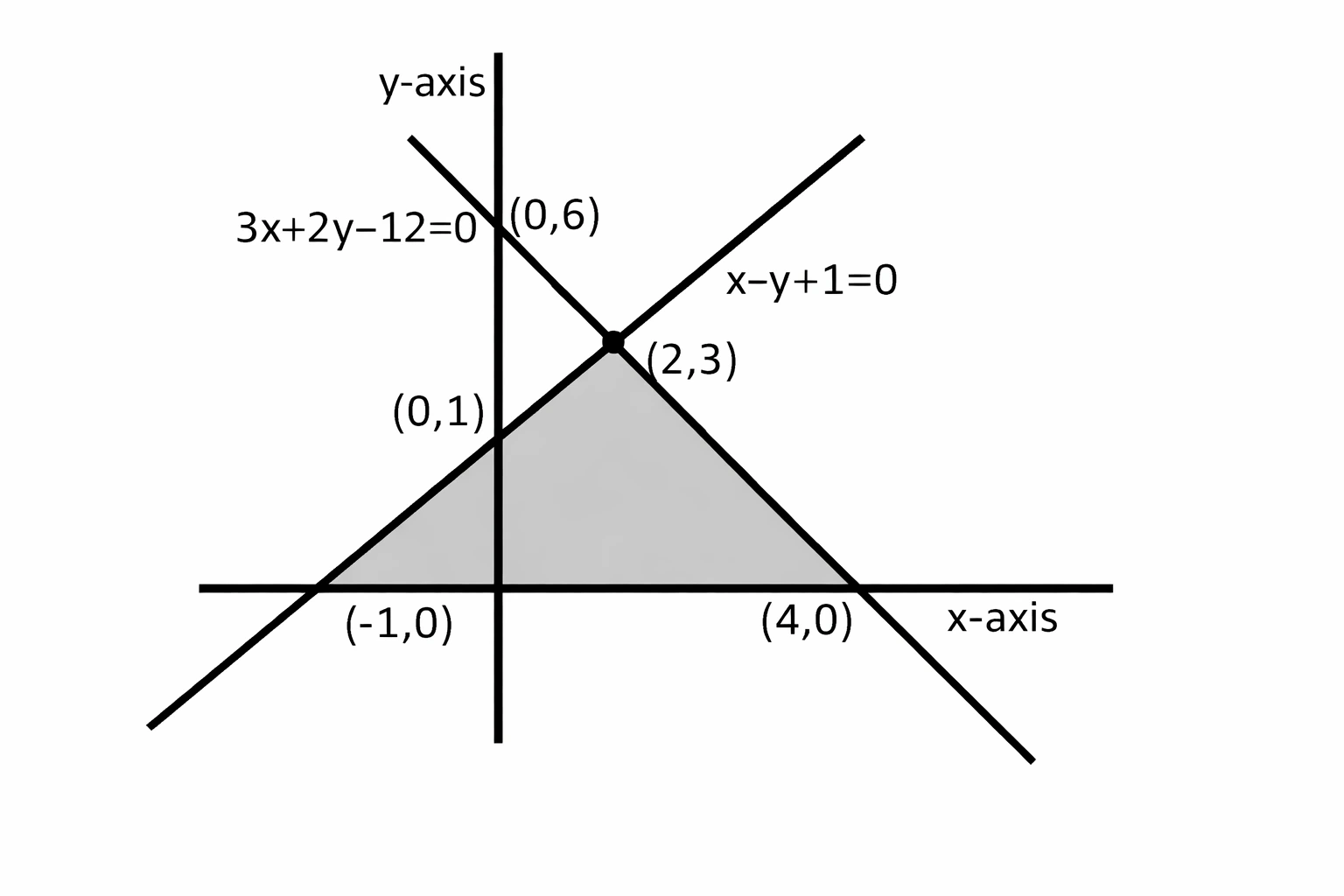
As shown in the graph above, the lines are intersecting each other at the point (2, 3) and the x-axis at (−1, 0) and (4, 0). So, the obtained triangle has vertices (2, 3), (−1, 0) and (4, 0).
5. Find the solution of the following pair of linear equations by the substitution method.
(i) x + y = 14; x − y = 4
Ans: The given equations are –
x + y = 14 …… (i)
x − y = 4 …… (ii)
From equation (i) –
x = 14 − y …… (iii)
Substituting (iii) in equation (ii), we get
(14 − y) − y = 4
14 − 2y = 4
10 = 2y
y = 5 …… (iv)
Substituting (iv) in (iii), we get
x = 9
Therefore, x = 9 and y = 5.
(ii) s − t = 3; s/3 + t/2 = 6
Ans: The given equations are –
s − t = 3 …… (i)
s/3 + t/2 = 6 …… (ii)
From equation (i) –
s = t + 3 …… (iii)
Substituting (iii) in equation (ii), we get
(t + 3)/3 + t/2 = 6
2t + 6 + 3t = 36
5t = 30
t = 6 …… (iv)
Substituting (iv) in (iii), we get
s = 9
Therefore, s = 9 and t = 6.
(iii) 3x − y = 3; 9x − 3y = 9
Ans: The given equations are –
3x − y = 3 …… (i)
9x − 3y = 9 …… (ii)
From equation (i) –
y = 3x − 3 …… (iii)
Substituting (iii) in equation (ii), we get
9x − 3(3x − 3) = 9
9x − 9x + 9 = 9
9 = 9
For all x and y.
Therefore, the given equations have infinite solutions. One of the solutions is x = 1, y = 0.
(iv) 0.2x − 0.3y = 1.3; 0.4x + 0.5y = 2.3
Ans: The given equations are –
0.2x − 0.3y = 1.3 …… (i)
0.4x + 0.5y = 2.3 …… (ii)
From equation (i) –
x = (1.3 − 0.3y) / 0.2 …… (iii)
Substituting (iii) in equation (ii), we get
0.4((1.3 − 0.3y) / 0.2) + 0.5y = 2.3
2.6 − 0.6y + 0.5y = 2.3
2.6 − 2.3 = 0.1y
y = 3 …… (iv)
Substituting (iv) in (iii), we get
x = (1.3 − 0.3(3)) / 0.2
x = 2
Therefore, x = 2 and y = 3.
(v) √2x − √3y = 0; √3x − √8y = 0
Ans: The given equations are –
√2x − √3y = 0 …… (i)
√3x − √8y = 0 …… (ii)
From equation (i) –
x = (−√3y) / √2 …… (iii)
Substituting (iii) in equation (ii), we get
√3((−√3y) / √2) − √8y = 0
(−√3y) / √2 − 2√2y = 0
y((−√3 / √2) − 2√2) = 0
y = 0 …… (iv)
Substituting (iv) in (iii), we get
x = 0
Therefore, x = 0 and y = 0.
(vi) (3x/2) − (5y/3) = −2; (x/3) + (y/2) = 13/6
Ans: The given equations are –
3x/2 − 5y/3 = −2 …… (i)
x/3 + y/2 = 13/6 …… (ii)
From equation (i) –
x = (−12 + 10y) / 9 …… (iii)
Substituting (iii) in equation (ii), we get
((−12 + 10y) / 9)/3 + y/2 = 13/6
(−12 + 10y)/27 + y/2 = 13/6
−24 + 20y + 27y = 54 / 6
47y = 141
y = 3 …… (iv)
Substituting (iv) in (iii), we get
x = 2
Therefore, x = 2 and y = 3.
6. Solve 2x + 3y = 11 and 2x − 4y = −24 and hence find the value of m for which y = mx + 3.
Ans: The given equations are –
2x + 3y = 11 …… (i)
2x − 4y = −24 …… (ii)
From equation (i) –
x = (11 − 3y) / 2 …… (iii)
Substituting (iii) in equation (ii), we get
2((11 − 3y) / 2) − 4y = −24
11 − 3y − 4y = −24
−7y = −35
y = 5 …… (iv)
Substituting (iv) in (iii), we get
x = −2
Therefore, x = −2 and y = 5.
Calculating the value of m –
y = mx + 3
5 = −2m + 3
m = −1
7. Write the pair of linear equations for the following problems and solve them using the substitution method.
(i) The difference between two numbers is 26 and one number is three times the other. Find them.
Ans: Assuming one number be x and another number be y such that y > x,
Writing the algebraic representation using the information given in the question:
y = 3x …….. (i)
y − x = 26 …. (ii)
Substituting the value of y from equation (i) in equation (ii), we get:
3x − x = 26
2x = 26
x = 13 …. (iii)
Substituting (iii) in (i), we get:
y = 39
Therefore, x = 13 and y = 39.
(ii) The larger of two supplementary angles exceeds the smaller by 18 degrees. Find them.
Ans: Assuming the larger angle be x and the smaller angle be y.
The sum of a pair of supplementary angles is always 180°.
Writing the algebraic representation using the information given in the question:
x + y = 180 …… (i)
x − y = 18 …. (ii)
Substituting the value of x from equation (i) in equation (ii), we get:
180 − y − y = 18
162 = 2y
y = 81 …. (iii)
Substituting (iii) in (i), we get:
x = 99
Therefore, the two angles are x = 99° and y = 81°.
(iii) The coach of a cricket team buys 7 bats and 6 balls for Rs 3800. Later, she buys 3 bats and 5 balls for Rs 1750. Find the cost of each bat and each ball.
Ans: Assuming the cost of a bat is x and the cost of a ball is y.
Writing the algebraic representation using the information given in the question:
7x + 6y = 3800 ….. (i)
3x + 5y = 1750 ….. (ii)
From equation (i):
y = 3800 − 7x / 6 ….. (iii)
Substituting (iii) in equation (ii):
3x + 5 ( 3800 − 7x / 6 ) = 1750
3x + 9500/3 − 35x/6 = 1750
3x − 35x/6 = 1750 − 9500/3
18x − 35x / 6 = 5250 − 9500 / 3
17x / 6 = −4250 / 3
x = 500 ….. (iv)
Substituting (iv) in (iii), we get:
y = 3800 − 7(500) / 6
y = 50
Therefore, the bat costs Rs 500 and the ball costs Rs 50.
(iv) The taxi charges in a city consist of a fixed charge together with the charge for the distance covered. For a distance of 10 km, the charge paid is Rs 105 and for a journey of 15 km, the charge paid is Rs 155. What are the fixed charges and the charge per km? How much does a person have to pay for travelling a distance of 25 km?
Ans: Assuming the fixed charge be Rs x and the per km charge be Rs y.
Writing the algebraic representation using the information given in the question:
x + 10y = 105 ….. (i)
x + 15y = 155 ….. (ii)
From equation (i):
x = 105 − 10y ….. (iii)
Substituting (iii) in equation (ii):
105 − 10y + 15y = 155
5y = 50
y = 10 ….. (iv)
Substituting (iv) in (iii), we get:
x = 105 − 10(10)
x = 5
Therefore, the fixed charge is Rs 5 and the per km charge is Rs 10.
So, charge for 25 km will be:
= Rs (x + 25y)
= Rs 255
(v) A fraction becomes 9/11, if 2 is added to both the numerator and the denominator. If 3 is added to both the numerator and the denominator it becomes 5/6. Find the fraction.
Ans: Assuming the fraction be x/y.
Writing the algebraic representation using the information given in the question:
(x + 2) / (y + 2) = 9 / 11
11x + 22 = 9y + 18
11x − 9y = −4 ….. (i)
(x + 3) / (y + 3) = 5 / 6
6x + 18 = 5y + 15
6x − 5y = −3 ….. (ii)
From equation (i):
x = −4 + 9y / 11 ….. (iii)
Substituting (iii) in equation (ii):
6 ( −4 + 9y / 11 ) − 5y = −3
−24 + 54y − 55y = −33
y = 9 ….. (iv)
Substituting (iv) in (iii), we get:
x = −4 + 9(9) / 11
x = 7
Therefore, the required fraction is 7/9.
(vi) Five years hence, the age of Jacob will be three times that of his son. Five years ago, Jacob’s age was seven times that of his son. What are their present ages?
Ans: Assuming the age of Jacob be x and the age of his son be y.
Writing the algebraic representation using the information given in the question:
(x + 5) = 3(y + 5)
x − 3y = 10 ….. (i)
(x − 5) = 7(y − 5)
x − 7y = −30 ….. (ii)
From equation (i):
x = 3y + 10 ….. (iii)
Substituting (iii) in equation (ii):
3y + 10 − 7y = −30
−4y = −40
y = 10 ….. (iv)
Substituting (iv) in (iii), we get:
x = 3(10) + 10
x = 40
Therefore, Jacob’s present age is 40 years and his son’s present age is 10 years.
8. Solve the following pair of linear equations by the elimination method and the substitution method-
(i) x + y = 5 and 2x − 3y = 4
Ans: Elimination Method
The given equations are:
x + y = 5 ….. (i)
2x − 3y = 4 ….. (ii)
Multiplying equation (i) by 2, we get:
2x + 2y = 10 ….. (iii)
Subtracting equation (ii) from equation (iii), we obtain:
5y = 6
y = 6 / 5 ….. (iv)
Substituting the value of (iv) in equation (i), we get:
x = 5 − 6 / 5
x = 19 / 5
Therefore, x = 19/5 and y = 6/5.
Substitution Method
From equation (i), we get:
x = 5 − y ….. (v)
Substituting (v) in equation (ii), we get:
2(5 − y) − 3y = 4
−5y = −6
y = 6 / 5 ….. (vi)
Substituting (vi) in equation (v), we obtain:
x = 5 − 6 / 5
x = 19 / 5
Therefore, x = 19/5 and y = 6/5.
(ii) 3x + 4y = 10 and 2x − 2y = 2
Ans: Elimination Method
The given equations are:
3x + 4y = 10 ….. (i)
2x − 2y = 2 ….. (ii)
Multiplying equation (ii) by 2, we get:
4x − 4y = 4 ….. (iii)
Adding equation (i) and (iii), we obtain:
7x = 14
x = 2 ….. (iv)
Substituting the value of (iv) in equation (i), we get:
6 + 4y = 10
4y = 4
y = 1
Therefore, x = 2 and y = 1.
Substitution Method
From equation (ii), we get:
x = 1 + y ….. (v)
Substituting (v) in equation (i), we get:
3(1 + y) + 4y = 10
7y = 7
y = 1 ….. (vi)
Substituting (vi) in equation (v), we obtain:
x = 1 + 1
x = 2
Therefore, x = 2 and y = 1.
(iii) 3x − 5y − 4 = 0 and 9x = 2y + 7
Ans: Elimination method
The given equations are–
3x − 5y − 4 = 0 ….. (i)
9x = 2y + 7
9x − 2y = 7 ….. (ii)
Multiplying equation (i) by 3, we get
9x − 15y − 12 = 0 ….. (iii)
Subtracting equation (iii) from equation (ii), we obtain
13y = −5
y = −5/13 ….. (iv)
Substituting the value of (iv) in equation (i), we get
3x + 25/13 − 4 = 0
3x = 27/13
x = 9/13
Therefore, x = 9/13 and y = −5/13.
Substitution method–
From equation (i) we get
x = (5y + 4) / 3 ….. (v)
Substituting (v) in equation (ii), we get
9(5y + 4) / 3 − 2y − 7 = 0
13y = −5
y = −5 / 13 ….. (vi)
Substituting (vi) in equation (v), we obtain
x = [5(−5 / 13) + 4] / 3
x = 9 / 13
Therefore, x = 9 / 13 and y = −5 / 13.
(iv) x/2 + 2y/3 = −1 and x − y/3 = 3
Ans: Elimination method
The given equations are–
x/2 + 2y/3 = −1
3x + 4y = −6 ….. (i)
x − y/3 = 3
3x − y = 9 ….. (ii)
Subtracting equation (ii) from equation (i), we obtain
5y = −15
y = −3 ….. (iv)
Substituting the value of (iv) in equation (i), we get
3x + 4(−3) = −6
3x = 6
x = 2
Therefore, x = 2 and y = −3.
Substitution method–
From equation (ii) we get
x = (y + 9) / 3 ….. (v)
Substituting (v) in equation (i), we get
3( (y + 9) / 3 ) + 4y = −6
5y = −15
y = −3 ….. (vi)
Substituting (vi) in equation (v), we obtain
x = (−3 + 9) / 3
x = 2
Therefore, x = 2 and y = −3.
9. Form the pair of linear equations in the following problems, and find their solutions (if they exist) by the elimination method-
(i) If we add 1 to the numerator and subtract 1 from the denominator, a fraction reduces to 1.
It becomes 1/2 if we only add 1 to the denominator. What is the fraction?
Ans: Assuming the fraction be x/y.
Writing the algebraic representation using the information given in the question—
(x + 1) / (y − 1) = 1
x − y = −2 ….. (i)
x / (y + 1) = 1
2x − y = 1 ….. (ii)
Subtracting equation (i) from equation (ii), we obtain
x = 3 ….. (iii)
Substituting the value of (iii) in equation (i), we get
3 − y = −2
y = 5
Therefore, x = 3 and y = 5.
Hence, the fraction is 3/5.
(ii) Five years ago, Nuri was thrice as old as Sonu. Ten years later, Nuri will be twice as old as Sonu. How old are Nuri and Sonu?
Ans: Assuming the present age of Nuri be x and present age of Sonu be y.
Writing the algebraic representation using the information given in the question—
(x − 5) = 3(y − 5)
x − 3y = −10 ….. (i)
(x + 10) = 2(y + 10)
x − 2y = 10 ….. (ii)
Subtracting equation (i) from equation (ii), we obtain
y = 20 ….. (iii)
Substituting the value of (iii) in equation (i), we get
x − 60 = −10
x = 50
Therefore, x = 50 and y = 20.
Hence, Nuri’s present age is 50 years and Sonu’s present age is 20 years.
(iii) The sum of the digits of a two-digit number is 9. Also, nine times this number is twice the number obtained by reversing the order of the digits. Find the number.
Ans: Assuming the unit digit of the number be x and the tens digit be y.
Therefore, the number is 10y + x.
The number after reversing the digits is 10x + y.
Writing the algebraic representation using the information given in the question—
x + y = 9 ….. (i)
9(10y + x) = 2(10x + y)
−x + 8y = 0 ….. (ii)
Adding equation (i) and (ii), we obtain
9y = 9
y = 1 ….. (iii)
Substituting the value of (iii) in equation (i), we get
x = 8
Therefore, x = 8 and y = 1.
Hence, the number is 10y + x = 18.
(iv) Meena went to the bank to withdraw Rs 2000. She asked the cashier to give her Rs 50 and Rs 100 notes only. Meena got 25 notes in all. Find how many notes of Rs 50 and Rs 100 she received.
Ans: Assuming the number of Rs 50 notes be x and the number of Rs 100 notes be y.
Writing the algebraic representation using the information given in the question—
x + y = 25 ….. (i)
50x + 100y = 2000 ….. (ii)
Multiplying equation (i) by 50, we obtain
50x + 50y = 1250 ….. (iii)
Subtracting equation (iii) from equation (ii), we obtain
50y = 750
y = 15 ….. (iv)
Substituting the value of (iv) in equation (i), we get
x = 10
Therefore, x = 10 and y = 15.
Hence, Meena has 10 notes of Rs 50 and 15 notes of Rs 100.
(v) A lending library has a fixed charge for the first three days and an additional charge for each day thereafter. Saritha paid Rs 27 for a book kept for seven days, while Susy paid Rs 21 for the book she kept for five days. Find the fixed charge and the charge for each extra day.
Ans: Assuming that the charge for the first three days is Rs x and the charge for each day thereafter is Rs y.
Writing algebraic representation using the information given in the question:
x + 4y = 27 …… (i)
x + 2y = 21 …… (ii)
Subtracting equation (ii) from equation (i), we obtain:
2y = 6
y = 3 …… (iii)
Substituting equation (iii) in equation (i), we obtain:
x + 12 = 27
x = 15 …… (iv)
Therefore, x = 15 and y = 3.
Hence, the fixed charge is Rs 15 and the charge per extra day is Rs 3.
FAQs
1. How are the NCERT Solutions for Class 10 Maths Chapter 3 structured for each exercise?
The NCERT Solutions for Class 10 Maths Chapter 3, Pair of Linear Equations in Two Variables, are designed to offer clear, step-by-step explanations for every question in each exercise of the NCERT textbook. Prepared in accordance with the 2025–26 guidelines, these solutions help students learn the proper methods for presenting answers in board examinations. Each step is explained in detail, enabling students to understand the reasoning and concepts involved in solving the problems.
2. How do I decide whether to use the substitution method or the elimination method for a given problem?
Selecting the appropriate method can significantly speed up the solution process. Here’s a simple guideline to follow:
- Use the substitution method when the coefficient of at least one variable (x or y) in either equation is 1 or −1. This allows you to isolate the variable easily without introducing fractions.
- Use the elimination method when the coefficients of one variable in both equations are equal, opposite, or can be made equal by multiplying by a small integer. This approach is often more efficient when dealing with equations that have larger coefficients.
3. How does solving a pair of linear equations graphically relate to the algebraic solution?
The graphical method offers a clear visual interpretation of algebraic solutions. When a pair of linear equations is solved algebraically, the result is a coordinate (x,y)(x, y)(x,y) that satisfies both equations. In graphical terms, this solution corresponds to the point where the two lines intersect. If the lines are parallel, they do not intersect, which means there is no solution. If the lines are coincident (overlapping), they intersect at every point, indicating infinitely many solutions.
4. What is a common mistake to avoid when framing equations from word problems in Chapter 3?
A common and serious error occurs when the conditions of a word problem are not correctly translated into mathematical equations. Students often confuse variables or misinterpret relationships, such as phrases like “five years ago” or “ten years hence.” To avoid this, begin by clearly defining the variables—for example, let the present age of the father be xxx and that of the son be yyy. Next, form two separate equations based on the two different conditions given in the problem. Finally, verify that each equation accurately represents the statement from which it was derived.
5. How do I correctly apply the elimination method to solve NCERT problems?
To apply the elimination method correctly, follow these steps:
Step 1: Multiply one or both equations by suitable non-zero constants so that the coefficients of one variable (x or y) become equal in magnitude.
Step 2: Add or subtract the equations to eliminate that variable, resulting in an equation with only one variable.
Step 3: Solve this equation to find the value of the remaining variable.
Step 4: Substitute this value into either of the original equations to determine the value of the variable that was eliminated.