
- Overview of Class 10 Maths Chapter 4: Quadratic Equations
- NCERT Solutions for Class 10 Maths Chapter 4 Quadratic Equations – Quick View | ToppersSky
- Important Topics Covered in Class 10 Maths Chapter 4 Quadratic Equations
- Methods of Solving a Quadratic Equation
- Methods of Factorization
- Method of Completing the Square
- Quadratic Formula
- Conclusion
- Class 10 Maths Chapter 4 Quadratic Equations Questions and Answers
- Class 10 Maths Chapter 4 - Quadratic Equations: Practice & Exercises
- FAQs
Overview of Class 10 Maths Chapter 4: Quadratic Equations
Chapter 4 of Class 10 Maths introduces Quadratic Equations, which are equations of the form ax² + bx + c = 0, where a ≠ 0. In this chapter, students learn different methods to solve quadratic equations, including factorization, completing the square, and using the quadratic formula. It also explains the nature of roots using the discriminant. Real-life problems based on quadratic equations help students understand practical applications. This chapter builds a strong foundation for higher mathematics and is important for board exams, as numerical questions are commonly asked from this topic.
NCERT Solutions for Class 10 Maths Chapter 4 Quadratic Equations – Quick View | ToppersSky
- A quadratic equation can be represented as:
ax2 + bx + c = 0
Where x is the variable of the equation and a, b and c are the real numbers. Also, a≠0.
- The nature of roots of a quadratic equation ax2 + bx + c = 0 can be find as:
| Condition | Nature of Roots |
|---|---|
| b2 − 4ac > 0 | Two distinct real roots |
| b2 − 4ac = 0 | Two equal roots |
| b2 − 4ac < 0 | No real roots |
- A real number α be root of quadratic equations ax2 + bx + c = 0 if and only if
aα2 + bα + c = 0.
Quadratic equations are very important in real-life situations. Learn all the concepts deeply and understand each topic conceptually. And, now let us solve questions related to quadratic equations.
Important Topics Covered in Class 10 Maths Chapter 4 Quadratic Equations
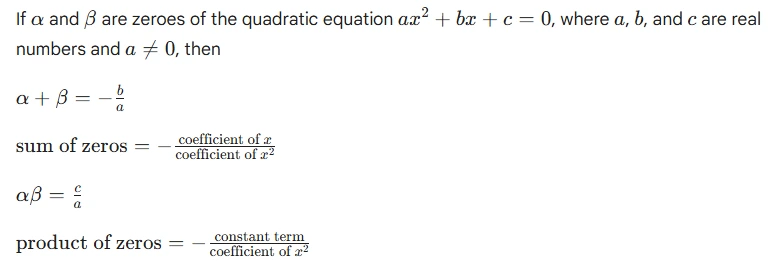
Methods of Solving a Quadratic Equation
The following are the methods that are used to solve quadratic equations:
(i) Factorization; (ii) Completing the Square; (iii) Quadratic Formula
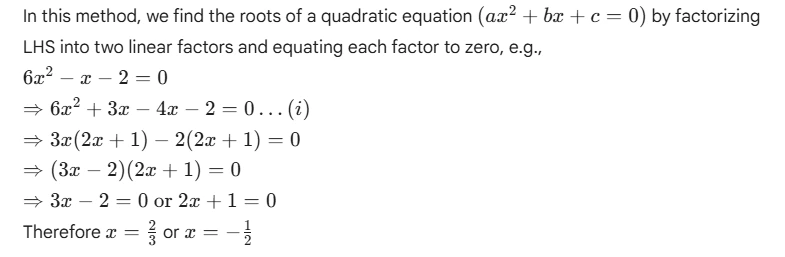
Methods of Factorization
Method of Completing the Square
This method involves transforming the left-hand side of a quadratic equation that is not a perfect square into the sum or difference of a perfect square and a constant by suitably adding and subtracting terms.
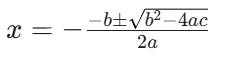
Quadratic Formula
Consider a quadratic equation: ax2 + bx + c = 0.
If b2 – 4ac ≥ 0, then the roots of the above equation are given by:
Conclusion
ToppersSky’s NCERT Solutions for Class 10 Maths Chapter 4 provide a complete and easy-to-understand guide to mastering Quadratic Equations. This chapter plays a crucial role in building a strong base for higher-level mathematics.
Through animated explanations and step-by-step problem solving, students learn how to:
- Solve quadratic equations using different methods
- Apply the quadratic formula correctly
- Analyze the nature of roots using the discriminant
For effective exam preparation, students should focus on understanding the derivation of formulas and practicing various types of problems explained visually on ToppersSky App.
In the previous board exams, 4 to 6 questions were asked from this chapter, highlighting its high weightage. With ToppersSky’s interactive and animation-based learning approach, students can strengthen their conceptual clarity, boost confidence, and improve overall problem-solving skills.

Class 10 Maths Chapter 4 Quadratic Equations Questions and Answers
Exercise 4.1:
This exercise introduces students to quadratic equations and explains the standard form of a quadratic equation in a simple and clear way. Using animated lessons on ToppersSky, students can easily understand how quadratic equations are formed and identified.
The exercise also focuses on solving quadratic equations using the factorisation method. Students will learn:
- How to recognize a quadratic equation
- How to convert a given equation into its standard form
- Different techniques to factorise quadratic equations
The questions in this exercise are arranged from easy to difficult, helping students gradually strengthen their understanding and confidence. With ToppersSky’s visual and animation-based explanations, learners can grasp concepts more effectively and improve their problem-solving skills step by step.
Exercise 4.2:
This exercise focuses on advanced methods of solving quadratic equations, explained in an easy and engaging way through animated learning on ToppersSky. Students will learn important techniques such as completing the square and using the quadratic formula.
The exercise includes a clear step-by-step derivation of the quadratic formula, helping students understand where the formula comes from instead of just memorising it. With visual explanations, learners can see how each step works in practice.
In this section, students will learn:
- How to convert a quadratic equation into standard form by completing the square
- How to apply the quadratic formula to solve different types of quadratic equations
- When and how to choose the correct method for solving a given equation
The questions are designed to make students practise both methods, strengthening their conceptual clarity and problem-solving skills. ToppersSky’s animated explanations make complex steps simple, interactive, and easy to remember, helping students prepare confidently for exams.
Exercise 4.3:
This exercise focuses on the real-life applications of quadratic equations, helping students understand how these concepts are used in everyday situations through visual and animated explanations on ToppersSky. Instead of only solving textbook equations, students learn how to apply quadratic equations to practical problems.
The exercise includes word problems based on real-world scenarios such as:
- The path (trajectory) of a projectile
- Calculating the distance between two ships
- Finding the dimensions of a garden
Students are guided to form equations from given situations, solve them step by step, and interpret the results meaningfully. With the help of animated problem breakdowns, learners can easily visualize the situation, understand the logic behind forming quadratic equations, and apply the correct solving method.
The difficulty level of the problems increases gradually, allowing students to build confidence, improve analytical thinking, and strengthen their problem-solving skills. ToppersSky’s interactive learning approach ensures better understanding and long-term retention, making exam preparation more effective and engaging.
Class 10 Maths Chapter 4 – Quadratic Equations: Practice & Exercises
Exercise 4.1
1. Check whether the following are quadratic equations:
I. (x + 1)2 = 2(x − 3)
Ans: (x + 1)2 = 2(x − 3)
⇒ x2 + 2x + 1 = 2x − 6
⇒ x2 + 7 = 0
Since it is in the form ax2 + bx + c = 0.
Therefore, the given equation is a quadratic equation.
II. x2 − 2x = (−2)(3 − x)
Ans: x2 − 2x = (−2)(3 − x)
⇒ x2 − 2x = −6 + 2x
⇒ x2 − 4x + 6 = 0
Since it is in the form ax2 + bx + c = 0.
Therefore, the given equation is a quadratic equation.
III. (x − 2)(x + 1) = (x − 1)(x + 3)
Ans: (x − 2)(x + 1) = (x − 1)(x + 3)
⇒ x2 − x − 2 = x2 + 2x − 3
⇒ 3x − 1 = 0
Since it is not in the form ax2 + bx + c = 0.
Therefore, the given equation is not a quadratic equation.
IV. (x − 3)(2x + 1) = x(x + 5)
Ans: (x − 3)(2x + 1) = x(x + 5)
⇒ 2x2 − 5x − 3 = x2 + 5x
⇒ x2 − 10x − 3 = 0
Since it is in the form ax2 + bx + c = 0.
Therefore, the given equation is a quadratic equation.
V. (2x − 1)(x − 3) = (x + 5)(x − 1)
Ans: (2x − 1)(x − 3) = (x + 5)(x − 1)
⇒ 2x2 − 7x + 3 = x2 + 4x − 5
⇒ x2 − 11x + 8 = 0
Since it is in the form ax2 + bx + c = 0.
Therefore, the given equation is a quadratic equation.
VI. x2 + 3x + 1 = (x − 2)2
Ans: x2 + 3x + 1 = (x − 2)2
⇒ x2 + 3x + 1 = x2 + 4 − 4x
⇒ 7x − 3 = 0
Since it is not in the form ax2 + bx + c = 0.
Therefore, the given equation is not a quadratic equation.
VII. (x + 2)3 = 2x(x2 − 1)
Ans: (x + 2)3 = 2x(x2 − 1)
⇒ x3 + 8 + 6x2 + 12x = 2x3 − 2x
⇒ x3 − 14x − 6x2 − 8 = 0
Since it is not in the form ax2 + bx + c = 0.
Therefore, the given equation is not a quadratic equation.
VIII. x3 − 4×2 − x + 1 = (x − 2)3
Ans: x3 − 4x2 − x + 1 = (x − 2)3
⇒ x3 − 4x2 − x + 1 = x3 − 6x2 + 12x − 8
⇒ 2x2 − 13x + 9 = 0
Since it is in the form ax2 + bx + c = 0.
Therefore, the given equation is a quadratic equation.
2. Represent the following situations in the form of quadratic equations.
I. The area of a rectangular plot is 528 m2. The length of the plot (in metres) is one more than twice its breadth. We need to find the length and breadth of the plot.
Ans: Let the breadth of the plot be x m.
Thus, length would be:
Length = (2x + 1) m
Hence, Area of rectangle = Length × Breadth
528 = x (2x + 1)
⇒ 2x2 + x − 528 = 0
II. The product of two consecutive positive integers is 306. We need to find the integers.
Ans: Let the consecutive integers be x and x + 1.
Thus, according to the question:
x (x + 1) = 306
⇒ x2 + x − 306 = 0
III. Rohan’s mother is 26 years older than him. The product of their ages (in years) 3 years from now will be 360. We would like to find Rohan’s present age.
Ans: Let Rohan’s age be x.
Hence, his mother’s age is x + 26.
Now, after 3 years:
Rohan’s age will be x + 3.
His mother’s age will be x + 29.
So, according to the question:
(x + 3)(x + 29) = 360
⇒ x2 + 3x + 29x + 87 = 360
⇒ x2 + 32x − 273 = 0
IV. A train travels a distance of 480 km at a uniform speed. If the speed had been 8 km/h less, then it would have taken 3 hours more to cover the same distance. We need to find the speed of the train.
Ans: Let the speed of the train be x km/h.
Thus, time taken to travel 480 km is 480 / x hours.
Now, let the speed of the train be (x − 8) km/h.
Therefore, time taken to travel 480 km is (480 / x + 3) hours.
Hence, speed × time = distance
That is, (x − 8)(480 / x + 3) = 480
⇒ 480 + 3x − 3840 / x − 24 = 480
⇒ 3x − 3840 / x = 24
⇒ 3x2 − 24x − 3840 = 0
⇒ x2 − 8x − 1280 = 0
Exercise 4.2
1. Find the roots of the following quadratic equations using the method of factorisation:
I. x2 − 3x − 10 = 0
Ans: x2 − 3x − 10 = 0
⇒ x2 − 5x + 2x − 10
⇒ x(x − 5) + 2(x − 5)
⇒ (x − 5)(x + 2)
Therefore, roots of this equation are –
x − 5 = 0 or x + 2 = 0
i.e. x = 5 or x = −2
II. 2x2 + x − 6 = 0
Ans: 2x2 + x − 6 = 0
⇒ 2x2 + 4x − 3x − 6
⇒ 2x(x + 2) − 3(x + 2)
⇒ (x + 2)(2x − 3)
Therefore, roots of this equation are –
x + 2 = 0 or 2x − 3 = 0
i.e. x = −2 or x = 3⁄2
III. √2x2 + 7x + 5√2 = 0
Ans: √2x2 + 7x + 5√2 = 0
⇒ √2x2 + 5x + 2x + 5√2
⇒ x(√2x + 5) + √2(√2x + 5)
⇒ (√2x + 5)(x + √2)
Therefore, roots of this equation are –
√2x + 5 = 0 or x + √2 = 0
i.e. x = −5⁄√2 or x = −√2
IV. 2x2 − x + 1⁄8 = 0
Ans: 2x2 − x + 1⁄8 = 0
⇒ 1⁄8 (16x2 − 8x + 1)
⇒ 1⁄8 (4x(4x − 1) − 1(4x − 1))
⇒ 1⁄8 (4x − 1)2
Therefore, roots of this equation are –
4x − 1 = 0 or 4x − 1 = 0
i.e. x = 1⁄4 or x = 1⁄4
V. 100x2 − 20x + 1 = 0
Ans: 100x2 − 20x + 1 = 0
⇒ 100x2 − 10x − 10x + 1
⇒ 10x(10x − 1) − 1(10x − 1)
⇒ (10x − 1)(10x − 1)
Therefore, roots of this equation are –
(10x − 1) = 0 or (10x − 1) = 0
i.e. x = 1⁄10 or x = 1⁄10
2. Solve the problems given in Example 1
I. John and Jivanti together have 45 marbles. Both of them lost 5 marbles each, and the product of the number of marbles they now have is 124. Find out how many marbles they had to start with.
Ans: Let the number of John’s marbles be x.
Thus, the number of Jivanti’s marbles be 45 − x.
According to the question, i.e., after losing 5 marbles:
Number of John’s marbles = x − 5
Number of Jivanti’s marbles = 40 − x
Therefore,
(x − 5)(40 − x) = 124
⇒ x2 − 45x + 324 = 0
⇒ x2 − 36x − 9x + 324 = 0
⇒ x(x − 36) − 9(x − 36) = 0
⇒ (x − 36)(x − 9) = 0
So now,
Case 1: If x − 36 = 0 i.e. x = 36
So, the number of John’s marbles = 36
Thus, the number of Jivanti’s marbles = 9
Case 2: If x − 9 = 0 i.e. x = 9
So, the number of John’s marbles = 9
Thus, the number of Jivanti’s marbles = 36
II. A cottage industry produces a certain number of toys in a day. The cost of production of each toy (in rupees) was found to be 55 minus the number of toys produced in a day. On a particular day, the total cost of production was Rs 750. Find out the number of toys produced on that day.
Ans: Let the number of toys produced be x.
Therefore, cost of production of each toy = Rs (55 − x)
Thus,
(55 − x)x = 750
⇒ x2 − 55x + 750 = 0
⇒ x2 − 25x − 30x + 750 = 0
⇒ x(x − 25) − 30(x − 25) = 0
⇒ (x − 25)(x − 30) = 0
Case 1: If x − 25 = 0 i.e. x = 25
So, the number of toys = 25.
Case 2: If x − 30 = 0 i.e. x = 30
So, the number of toys = 30.
III. Find two numbers whose sum is 27 and product is 182.
Ans: Let the first number be x.
Thus, the second number be 27 − x.
Therefore,
x(27 − x) = 182
⇒ x2 − 27x + 182 = 0
⇒ x2 − 13x − 14x + 182 = 0
⇒ x(x − 13) − 14(x − 13) = 0
⇒ (x − 13)(x − 14) = 0
Case 1: If x − 13 = 0 i.e. x = 13
So, the first number = 13.
Thus, the second number = 14.
Case 2: If x − 14 = 0 i.e. x = 14
So, the first number = 14.
Thus, the second number = 13.
IV. Find two consecutive positive integers, sum of whose squares is 365.
Ans: Let the consecutive positive integers be x and x + 1.
Thus,
x2 + (x + 1)2 = 365
⇒ x2 + x2 + 1 + 2x = 365
⇒ 2×2 + 2x − 364 = 0
⇒ x2 + x − 182 = 0
⇒ x2 + 14x − 13x − 182 = 0
⇒ x(x + 14) − 13(x + 14) = 0
⇒ (x + 14)(x − 13) = 0
Case 1: If x + 14 = 0 i.e. x = −14
This case is rejected because the number is positive.
Case 2: If x − 13 = 0 i.e. x = 13
So, the first number = 13.
Thus, the second number = 14.
Hence, the two consecutive positive integers are 13 and 14.
V. The altitude of a right triangle is 7 cm less than its base. If the hypotenuse is 13 cm, find the other two sides.
Ans: Let the base of the right-angled triangle be x cm.
Its altitude be (x − 7) cm.
Thus, by Pythagoras theorem:
base2 + altitude2 = hypotenuse2
∴ x2 + (x − 7)2 = 132
⇒ x2 + x2 + 49 − 14x = 169
⇒ 2×2 − 14x − 120 = 0
⇒ x2 − 7x − 60 = 0
⇒ x2 + 12x − 5x − 60 = 0
⇒ x(x − 12) + 5(x − 12) = 0
⇒ (x − 12)(x + 5) = 0
Case 1: If x − 12 = 0 i.e. x = 12
So, the base of the right-angled triangle = 12 cm and its altitude = 5 cm.
Case 2: If x + 5 = 0 i.e. x = −5
This case is rejected because side length is always positive.
Hence, the base of the right-angled triangle is 12 cm and its altitude is 5 cm.
VI. A cottage industry produces a certain number of pottery articles in a day. It was observed on a particular day that the cost of production of each article (in rupees) was 3 more than twice the number of articles produced on that day. If the total cost of production on that day was Rs 90, find the number of articles produced and the cost of each article.
Ans: Let the number of articles produced be x.
Therefore, cost of production of each article = Rs (2x + 3)
Thus,
x (2x + 3) = 90
⇒ 2×2 + 3x − 90 = 0
⇒ 2×2 + 15x − 12x − 90 = 0
⇒ x(2x + 15) − 6(2x + 15) = 0
⇒ (2x + 15)(x − 6) = 0
Case 1: If 2x + 15 = 0 i.e. x = −15⁄2
This case is rejected because the number of articles is always positive.
Case 2: If x − 6 = 0 i.e. x = 6
Hence, the number of articles produced = 6.
Therefore, cost of production of each article = Rs 15.
Exercise 4.3
1. Find the nature of the roots of the following quadratic equations. If the real roots exist, find them-
I. 2×2 − 3x + 5 = 0
Ans: For a quadratic equation ax2 + bx + c = 0.
Where Discriminant = b2 − 4ac
Then –
Case 1: If b2 − 4ac > 0 then there will be two distinct real roots.
Case 2: If b2 − 4ac = 0 then there will be two equal real roots.
Case 3: If b2 − 4ac < 0 then there will be no real roots.
Thus, for 2×2 − 3x + 5 = 0.
On comparing this equation with ax2 + bx + c = 0.
So, a = 2, b = −3, c = 5.
Discriminant = (−3)2 − 4(2)(5)
= 9 − 40
= −31
Since Discriminant: b2 − 4ac < 0.
Therefore, there is no real root for the given equation.
II. 3×2 − 4√3x + 4 = 0
Ans: For a quadratic equation ax2 + bx + c = 0.
Where Discriminant = b2 − 4ac
Then –
Case 1: If b2 − 4ac > 0 then there will be two distinct real roots.
Case 2: If b2 − 4ac = 0 then there will be two equal real roots.
Case 3: If b2 − 4ac < 0 then there will be no real roots.
Thus, for 3×2 − 4√3x + 4 = 0.
On comparing this equation with ax2 + bx + c = 0.
So, a = 3, b = −4√3, c = 4.
Discriminant = (−4√3)2 − 4(3)(4)
= 48 − 48
= 0
Since Discriminant: b2 − 4ac = 0.
Therefore, there is equal real root for the given equation and the roots are –
−b / 2a and −b / 2a.
Hence, roots are –
−b / 2a = −(−4√3) / 6
= 4√3 / 6
= 2√3 / 3
Therefore, roots are 2√3 / 3 and 2√3 / 3.
III. 2×2 − 6x + 3 = 0
Ans: For a quadratic equation ax2 + bx + c = 0.
Where Discriminant = b2 − 4ac
Then –
Case 1: If b2 − 4ac > 0 then there will be two distinct real roots.
Case 2: If b2 − 4ac = 0 then there will be two equal real roots.
Case 3: If b2 − 4ac < 0 then there will be no real roots.
Thus, for 2×2 − 6x + 3 = 0.
On comparing this equation with ax2 + bx + c = 0.
So, a = 2, b = −6, c = 3.
Discriminant = (−6)2 − 4(2)(3)
= 36 − 24
= 12
Since Discriminant: b2 − 4ac > 0.
Therefore, distinct real roots exist for the given equation and the roots are –
x = (−b ± √(b2 − 4ac)) / 2a
Hence, roots are –
x = (−(−6) ± √((−6)2 − 4(2)(3))) / 4
= (6 ± √(36 − 24)) / 4
= (6 ± √12) / 4
= (6 ± 2√3) / 4
= (3 ± √3) / 2
Therefore, roots are (3 + √3) / 2 and (3 − √3) / 2.
2. Find the values of k for each of the following quadratic equations, so that they have two equal roots.
I. 2×2 + kx + 3 = 0
Ans: If a quadratic equation ax2 + bx + c = 0 has two equal roots, then its discriminant will be 0, i.e., b2 − 4ac = 0.
So, for 2×2 + kx + 3 = 0.
On comparing this equation with ax2 + bx + c = 0.
So, a = 2, b = k, c = 3.
Discriminant = (k)2 − 4(2)(3)
= k2 − 24
For equal roots –
b2 − 4ac = 0
∴ k2 − 24 = 0
⇒ k2 = 24
⇒ k = √24
⇒ k = ±2√6
II. kx (x − 2) + 6 = 0
Ans: If a quadratic equation ax2 + bx + c = 0 has two equal roots, then its discriminant will be 0, i.e., b2 − 4ac = 0.
So, for kx (x − 2) + 6 = 0
⇒ kx2 − 2kx + 6 = 0
On comparing this equation with ax2 + bx + c = 0.
So, a = k, b = −2k, c = 6.
Discriminant = (−2k)2 − 4(k)(6)
= 4k2 − 24k
For equal roots –
b2 − 4ac = 0
∴ 4k2 − 24k = 0
⇒ 4k(k − 6) = 0
⇒ k = 0 or k = 6
But k cannot be zero. Thus, this equation has two equal roots when k = 6.
3. Is it possible to design a rectangular mango grove whose length is twice its breadth, and the area is 800 m2? If so, find its length and breadth.
Ans: Let the breadth of the mango grove be x.
So, length of mango grove will be 2x.
Hence, area of mango grove is = (2x) × x
= 2×2
So, 2×2 = 800
⇒ x2 = 400
⇒ x2 − 400 = 0
On comparing this equation with ax2 + bx + c = 0.
So, a = 1, b = 0, c = −400.
Discriminant = (0)2 − 4(1)(−400)
= 1600
Since Discriminant: b2 − 4ac > 0.
Therefore, distinct real roots exist for the given equation and the roots are –
x = (−b ± √(b2 − 4ac)) / 2a
Hence, roots are –
x = (−(0) ± √((0)2 − 4(1)(−400))) / 2
= ± √1600 / 2
= ± 40 / 2
= ± 20
Since length cannot be negative.
Therefore, breadth of the mango grove is 20 m.
And length of the mango grove is 2 × 20 m i.e., 40 m.
4. Is the following situation possible? If so, determine their present ages. The sum of the ages of two friends is 20 years. Four years ago, the product of their ages in years was 48.
Ans: Let the age of one friend be x years.
So, age of the other friend will be (20 − x) years.
Thus, four years ago, the age of one friend be (x − 4) years.
And age of the other friend will be (16 − x) years.
Hence, according to question –
(x − 4)(16 − x) = 48
⇒ 16x − 64 − x2 + 4x = 48
⇒ 20x − 112 − x2 = 0
⇒ x2 − 20x + 112 = 0
On comparing this equation with ax2 + bx + c = 0.
So, a = 1, b = −20, c = 112.
Discriminant = (−20)2 − 4(1)(112)
= 400 − 448
= −48
Since Discriminant: b2 − 4ac < 0.
Therefore, there is no real root for the given equation and hence, this situation is not possible.
5. Is it possible to design a rectangular park of perimeter 80 m and area 400 m2? If so, find its length and breadth.
Ans: Let the length of the park be x m and breadth of the park be y m.
Thus, Perimeter = 2(x + y).
Hence, according to question –
2(x + y) = 80
⇒ x + y = 40
⇒ y = 40 − x
Now, Area = x × y.
Substituting value of y,
Area = x(40 − x)
So, according to question –
x(40 − x) = 400
⇒ x2 − 40x + 400 = 0
On comparing this equation with ax2 + bx + c = 0.
So, a = 1, b = −40, c = 400.
Discriminant = (−40)2 − 4(1)(400)
= 1600 − 1600
= 0
Since Discriminant: b2 − 4ac = 0.
Therefore, there are equal real roots for the given equation and hence, this situation is possible.
Hence, roots are –
−b / 2a = −(−40) / 2
= 40 / 2
= 20
Therefore, length of the park is x = 20 m.
And breadth of the park is y = (40 − 20) m i.e., 20 m.
FAQs
1. What is a quadratic equation (Class 10 Maths)?
A quadratic equation is an equation in one variable that has the highest power of 2. Its standard form is ax² + bx + c = 0, where x is the variable, a, b, and c are real numbers, and a ≠ 0.
2. How many methods are there to solve quadratic equations in Chapter 4?
As per the NCERT Class 10 Maths textbook, there are three main methods to solve quadratic equations: factorisation, completing the square, and using the quadratic formula. Each method is suitable for different types of quadratic equations.
3. How do the NCERT Solutions for Quadratic Equations Class 10 help students?
NCERT Solutions for this chapter offer clear, step-by-step answers to all textbook questions. They help students check their solutions, understand difficult word problems, and build a strong foundation for board exam preparation by following the correct problem-solving approach.
4. Are all exercise questions from Chapter 4 covered in these solutions?
Yes, the NCERT Solutions for Class 10 Maths Chapter 4 cover all questions from every exercise in the chapter. This makes them a reliable resource for homework, self-study, and complete exam preparation.
5. Can a quadratic equation have more than two roots?
No, a quadratic equation can have at most two roots because its degree is two. The roots may be real and distinct, real and equal, or not real (imaginary).