
Overview of Class 10 Maths Chapter 6: Triangles
Class 10 Maths Chapter 6 Triangles serves as an essential chapter which teaches students about the properties and theorems of triangles that are commonly tested in CBSE examinations. The chapter covers essential topics which include the Pythagorean Theorem and the principles of triangle congruence and triangle similarity. These concepts form the base for solving many geometry problems.
The NCERT Solutions for Class 10 Maths Chapter 6 provide students with clear step-by-step explanations which show them how to understand theorems and use their applications. The solutions offer guidance for selecting appropriate theorems which match various question types. Students develop better problem-solving abilities through regular practice with NCERT Solutions while they establish a solid base which leads them to success in their Class 10 board exams.
Important Points from NCERT Class 10 Triangles
The NCERT Solutions for Class 10 Maths Chapter 6 Triangles provide a complete explanation of both triangle properties and triangle types. The chapter presents six exercises which each exercise provides a different concept through its organized and clear explanation. The exercises are introduced through the following basic description:
The exercise teaches triangle fundamentals through its definition of triangles and explanation of their basic components and different types and their various angles. The exercise describes congruent triangles through their definition and presents three rules which researchers use to determine triangle congruence.
The study introduces three essential triangle properties which include the exterior angle property and angle sum property and the inequality theorem. The exercise teaches the Pythagorean theorem together with its application in problem-solving situations.
The exercise tests triangle similarity through its assessment. The study presents similarity conditions together with the basic proportionality theorem and the application of triangle similarity to real-world situations.
Conclusion
The NCERT Solutions for Class 10 Maths Chapter 6 Triangles provide complete explanations of triangle concepts. The Pythagoras Theorem and triangle area and trigonometric ratios become easy to learn because they present the material in a simplified manner. Students should focus on understanding the basic properties of triangles and the important theorems covered in this chapter. The students who practice with NCERT Solutions and previous year question papers will achieve better exam results. The past exams included 4 to 5 questions from Chapter 6 Triangles which makes this chapter an essential topic for complete study.
Class 10 Maths Chapter 6 Q&A with Step-by-Step Solutions
Q.1 State whether the following quadrilaterals are similar or not.
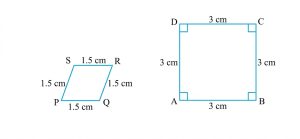
The given quadrilaterals PQRS and ABCD are not similar because their corresponding sides are proportional, that is, 1: 2, but their corresponding angles are not equal.
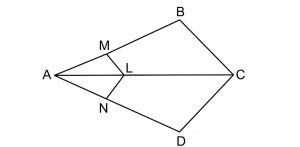
Q.2 In the figure given below, if sides LM ∥ CB and LN ∥ CD, show that AM / AB = AN / AD.
Q.3 In the figure given below, if sides DE ∥ AC and DF ∥ AE, show that BF / FE = BE / EC.
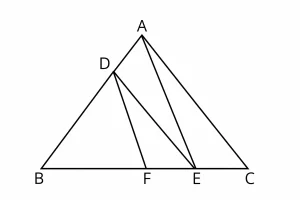
Ans: In ΔABC, DE ∥ AC
∴ BD / DA = BE / EC
(By Basic Proportionality Theorem)
In ΔBAE, DF ∥ AE
∴ BD / DA = BF / FE
(By Basic Proportionality Theorem)
From (i) and (ii), we get
BE / EC = BF / FE
Q.4 In the figure given below, if sides DE ∥ OQ and DF ∥ OR, show that EF ∥ QR.
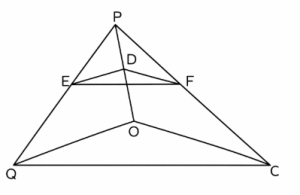
Ans: In ΔPOQ, DE ∥ OQ
∴ PE / EQ = PD / DO …………… (i) By Basic Proportionality Theorem
In ΔPOR, DF ∥ OR
∴ PF / FR = PD / DO …………… (ii) By Basic Proportionality Theorem
From (i) and (ii), we get
PE / EQ = PF / FR
∴ EF ∥ QR (Converse of Basic Proportionality Theorem)
Q.5 In the figure given below, A, B and C are points on OP, OQ and OR respectively such that AB ∥ PQ and AC ∥ PR. Prove that BC ∥ QR.
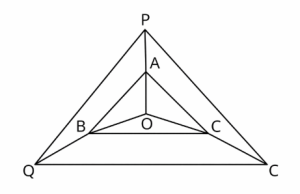
Ans: In ΔPOQ, AB ∥ PQ
∴ OA / OP = OB / OQ …………… (i) By Basic Proportionality Theorem
In ΔPOR, AC ∥ PR
∴ OA / OP = OC / OR …………… (ii) By Basic Proportionality Theorem
From (i) and (ii), we get
OB / OQ = OC / OR
∴ BC ∥ QR
(Converse of Basic Proportionality Theorem)
Q.6 By using Basic proportionality theorem, Show that a line passing through the mid-points of one side of a triangle parallel to another side bisects the third side. (Recall that you have proved it in Class IX).
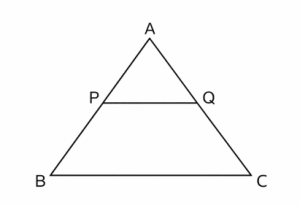
Ans:
Let us assume in the given figure in which PQ is a line segment passing through the mid-point P of line AB, such that PQ ∥ BC.
From Basic Proportionality Theorem, we know that
AQ / QC = AP / PB
AQ / QC = 1
As P is the midpoint of AB, AP = PB
=> AQ = QC
Or
Q is the midpoint of AC
Q.7 By using the Converse of Basic Proportionality Theorem, show that the line joined by the midpoints of any two sides of a triangle is parallel to the third side. (Recall that you have done it in Class IX).
Ans: Let us assume that the given figure in which PQ is a line segment joined by the mid-points P and Q of lines AB and AC respectively.
i.e., AP = PB and AQ = QC
Also it is clear that
AP / PB = 1 and
AQ / QC = 1
∴ AP / PB = AQ / QC
Hence, using Basic Proportionality Theorem, we get
PQ ∥ BC
Q.8 If ABCD is a trapezium where AB ∥ DC and its diagonals intersect each other at the point O. Prove that AO / BO = CO / DO
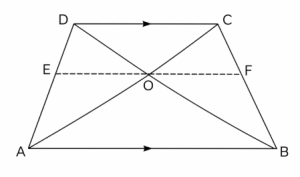
Ans:
Draw a line EF through point O, such that
In ΔADC, EO ∥ CD
Using Basic Proportionality Theorem, we get
AE / ED = AO / OC …………… (i)
In ΔABD, EO ∥ AB
So, using Basic Proportionality Theorem, we get
AE / ED = BO / DO …………… (ii)
From equation (i) and (ii), we get
AO / OC = BO / DO
∴ AO / BO = CO / DO
Q.9 The diagonals of a quadrilateral ABCD intersect each other at the point O such that AO / BO = CO / DO. Prove that ABCD is a trapezium.
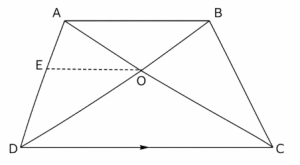
Ans: Let us assume the following figure for the given question.
Draw a line EO ∥ AB
Draw a line EF through point O, such that
In ΔADC, EO ∥ CD
Using Basic Proportionality Theorem, we get
AE / ED = AO / OC …………… (i)
In ΔABD, EO ∥ AB
So, using Basic Proportionality Theorem, we get
AE / ED = BO / DO …………… (ii)
From equation (i) and (ii), we get
AO / OC = BO / DO
∴ AO / BO = CO / DO
Q.10 In the following figure, ΔODC ∼ ΔOBA, ∠BOC = 125° and ∠CDO = 70°. Find ∠DOC, ∠DCO and ∠OAB.
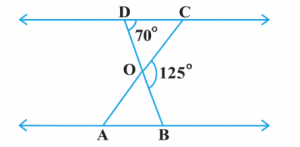
Ans: Given:
ΔODC ∼ ΔOBA
∠BOC = 125°
∠CDO = 70°
To find: ∠DOC, ∠DCO and ∠OAB
Sol: Here, BD is a line,
so, we can apply a linear pair on it.
∠BOC + ∠DOC = 180° (Linear Pair)
125° + ∠DOC = 180°
∠DOC = 180° − 125°
∠DOC = 55°
Now in ΔDCO
∠CDO + ∠DCO + ∠DOC = 180°
70° + ∠DCO + 55° = 180°
125° + ∠DCO = 180°
∠DCO = 180° − 125°
∠DCO = 55°
Now it is given that
ΔODC ∼ ΔOBA
Hence,
∠DCO = ∠OAB
55° = ∠OAB
∠OAB = 55°
(Corresponding angles of similar triangles are equal)

FAQs
1. What topics are covered in NCERT Solutions for Class 10 Maths Chapter 6 Triangles?
NCERT Solutions for Class 10 Maths Chapter 6 (Triangles) cover similarity of triangles, the AA, SSS, and SAS similarity criteria, the Basic Proportionality Theorem, areas of similar triangles, and the Pythagoras Theorem. Solutions provide clear, step-by-step explanations for textbook questions, including geometric proofs and constructions.
2. How does the Basic Proportionality Theorem apply to triangles?
The Basic Proportionality Theorem says that when a line is drawn parallel to one side of a triangle, it divides the other two sides in the same ratio. For example, in △ABC, if DE ∥ BC, then AD / DB = AE / EC.
3. What are the three criteria for triangle similarity in Class 10?
The three criteria for triangle similarity are AA (Angle-Angle), SSS (Side-Side-Side), and SAS (Side-Angle-Side). The criteria provide a method to establish triangle similarity between two triangles without requiring complete measurement of their sides and angles. The ability to solve problems that involve proportional relationships and geometric proofs depends on understanding similarity criteria.
4. How do students apply the Pythagoras theorem in triangle problems?
The Pythagorean theorem states that in a right triangle the square of the hypotenuse equals the sum of the squares of the two other sides. In a right triangle the relationship between sides a and b and hypotenuse c maintains the equation a² + b² = c².
5. How do converse theorems work in triangle geometry for Class 10?
Theorems get reversed through their converse statements which turn original theorems into their opposite forms. The Basic Proportionality Theorem states that a line which divides two sides of a triangle in proportional parts will create a parallel line to the third side.