Overview of Class 10 Maths Chapter 7 Coordinate Geometry
The distance formula allows students to solve coordinate plane problems which they learn about in Class 10 Maths Chapter 7 Coordinate Geometry. Many students find it difficult to plot points correctly and apply formulas, especially in real-life based questions. Through NCERT Solutions, students learn the correct procedures, complete methods, and reasoning processes which they need to answer these problems.
The Class 10 Coordinate Geometry NCERT Solutions explain how to plot points on the Cartesian plane and find the distance between points in a clear, step-by-step manner. The solutions of the problems follow NCERT guidelines because they display formulas and calculations and final answers in a neat and correct manner which matches the requirements of board examinations.
Students who practice NCERT Solutions for Class 10 Maths Chapter 7 will achieve three goals through their practice because they will develop better calculation skills and increased accuracy and confidence. The practice helps students solve coordinate geometry problems, which they need for their school tests and Class 10 board examination.
Important Points from NCERT Class 10 Triangles
Solutions to all the questions in Chapter 7 of the 10th class NCERT Math book, “Coordinate Geometry,” are provided for the following four exercises:
The exercise consists of 10 questions which teach students about the Cartesian Plane first before they learn how to plot points and determine point coordinates. Students learn how to identify the quadrants of the plane and the axes (x-axis and y-axis). The exercise contains questions which require students to determine point coordinates and plot points on the plane and identify which quadrant a point occupies.
The exercise consists of 10 questions which teach students how to use the distance formula to calculate distances between two points on a Cartesian Plane. The lesson teaches students how to use the midpoint formula to determine the midpoint of a line segment. The exercise contains questions which require students to find distances between two points and determine line segment midpoints and use distance and midpoint formulas to complete assignments.
What is Coordinate Geometry
Coordinate Geometry defines mathematical methods which allow us to precisely find any point through the use of two numerical measurements. The field of coordinate geometry combines elements from geometry and algebra to create solutions for various mathematical challenges. The system enables users to calculate distances between two locations based on their specified location coordinates. The system enables users to determine the location which divides a line segment between two specified points according to a given proportion.
Coordinate geometry is also said to be the study of graphs. Graphs serve as visual tools which display our collected information. The data can be represented through various methods which include bar graphs and histograms and line graphs.
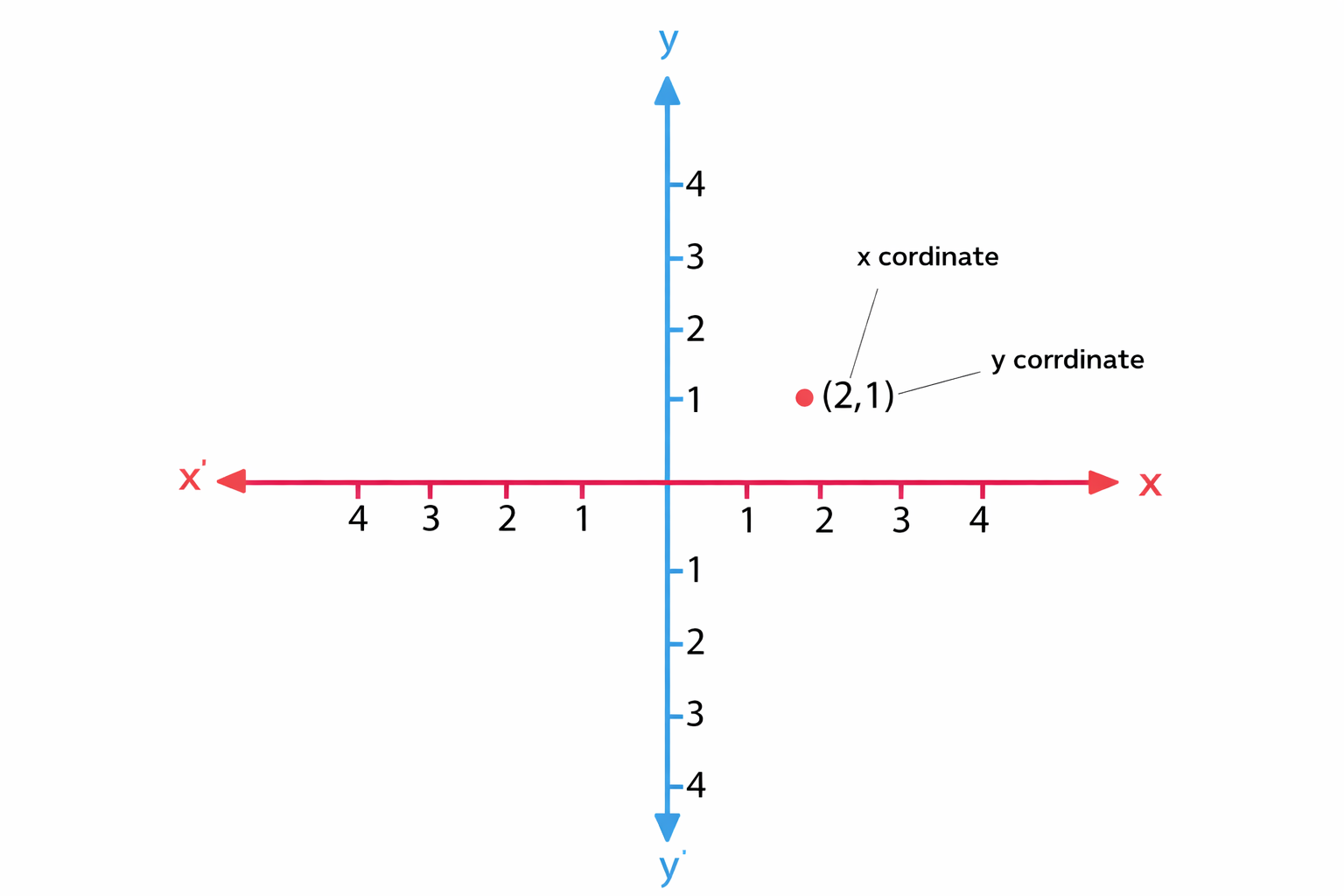
Key Terms in Coordinate Geometry
In this chapter, some important terms of coordinate geometry must be understood by students, a fair amount of which has been vividly discussed in this chapter.
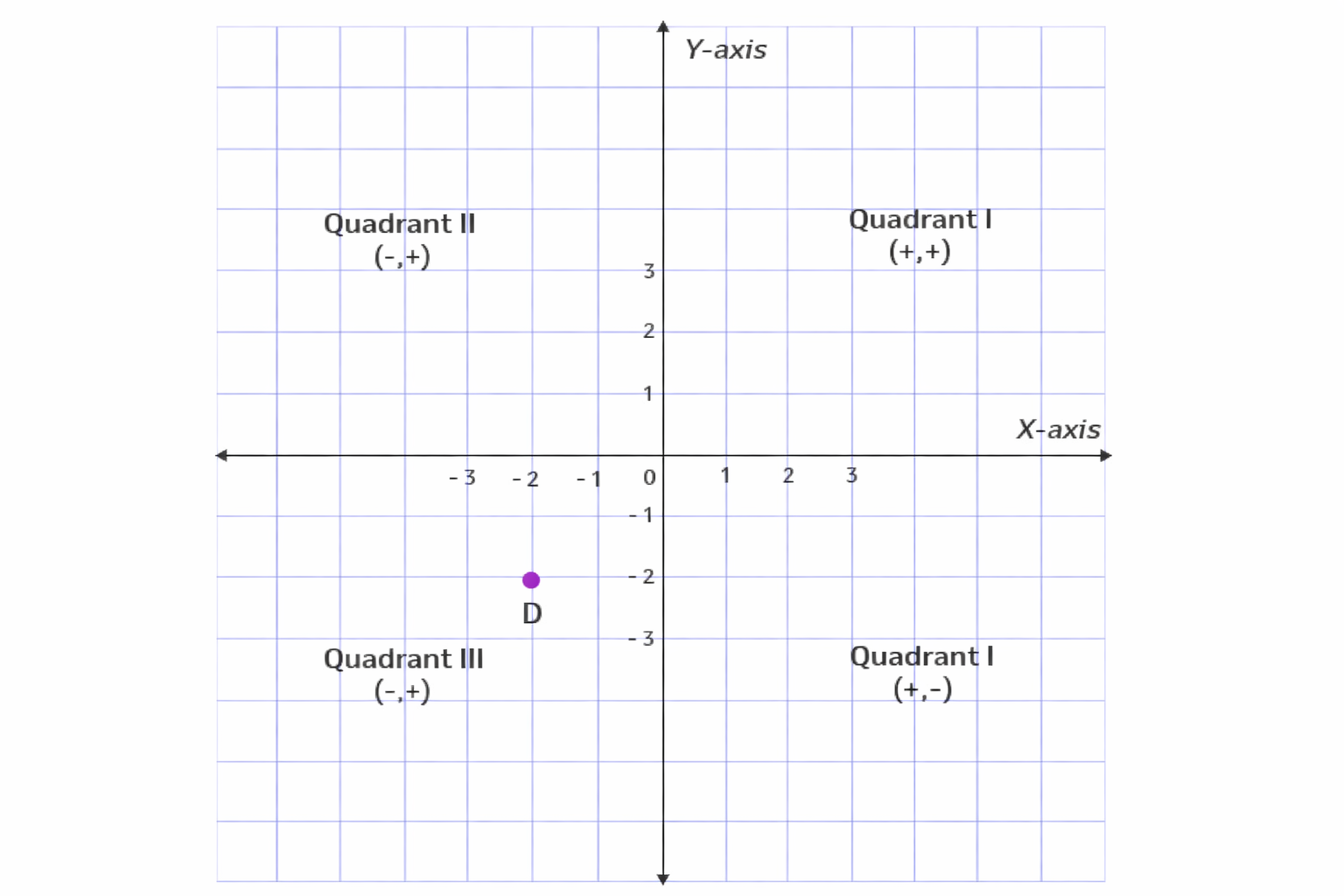
From this figure, we can understand some important terms used in coordinate geometry formulas.
- Coordinate Axes: In the figure above, OX is called the X-axis and OY is called the Y-axis. Together, they are referred to as the coordinate axes.
- Origin: The point where the axes intersect is called the origin, denoted by O.
- X-coordinate: The abscissa of a point is its distance from the Y-axis.
- Ordinate: The distance of a point from the X-axis is called its ordinate.
- Coordinate of the Origin: The origin is at zero distance from both axes, so its coordinates are (0, 0).
- Quadrant: The axes divide the plane into four parts, called quadrants.
Each quadrant is one-fourth of the plane formed by the coordinate axes.
The plane is known as the coordinate plane or XY-plane, and the axes are called the coordinate axes.
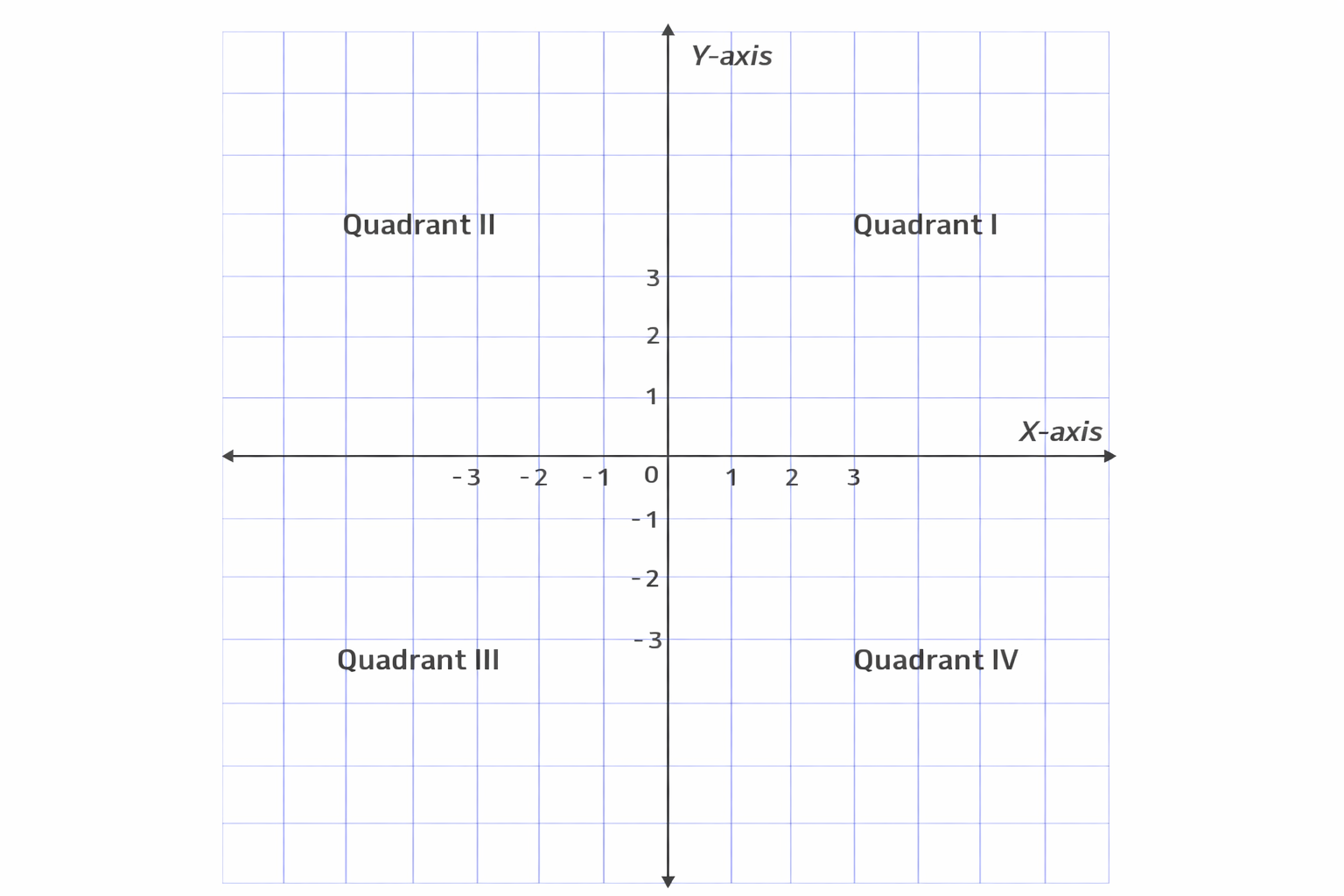
In the first quadrant, both the coordinates are positive.
The second quadrant, the y-coordinate is positive and x-coordinate is negative.
In the third quadrant, both the coordinates are negative.
In the fourth quadrant, the y-coordinate is negative and the x-coordinate is positive.
Distance Formula
In Class 10 Maths Chapter 7, students learn about the distance formula, which is used to find the distance between two points on a coordinate plane. When the coordinates of both points are given, the distance between them can be calculated easily using this formula.
Distance between two points O(x1, y1) and B(x2, y2) = OB = √[(x2 − x1)2 + (y2 − y1)2]
Section Formula
Section formula helps us in finding the coordinates of the point dividing the line in the ratio m:n.
If P is the point dividing the line AB in the ratio m:n where coordinates of A(x1, y1) and B(x2, y2).
The coordinates of P will be ( mx2 + nx1 / (m + n), my2 + ny1 / (m + n) )
Area of Triangle
It will let us find the area of any triangle in terms of coordinates of its vertices. This formula will also be used in finding the area of quadrilaterals.
Area of a Triangle = ½ |x1(y2−y3)+x2(y3–y1)+x3(y1–y2)|
All the essential formulas of Coordinate Geometry play an important role in solving both geometry and algebra-based problems effectively. Students who understand these formulas will gain the ability to answer questions with both confidence and precise results.
Chapter 7 – Coordinate Geometry (Class 10 Maths) provides a complete list of important formulas required to solve all types of coordinate geometry problems. ToppersSky’s animated explanations help students learn when to use each formula because those explanations provide visual demonstrations of the formulas.
Conclusion
ToppersSky provides NCERT Solutions which deliver complete mathematical solutions for Class 10 students who study Chapter 7 Coordinate Geometry. The students will develop their understanding of coordinate geometry through three essential skills which include plotting points and measuring distances and learning about slopes. The step-by-step animated explanations available on ToppersSky make complex concepts easier to visualize and understand, while also strengthening problem-solving skills. This chapter is essential for two reasons: it serves as a requirement for board exams and it builds the essential skills needed to study advanced mathematical subjects.
The field of coordinate geometry provides students with essential knowledge which they use in multiple real-world applications that include computer graphics and engineering and architecture. The board exams from previous years have shown that this chapter contains 5 to 6 questions which demonstrate its critical role in preparing for exams.
Class 10 Maths Chapter 7 Q&A with Step-by-Step Solutions
Q.1 Find the distance between the points (0, 0) and (36, 15). Can you now find the distance between the two towns A and B discussed in Section 7.2?
Ans. Given that,
Let the points be (0, 0) and (36, 15).
To find the distance between the points (0, 0) and (36, 15).
Distance between two points is given by the Distance formula =
√[(x₁ − x₂)² + (y₁ − y₂)²]
Here,
x₁ = 0
x₂ = 36
y₁ = 0
y₂ = 15
Thus, the distance between (0, 0) and (36, 15) is given by,
d = √[(0 − 36)² + (0 − 15)²]
= √[(−36)² + (−15)²]
= √[1296 + 225]
= √1521
= 39
Yes, it is possible to find the distance between the given towns A and B. The positions of the towns are A (0, 0) and B (36, 15). It can be calculated as shown above.
∴ The distance between A (0, 0) and B (36, 15) is 39 km.
Q.2 Determine if the points (1, 5), (2, 3) and (−2, −11) are collinear.
Ans. Given that,
Let the three points be (1, 5), (2, 3) and (−2, −11).
To determine if the given points are collinear.
Let A (1, 5), B (2, 3), and C (−2, −11) be the vertices of the given triangle.
The distance between any two points is given by the Distance formula,
d = √[(x₁ − x₂)² + (y₁ − y₂)²]
The distance between the points A (1, 5) and B (2, 3):
x₁ = 1
x₂ = 2
y₁ = 5
y₂ = 3
AB = √[(1 − 2)² + (5 − 3)²]
= √[(-1)² + (2)²]
= √[1 + 4]
= √5
Find the distance between the points B (2, 3) and C (−2, −11):
x₁ = 2
x₂ = −2
y₁ = 3
y₂ = −11
BC = √[(2 − (−2))² + (3 − (−11))²]
= √[(4)² + (14)²]
= √[16 + 196]
= √212
To find the distance between the points A (1, 5) and C (−2, −11):
x₁ = 1
x₂ = −2
y₁ = 5
y₂ = −11
CA = √[(1 − (−2))² + (5 − (−11))²]
= √[(3)² + (16)²]
= √[9 + 256]
= √265
Since AB + AC ≠ BC, AB + BC ≠ AC, and AC + BC ≠ AB.
∴ The points A (1, 5), B (2, 3), and C (−2, −11) are not collinear.
Q.3 Check whether (5, −2), (6, 4) and (7, −2) are the vertices of an isosceles triangle.
Ans. Given that,
Let the three points be (5, −2), (6, 4) and (7, −2), which are the vertices of the triangle.
To determine if the given points are the vertices of an isosceles triangle.
Let A (5, −2), B (6, 4), and C (7, −2) be the vertices of the given triangle.
The distance between any two points is given by the Distance formula,
d = √[(x₁ − x₂)² + (y₁ − y₂)²]
To find the distance between the points A (5, −2) and B (6, 4):
x₁ = 5
x₂ = 6
y₁ = −2
y₂ = 4
AB = √[(5 − 6)² + (−2 − 4)²]
= √[(-1)² + (−6)²]
= √[1 + 36]
= √37
To find the distance between the points B (6, 4) and C (7, −2):
x₁ = 6
x₂ = 7
y₁ = 4
y₂ = −2
BC = √[(6 − 7)² + (4 − (−2))²]
= √[(-1)² + (6)²]
= √[1 + 36]
= √37
To find the distance between the points A (5, −2) and C (7, −2):
x₁ = 5
x₂ = 7
y₁ = −2
y₂ = −2
CA = √[(5 − 7)² + (−2 − (−2))²]
= √[(−2)² + (0)²]
= √[4 + 0]
= 2
We can conclude that AB = BC.
Since two sides of the triangle are equal in length, △ABC is an isosceles triangle.
Q.4 In a classroom, 4 friends are seated at the points A, B, C and D as shown in the following figure. Champa and Chameli walk into the class and after observing for a few minutes, Champa asks Chameli, “Don’t you think ABCD is a square?” Chameli disagrees. Using the distance formula, find which of them is correct.
Ans: Given that,
Four friends are seated at the points A, B, C and D.
To find:
Whether they form a square together by using the distance formula.
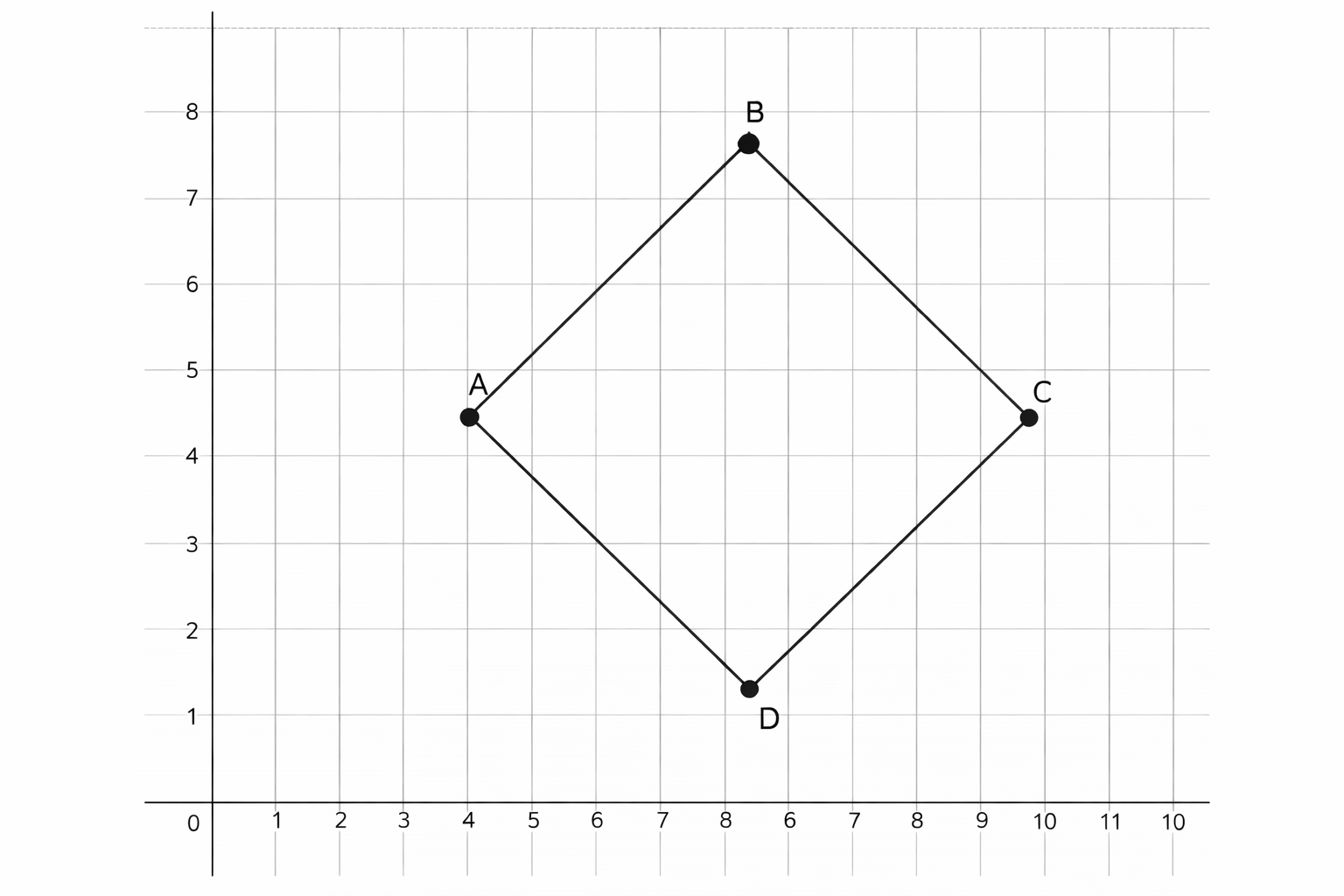
From the figure, we observe the points A (3, 4), B (6, 7), C (9, 4) and D (6, 1) are the positions of the four students.
The distance between any two points is given by the Distance formula,
d = √((x1 − x2)² + (y1 − y2)²)
To find the distance between the points A (3, 4) and B (6, 7)
x1 = 3
x2 = 6
y1 = 4
y2 = 7
AB = √((3 − 6)² + (4 − 7)²)
= √((-3)² + (-3)²)
= √(9 + 9)
= √18
= 3√2
Find the distance between the points B (6, 7) and C (9, 4)
x1 = 6
x2 = 9
y1 = 7
y2 = 4
BC = √((6 − 9)² + (7 − 4)²)
= √((-3)² + (3)²)
= √(9 + 9)
= √18
= 3√2</p>
To find the distance between the points C (9, 4) and D (6, 1)
x1 = 9
x2 = 6
y1 = 4
= 2 (lb + bh + lh)
= 2 (80) CD = √(9 − 6)² + (4 − 1)²
∴ = √9 + 9
= √18
=
3√2</p>
To find the distance between the points A (3, 4) and D (6, 1)
x₁ = 3
x₂ = 6
y₁ = 4
y₂ = 1
AB = √(3 − 6)² + (4 − 1)²
= √(−3)² + (3)²
= √9 + 9
= √18
=
3√2
Since all sides of the squares are equal, now find the distance between the diagonals AC and BD.
To find the distance between the points A (3, 4) and C (9, 4)
x₁ = 3
x₂ = 9
y₁ = 4
y₂ = 4
Diagonal AC = √(3 − 9)² + (4 − 4)²
= √(−6)² + (0)²
= √36 + 0
= 6
Diagonal: To find the distance between the points B (6, 7) and D (6, 1)
x₁ = 6
x₂ = 6
y₁ = 7
y₂ = 1
Diagonal BD = √(6 − 6)² + (7 − 1)²
= √(0)² + (6)²
= √0 + 36
= 6
Thus, the four sides and DA are equal and its diagonals AC and BD are also equal.
∴ ABCD form a square and hence Champa was correct.
Q.5 Find the point on the x-axis which is equidistant from (2, −5) and (−2, 9).
Ans: Given that,
(2, −5)
(−2, 9)
To find,
The point that is equidistant from the points (2, −5) and (−2, 9).
Let us consider the points as A (2, −5) and B (−2, 9) and to find the equidistant point P.
Since the point is on the x-axis, the coordinates of the required point is of the form P (x, 0).
The distance between any two points is given by the Distance formula,
d = √((x₁ − x₂)² + (y₁ − y₂)²)
To find the distance between the points P (x, 0) and A (2, −5)
x₁ = x
x₂ = 2
y₁ = 0
y₂ = −5
PA = √((x − 2)² + (0 − (−5))²)
= √((x − 2)² + 25)
To find the distance between the points A (x, 0) and B (−2, 9)
x₁ = x
x₂ = −2
y₁ = 0
y₂ = 9
PB = √((x − (−2))² + (0 − 9)²)
= √((x + 2)² + (−9)²)
= √((x + 2)² + 81)
Since the distance are equal in measure,
PA = PB
√((x − 2)² + 25) = √((x + 2)² + 81)
Taking square on both sides,
(x − 2)² + 25 = (x + 2)² + 81
By solving, we get,
x² + 4 − 4x + 25 = x² + 4 + 4x + 81
8x = −56
x = −7
The coordinate is (−7, 0).
∴ The point that is equidistant from (2, −5) and (−2, 9) is (−7, 0).
Q.6 Find the values of y for which the distance between the points P (2, −3) and Q (10, y) is 10 units.
Ans: Given that,
P (2, −3)
Q (10, y)
The distance between these points is 10 units.
The distance between any two points is given by the Distance formula,
d = √((x₁ − x₂)² + (y₁ − y₂)²)
To find the distance between the points P (2, −3) and Q (10, y)
x₁ = 2
x₂ = 10
y₁ = −3
y₂ = y
PQ = √((10 − 2)² + (y − (−3))²)
= √((−8)² + (y + 3)²)
= √(64 + (y + 3)²)
Since the distance between them is 10 units,
√(64 + (y + 3)²) = 10
Squaring on both sides, we get,
64 + (y + 3)² = 100
(y + 3)² = 36
y + 3 = ±6
So, y + 3 = 6
y = 3
And, y + 3 = −6
y = −9
∴ The possible values of y are y = 3 or y = −9.

Q.7 If Q (0, 1) is equidistant from P (5, −3) and R (x, 6), find the values of x. Also find the distance of QR and PR.
Ans: Given that,
Q (0, 1)
P (5, −3)
R (x, 6)
To find,
• The values of x
• The distance of QR and PR
Q is equidistant between P and R.
So, PQ = QR
The distance between any two points is given by the Distance formula,
d = √(x₁ − x₂)² + (y₁ − y₂)²
√(5 − 0)² + (−3 − 1)² = √(0 − x)² + (1 − 6)²
√(5)² + (−4)² = √(−x)² + (−5)²
√25 + 16 = √(x² + 25)
Squaring on both sides, we get,
41 = x² + 25
x² = 16
x = ±4
Thus the point R is R (4, 6) or (−4, 6).
To find the distance PR and QR
Case (1): When the point is R (4, 6)
Distance between the point P (5, −3) and R (4, 6) is,
PR = √(5 − 4)² + (−3 − 6)²
= √(1)² + (−9)²
= √(1 + 81)
= √82
Distance between the point Q (0, 1) and R (4, 6),
QR = √(0 − 4)² + (1 − 6)²
= √(−4)² + (−5)²
= √(16 + 25)
= √41
Case (2): When the point is R (−4, 6)
Distance between the point P (5, −3) and R (−4, 6),
PR = √(5 − (−4))² + (−3 − 6)²
= √(9)² + (−9)²
= √(81 + 81)
= √162
= 9√2
Distance between the point Q (0, 1) and R (−4, 6),
QR = √(0 − (−4))² + (1 − 6)²
= √(4)² + (−5)²
= √(16 + 25)
= √41
Q.8 Find a relation between x and y such that the point (x, y) is equidistant from the points (3, 6) and (−3, 4).
Ans: Given that,
(x, y) is equidistant from (3, 6) and (−3, 4)
To find,
The relation between x and y
Let P (x, y) is equidistant from A (3, 6) and B (−3, 4)
Since they are equidistant,
PA = PB
√(x − 3)² + (y − 6)² = √(x − (−3))² + (y − 4)²
√(x − 3)² + (y − 6)² = √(x + 3)² + (y − 4)²
Squaring on both sides, we get,
(x − 3)² + (y − 6)² = (x + 3)² + (y − 4)²
x² − 6x + 9 + y² − 12y + 36 = x² + 6x + 9 + y² − 8y + 16
36 − 16 = 12x + 4y
3x + y = 5
3x + y − 5 = 0
∴ The relation between x and y is given by
3x + y − 5 = 0
Q.9 Find the coordinates of the point which divides the join of (−1, 7) and (4, −3) in the ratio 2 : 3.
Ans: Given that,
The points A (−1, 7) and B (4, −3)
Ratio m : n = 2 : 3
To find,
The coordinates
Let P (x, y) be the required coordinate
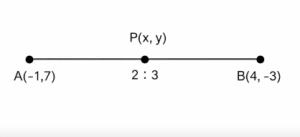
By section formula,
P (x, y) = [ (mx₂ + nx₁) / (m + n), (my₂ + ny₁) / (m + n) ]
P (x, y) = [ (2(4) + 3(-1)) / (2 + 3), (2(-3) + 3(7)) / (2 + 3) ]
= [ (8 – 3) / 5 , (-6 + 21) / 5 ]
= [ 5 / 5 , 15 / 5 ]
= (1, 3)
∴ The coordinates of P is P (1, 3).
Q.10 Find the coordinates of the point of trisection of the line segment joining (4, -1) and (-2, -3).
Ans: Given that,
The line segment joining (4, -1) and (-2, -3)
To find,
The coordinates of the point
Let the line segment joining the points be A (4, -1) and B (-2, -3)
Let P (x₁, y₁) and Q (x₂, y₂) are the points of trisection of the line segment joining the points
AP = PQ = QB
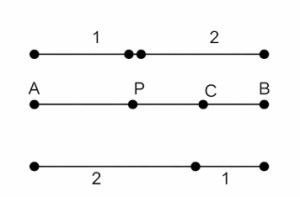
From the diagram, the point P divides AB internally in the ratio of 1 : 2
Hence m : n = 1 : 2
By section formula,
P (x, y) = [ (mx₂ + nx₁) / (m + n), (my₂ + ny₁) / (m + n) ]
P (x₁, y₁) = [ (1(−2) + 2(4)) / (1 + 2), (1(−3) + 2(−1)) / (1 + 2) ]
= [ (−2 + 8) / 3 , (−3 − 2) / 3 ]
= [ 6 / 3 , −5 / 3 ]
= (2, −5/3)
∴ The coordinates of P is P (2, −5/3).
From the diagram, the point Q divides AB internally in the ratio of 2 : 1
Hence m : n = 2 : 1
By section formula,
Q (x₂, y₂) = [ (mx₂ + nx₁) / (m + n), (my₂ + ny₁) / (m + n) ]
Q (x₂, y₂) = [ (2(−2) + 1(4)) / (2 + 1), (2(−3) + 1(−1)) / (2 + 1) ]
= [ (−4 + 4) / 3 , (−6 − 1) / 3 ]
= [ 0 , −7 / 3 ]
∴ The coordinates of Q is Q (0, −7/3).
FAQs
Q.1 What is explained in Class 10 Maths Chapter 7 Coordinate Geometry NCERT Solutions?
Class 10 Maths Chapter 7 – Coordinate Geometry NCERT Solutions by ToppersSky explain how algebra and geometry are connected through the use of coordinates. Students learn how to apply coordinate formulas to solve problems related to:
- Distance between two points
- Section formula
- Area of a triangle
With the help of animated step-by-step explanations, students can clearly understand how these formulas work and how to apply them accurately in exams.
Q.2 What skills do students develop by solving NCERT Solutions for Class 10 Maths Chapter 7 Coordinate Geometry?
By solving the NCERT Solutions for Class 10 Maths Chapter 7 – Coordinate Geometry, students improve their calculation accuracy, strengthen their logical reasoning abilities, and gain a better understanding of how to interpret and apply coordinates in problem-solving.
Q.3 How are step-by-step methods shown in NCERT Solutions for Class 10 Maths Chapter 7 Coordinate Geometry useful?
The step-by-step methods provided in NCERT Solutions for Class 10 Maths Chapter 7 – Coordinate Geometry help students understand the correct approach to solving problems and present their answers clearly in exams, increasing their chances of scoring full marks.
Q.4 How should beginners start practising Class 10 Maths Chapter 7 Coordinate Geometry using NCERT Solutions?
Beginners should begin Class 10 Maths Chapter 7 – Coordinate Geometry by first learning and understanding the important formulas. After that, they should practice solving the NCERT questions step by step to build clarity and confidence.
Q.5 What makes the NCERT Solutions for Class 10 Maths Chapter 7 Coordinate Geometry reliable for exams?
NCERT Solutions for Class 10 Maths Chapter 7 – Coordinate Geometry by ToppersSky are reliable for exams because they follow the exact NCERT pattern, step-wise marking scheme, and proper answer format expected by board examiners.
Each solution is presented in a clear, structured, and step-by-step manner, ensuring that students learn how to write answers correctly in exams. With the help of animated explanations, students not only understand the concepts but also learn the proper method of presentation, which is essential for scoring full marks.