
Overview of Class 10 Maths Chapter 8 Introduction to Trigonometry
NCERT Solutions for Class 10 Maths Chapter 8 – Introduction to Trigonometry by ToppersSky provide a clear and engaging understanding of this important mathematical concept. Trigonometry is a fundamental branch of mathematics that studies the relationship between the angles and sides of triangles. In this chapter, students learn the core concepts of trigonometric ratios, complementary angles, trigonometric identities, and their practical applications in solving problems related to heights and distances. At ToppersSky, these solutions are explained through interactive animations and step-by-step visual learning, making complex trigonometric concepts easy to understand. This approach helps students build a strong conceptual foundation, improve problem-solving skills, and confidently prepare for advanced mathematical topics in higher classes.
Important Points from NCERT Class 10 Introduction to Trigonometry
- Trigonometry comes from Greek words meaning “three sides” and “measure.”
- The article covers the basics of Trigonometry and Trigonometric Ratios.
- This chapter focuses on trigonometric ratios for acute angles (less than 90 degrees).
- You will learn how to calculate these ratios for specific angles.
- A table for the values of angles (0 Degree, 30 Degree, 45 Degree, 60 Degree, 90 Degree) with their corresponding trigonometric functions(sin, cos, tan, cot, sec, cosec) is provided.
- There are relationships between these ratios, which you will explore (trigonometric identities).
- Also, This article contains chapter notes, formulas, exercises links, and important questions for chapter 8 -Introduction to Trigonometry.
- There are four exercises (27 fully solved questions) in class 10th maths chapter 8 Introduction to Trigonometry.
Exercise 8.1 – This exercise introduces students to the fundamental trigonometric ratios: sine, cosine, and tangent, along with their reciprocal functions (cosecant, secant, and cotangent). Students learn how to determine the values of these ratios for acute angles in a right-angled triangle. It also explains basic trigonometric identities, which describe important relationships between different trigonometric functions.
Exercise 8.2 – In this exercise, students apply trigonometric ratios to practical, real-life situations. They learn how to calculate the height and distance of objects using angles of elevation and depression. The exercise also reinforces the use of the Pythagorean theorem in solving problems related to right-angled triangles.
Exercise 8.3 – This exercise focuses on solving trigonometric equations. Students use previously learned identities and ratios to find solutions to different equations. They are also introduced to the concept of the general solution of trigonometric equations and learn how to determine the period of various trigonometric functions.
NCERT Solutions for Class 10 Maths Chapter 8 solutions
Introduction to Trigonometry
Trigonometry is all about triangles. It is all about right-angled triangles, triangles with one angle equal to 90 degrees, to be more precise. It’s a method that helps us find a triangle’s missing angles and missing sides. The ‘trigono’ word means triangle and the ‘metry’ word means to measure.
Trigonometric Ratios
In ΔABC, right-angled at ∠B, the trigonometric ratios of the ∠A are as follows:
- sin A=opposite side/hypotenuse=BC/AC
- cos A=adjacent side/hypotenuse=AB/AC
- tan A=opposite side/adjacent side=BC/AB
- cosec A=hypotenuse/opposite side=AC/BC
- sec A=hypotenuse/adjacent side=AC/AB
- cot A=adjacent side/opposite side=AB/BC
Standard Values of Trigonometric Ratios
| ∠A | 0° | 30° | 45° | 60° | 90° |
|---|---|---|---|---|---|
| sin A | 0 | 1/2 | 1/√2 | √3/2 | 1 |
| cos A | 1 | √3/2 | 1/√2 | 1/2 | 0 |
| tan A | 0 | 1/√3 | 1 | √3 | Not Defined |
| cosec A | Not Defined | 2 | √2 | 2/√3 | 1 |
| sec A | 1 | 2/√3 | √2 | 2 | Not Defined |
| cot A | Not Defined | √3 | 1 | 1/√3 | 0 |
Trigonometric Identities: Trigonometric identities are essential tools in trigonometry for simplifying expressions, solving equations, and proving other mathematical statements. There are three Pythagorean trigonometric identities in trigonometry that are based on the right-triangle theorem or Pythagoras theorem.
sin2(x) + cos2(x) = 1
1 + tan2(x) = sec2(x)
cosec2(x) = 1 + cot2(x)
Conclusion
NCERT Solutions for Class 10 Maths – Introduction to Trigonometry by ToppersSky provide a complete and easy-to-understand explanation of this fundamental chapter. By focusing on important concepts such as trigonometric ratios, Pythagorean identities, and solving triangles, students can build a strong base in trigonometry. At ToppersSky, concepts are explained through step-by-step animated lessons, making abstract ideas more visual, interactive, and easier to grasp.
Carefully going through the structured solutions helps students improve conceptual clarity and strengthen their problem-solving techniques. Trigonometry is extremely important as it forms the foundation for advanced mathematics and has practical applications in fields like engineering, physics, architecture, and navigation.
In previous years’ board examinations, around 5–6 questions have typically been asked from this chapter, making it a high-weightage and scoring topic for Class 10 students.
Class 10 Maths Chapter 7 Q&A with Step-by-Step Solutions
Q.1 If tan (A + B) = √3 and tan (A − B) = 1/√3, 0° < A + B ≤ 90°. Find A and B.
Ans: Given that tan (A + B) = √3 and tan (A − B) = 1/√3.
From the trigonometric ratio table we know that:
tan 60° = √3 and tan 30° = 1/√3.
Then we get:
tan (A + B) = √3
⇒ tan (A + B) = tan 60°
⇒ A + B = 60° ……(1)
Also, tan (A − B) = 1/√3
⇒ tan (A − B) = tan 30°
⇒ A − B = 30° ……(2)
Adding eq. (1) and (2), we get:
2A = 90°
∴ A = 45°
Substitute the obtained value in eq. (1), we get:
45° + B = 60°
⇒ B = 60° − 45°
∴ B = 15°
Therefore, the values of A and B are 45° and 15° respectively.
Q.2 Write all the other trigonometric ratios of ∠A in terms of sec A.
Ans: We know that cos A = 1 / sec A.
∴ cos A = 1 / sec A
For a right triangle we have an identity sin²A + cos²A = 1.
Let us consider the above identity, we get
sin²A + cos²A = 1
Now, we know that cos A = 1 / sec A, we get
⇒ sin²A = 1 − cos²A
⇒ sin²A = 1 − 1 / sec²A
⇒ sin A = √(1 − (1 / sec A)²)
∴ sin A = √(sec²A − 1) / sec A
Also, we will use the identity sec²A = 1 + tan²A, we get
tan²A = sec²A − 1
∴ tan A = √(sec²A − 1)
Now, we know that cot A = cos A / sin A, we get
⇒ cot A = (1 / sec A) / (√(sec²A − 1) / sec A)
⇒ cot A = 1 / √(sec²A − 1)
We know that cosec A = 1 / sin A, we get
∴ cosec A = sec A / √(sec²A − 1)
Q.3 In ▵ABC right angled at B, AB = 24 cm, BC = 7 cm. Determine
- (i) sin A, cos A
Ans: Given that in the right-angled triangle ▵ABC, AB = 24 cm, BC = 7 cm.
Let us draw a right triangle ▵ABC, also AB = 24 cm, BC = 7 cm. We get
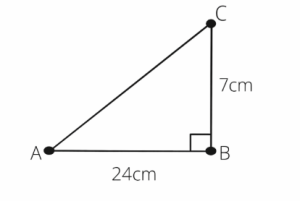
We have to find sin A, cos A.
We know that for right triangle:
sin θ = opposite side/hypotenuse and cos θ = adjacent side/hypotenuse
Now, we need to apply the Pythagoras theorem to find the measure of hypotenuse.
In ▵ABC, by Pythagoras theorem,
(hypotenuse)2 = (base)2 + (perpendicular)2
Here, AB = 24 cm, BC = 7 cm
We get
(AC)2 = (AB)2 + (BC)2
(AC)2 = (24)2 + (7)2
(AC)2 = 576 + 49
(AC)2 = 625 cm2
AC = 25 cm
Now,
sin θ = opposite side/hypotenuse
∴ sin A = BC / AC
sin A = 7 / 25
cos θ = adjacent side/hypotenuse
∴ cos A = AB / AC
cos A = 24 / 25
Q.4 In the given figure find tan P − cot R.
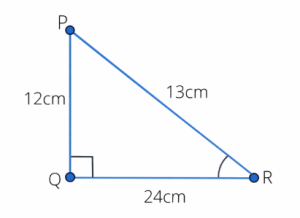
Ans: Given in the figure,
PQ = 12 cm
PR = 13 cm
We know that for right triangle:
tan θ = opposite side/adjacent side and cot θ = adjacent side/opposite side
Now, we need to apply the Pythagoras theorem to find the measure of adjacent side/base.
In ▵PQR, by Pythagoras theorem,
(hypotenuse)2 = (base)2 + (perpendicular)2
We get
(PR)2 = (PQ)2 + (QR)2
(13)2 = (12)2 + (QR)2
169 = 144 + (QR)2
(QR)2 = 169 − 144
(QR)2 = 25 cm2
QR = 5 cm
Now,
tan P = opposite side/adjacent side
tan P = QR / PQ
∴ tan P = 5 / 12
cot R = adjacent side/opposite side
cot R = QR / PQ
∴ cot R = 5 / 12
tan P − cot R = 5/12 − 5/12
∴ tan P − cot R = 0
Q.5 If sin A = 3/4, calculate cos A and tan A.
Ans: Let us consider a right-angled triangle ▵ABC. We get
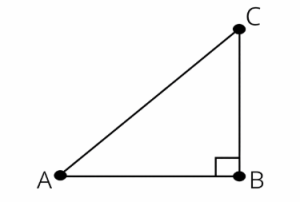
Given that sin A = 3/4.
We know that sin θ = opposite side/hypotenuse.
From the above figure, we get
sin A = BC / AC
Therefore, we get
BC = 3 and
AC = 4
Now, we have to find the values of cos A and tan A.
We know that cos θ = adjacent side/hypotenuse and tan θ = opposite side/adjacent side.
Now, we need to apply the Pythagoras theorem to find the measure of adjacent side/base.
In ▵ABC, by Pythagoras theorem,
(hypotenuse)2 = (base)2 + (perpendicular)2
Here, AC = 4 cm, BC = 3 cm
We get
(AC)2 = (AB)2 + (BC)2
42 = AB2 + 32
16 = AB2 + 9
AB2 = 16 − 9
AB2 = 7
AB = √7 cm
Now, we get
cos A = AB / AC
∴ cos A = √7 / 4
And tan A = BC / AB
∴ tan A = 3 / √7
Q.6 Given 15 cot A = 8. Find sin A and sec A.
Ans: Let us consider a right-angled triangle ▵ABC. We get
Given that 15 cot A = 8.
We get cot A = 8/15.
We know that cot θ = adjacent side/opposite side.
From the above figure, we get
cot A = AB / BC
Therefore, we get
BC = 15 and
AB = 8
Now, we have to find the values of sin A and sec A.
We know that sin θ = opposite side/hypotenuse and sec θ = hypotenuse/adjacent side.
Now, we need to apply the Pythagoras theorem to find the measure of hypotenuse.
In ▵ABC, by Pythagoras theorem,
(hypotenuse)2 = (base)2 + (perpendicular)2
We get
(AC)2 = (AB)2 + (BC)2
AC2 = 82 + 152
AC2 = 64 + 225
AC2 = 289
AC = 17 cm
Now, we get
sin A = BC / AC
∴ sin A = 15 / 17
And sec A = AC / AB
∴ sec A = 17 / 8
Q.7 Given sec θ = 13/12, calculate all other trigonometric ratios.
Ans: Let us consider a right-angled triangle ▵ABC. We get
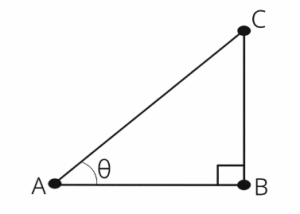
Given that sec θ = 13/12.
We know that sec θ = hypotenuse/adjacent side.
From the above figure, we get
sec θ = AC / AB
Therefore, we get
AC = 13 and
AB = 12
Now, we need to apply the Pythagoras theorem to find the measure of the perpendicular/opposite side.
In ▵ABC, by Pythagoras theorem,
(hypotenuse)2 = (base)2 + (perpendicular)2
We get
(AC)2 = (AB)2 + (BC)2
132 = 122 + BC2
169 = 144 + BC2
BC2 = 25
BC = 5 cm
Now, we know that
sin θ = opposite side/hypotenuse
sin θ = BC / AC
∴ sin θ = 5 / 13
cos θ = adjacent side/hypotenuse
cos θ = AB / AC
∴ cos θ = 12 / 13
tan θ = opposite side/adjacent side
tan θ = BC / AB
∴ tan θ = 5 / 12
cosec θ = hypotenuse/opposite side
cosec θ = AC / BC
∴ cosec θ = 13 / 5
cot θ = adjacent side/opposite side
cot θ = AB / BC
∴ cot θ = 12 / 5
Q.8 If ∠A and ∠B are acute angles such that cos A = cos B, then show that ∠A = ∠B.
Ans: Let us consider a right-angled triangle ▵ABC. We get
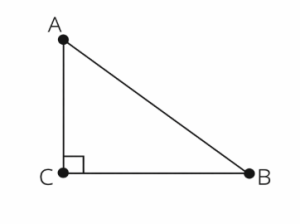
Given that cos A = cos B.
In a right triangle ΔABC, we know that
cos θ = adjacent side / hypotenuse
Here,
cos A = AC / AB
And cos B = BC / AB
As given cos A = cos B, we get
⇒ AC / AB = BC / AB
⇒ AC = BC
Now, we know that angles opposite to the equal sides are also equal in measure.
Then, we get
∠A = ∠B
Hence proved.
Q.9 Evaluate the following if cot θ = 7/8
(i)
(1 + sin θ)(1 − sin θ)
————————
(1 + cos θ)(1 − cos θ)
Ans: Let us consider a right angled triangle ΔABC. We get
Now, in a right triangle we know that cot θ = adjacent side / opposite side.
Here, from the figure cot θ = BC / AB.
We get
AB = 8 and
BC = 7
Now, we need to apply the Pythagoras theorem to find the measure of hypotenuse.
In ΔABC, by Pythagoras theorem,
(hypotenuse)² = (base)² + (perpendicular)²
We get
(AC)² = (AB)² + (BC)²
(AC)² = 8² + 7²
(AC)² = 64 + 49
(AC)² = 113
AC = √113
Now, we know that
sin θ = opposite side / hypotenuse
sin θ = AB / AC = 8 / √113
cos θ = adjacent side / hypotenuse
cos θ = BC / AC = 7 / √113
Now, we have to evaluate
(1 + sin θ)(1 − sin θ)
———————-
(1 + cos θ)(1 − cos θ)
Applying the identity (a + b)(a − b) = a² − b², we get
(1 + sin θ)(1 − sin θ) / (1 + cos θ)(1 − cos θ)
= (1 − sin²θ) / (1 − cos²θ)
Substituting the values, we get
= 1 − (8/√113)²
—————-
1 − (7/√113)²
= 1 − 64/113
————–
1 − 49/113
= (113 − 64)/113
——————
(113 − 49)/113
= 49/64
(ii) cot²θ
Ans: Given that cot θ = ⅞
Now, cot²θ = (7/8)²
cot²θ = 49/64
Q.10 If 3 cot A = 4, check whether
(1 − tan²A) / (1 + tan²A) = cos²A − sin²A or not.
Ans: Let us consider a right angled triangle ΔABC. We get
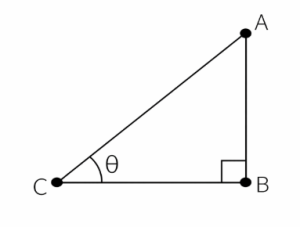
Given that 3 cot A = 4.
We get cot A = 4/3.
We know that cot θ = adjacent side / opposite side.
From the above figure, we get
cot A = AB / BC
Therefore, we get
BC = 3 and
AB = 4
Now, we need to apply the Pythagoras theorem to find the measure of hypotenuse.
In ΔABC, by Pythagoras theorem,
(hypotenuse)² = (base)² + (perpendicular)²
We get
(AC)² = (AB)² + (BC)²
(AC)² = 4² + 3²
(AC)² = 16 + 9
(AC)² = 25
AC = 5
Now, let us consider LHS of the expression
(1 − tan²A) / (1 + tan²A) = cos²A − sin²A
LHS = (1 − tan²A) / (1 + tan²A)
Now, we know that tan θ = opposite side / adjacent side.
Here, we get
tan A = BC / AB = ¾
Substitute the value, we get
(1 − (3/4)²) / (1 + (3/4)²)
= (1 − 9/16) / (1 + 9/16)
= (16/16 − 9/16) / (16/16 + 9/16)
= 7/16 / 25/16
= 7/25
Let us consider RHS of the expression
(1 − tan²A) / (1 + tan²A) = cos²A − sin²A
RHS = cos²A − sin²A
We know that sin θ = opposite side / hypotenuse
and cos θ = adjacent side / hypotenuse
Here, we get
sin A = BC / AC = ⅗
and cos A = AB / AC = ⅘
Substitute the values, we get
cos²A − sin²A
= (4/5)² − (3/5)²
= 16/25 − 9/25
= 7/25
Hence, we get LHS = RHS
Therefore,
(1 − tan²A) / (1 + tan²A) = cos²A − sin²A.
FAQs
1. What is the quickest method to determine one trigonometric ratio when another is given?
The fastest method is to apply the Pythagorean identity sin²θ + cos²θ = 1. For instance, if the value of cos θ is known, you can find sin θ by rearranging the identity: sin θ = √(1 − cos²θ) While calculating, always consider the quadrant of the angle (in higher-level problems) or the given context of the triangle to decide whether the final value should be positive or negative.
2. How can we use complementary angle formulas in trigonometry?
First, look for angle pairs in the question whose sum is 90°. Then apply complementary angle identities such as:
sin(90° − A) = cos A
cos(90° − A) = sin A
tan(90° − A) = cot A
These identities help simplify expressions by converting one trigonometric ratio into another. For example, you can rewrite sin 25° as cos 65°, making it easier to combine with other terms that involve 65°.
3. What should be the first step in solving any Class 10 trigonometry problem?
Begin by drawing a right-angled triangle and clearly labeling its sides with respect to the given angle (θ):
Perpendicular (Opposite)
Base (Adjacent)
Hypotenuse
Creating this visual representation helps you correctly identify the sides and avoid mistakes while applying trigonometric ratios such as:
sin θ = P/H
cos θ = B/H
tan θ = P/B
A clear diagram makes the solution more accurate and easier to understand.
4. How can all trigonometric ratios be found from one given ratio?
Start by using the given ratio to assume the lengths of two sides of a right-angled triangle. Then apply the Pythagoras Theorem to calculate the third side. Once all three sides are known, you can easily find the remaining trigonometric ratios.
This is a common question type in Class 10 Maths (Chapter 8 – Trigonometry).
Example:
If sin A = 3/5 (Perpendicular/Hypotenuse), assume:
Perpendicular = 3k
Hypotenuse = 5k
Using the Pythagoras Theorem, find the base, and then calculate the other ratios such as cos A, tan A, cosec A, sec A, and cot A.
5. How to use step-by-step NCERT Solutions to learn Trigonometry?
To effectively learn Introduction to Trigonometry (Class 10), students should use ToppersSky’s step-by-step NCERT Solutions for Chapter 8 to understand the logic behind every solution rather than simply memorising answers.
Through animated explanations and clear breakdowns of each step, students can understand how trigonometric ratios, identities, and formulas are applied in different types of questions. This method helps build a strong conceptual foundation, enabling students to confidently solve any Introduction to Trigonometry Class 10 questions and answers in exams. By focusing on understanding the reasoning behind each step, students improve accuracy, speed, and overall problem-solving skills.