


- Science Chapter 10 Class 10 - Quick Overview on Human Eye and the Colourful World
- Download PDF of NCERT Solutions Class 10 Science Chapter 10 Human Eye and the Colourful World
- Topics Covered In Class 10 Science Chapter 10: The Human Eye and The Colourful World
- Benefits of the Human Eye Class 10 NCERT Solutions
- Conclusion
- The Human Eye And The Colourful World Class 10 Questions And Answers
- Links for Other Chapter-wise NCERT Solutions Class 10 Science
- FAQs
Science Chapter 10 Class 10 – Quick Overview on Human Eye and the Colourful World
Connecting the theoretical concepts from Class 10 Science Chapter 10 – The Human Eye and the Colourful World with drawings and real-life applications is often a tough task for the students. The chapter brings to view essential points of biology as well as physics, for instance, human eye’s anatomy, vision defects, and light’s nature among others. Referring to NCERT-based solutions is a great help as it shows students the way to presenting answers that are clear and accurate in exams.
The Human Eye and the Colourful World Class 10 questions and answers point out myopia, hypermetropia, light dispersion, light scattering, and rainbow formation in a smart and exam-oriented way. Each answer sticks to the NCERT method so that students get attuned to the right words, good drawings, and step-by-step explanations which are needed in exams.
By doing NCERT Solutions for Class 10 Science Chapter 10, students can have both conceptual understanding and answer presentation improved. This not only makes revision more powerful but also helps students to get higher marks by not committing common mistakes and writing incomplete explanations in the course of exams.
Download PDF of NCERT Solutions Class 10 Science Chapter 10 Human Eye and the Colourful World
Add notes section and add an app download function for complete notes
Topics Covered In Class 10 Science Chapter 10: The Human Eye and The Colourful World
| S.No. | List of Topics Covered in Science Chapter 10 Class 10 |
|---|---|
| 1 |
The Human Eye
|
| 2 |
Defects of Vision and Their Correction
|
| 3 |
Refraction of Light Through a Prism
|
| 4 |
Dispersion of White Light By a Glass Prism
|
| 5 |
Atmospheric Refraction
|
| 6 |
Scattering of Light
|
Benefits of the Human Eye Class 10 NCERT Solutions
Class 10 Science Chapter 10 NCERT Solutions are made to support students in an effective way to plan their preparation for the exam by directing their attention to all essential concepts in a structured manner. The following are some of the benefits of referring to NCERT Solutions for Class 10 Chapter 10 – Human Eye and the Colourful World:
- Students can arrange their study material methodically and get an understanding of how to tackle different kinds of questions through the analysis of Human Eye Class 10 questions and answers.
- The Human Eye and the Colourful World question answers are thorough and laid out with a strong focus on the conception explanation and exam presentation.
- Moreover, detailed description of human eye structure along with a clear identification of its parts and their respective functions is provided as part of these solutions.
- There is a stress on comprehending the working of the human eye and the different eye parts carrying out different functions in the Human Eye Class 10 NCERT Solutions.
- Critical words like least distance of distinct vision and cataract are made easy to understand through their respective questions and answers.
- Besides that, students can do their homework without any doubts if they follow Chapter 10 Science Class 10 NCERT Solutions.
- The solutions are created based upon a comprehensive analysis of the topic area which is guaranteed to bring the students a solid conceptual base in all parts of the chapter.
Conclusion
Topperssky’s Class 10 Science Chapter 10 NCERT Solutions are the best way through which students can concentrate on the key concepts of the chapter. The explanations provided for each question and answer are in simple and easy-to-understand language to ensure clarity of the concept. The solutions are a great help in understanding the content better and also in the effective revision of the chapter after one has finished studying.

The Human Eye And The Colourful World Class 10 Questions And Answers
Q.1 What is the power of accommodation of the eye?
Answer:
The extent of the eye’s accommodation reveals its ability to change the condition of its lens, which is a bodily phenomenon that enables the eye to perceive near and far objects with equal sharpness by shifting the focal point of the light rays reaching the retina.
Q.2 A myopic person will only manage to see objects clearly within the range of 1.2m. What kind of lens is to be applied for vision correction?
Answer:
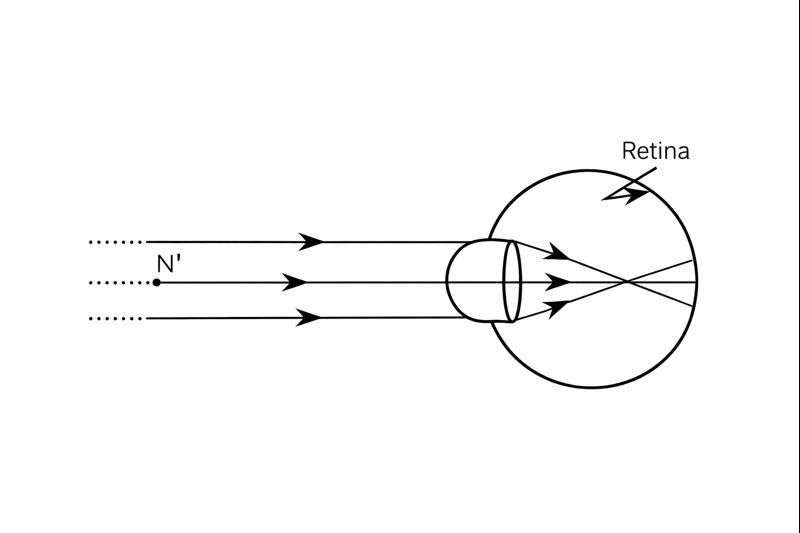
The vision of the person is good for near objects but he suffers the loss of distant vision. This happens because of the fact that the image of the object placed more than 1.2m is formed in front of the retina and not at the retina as shown in the diagram below.
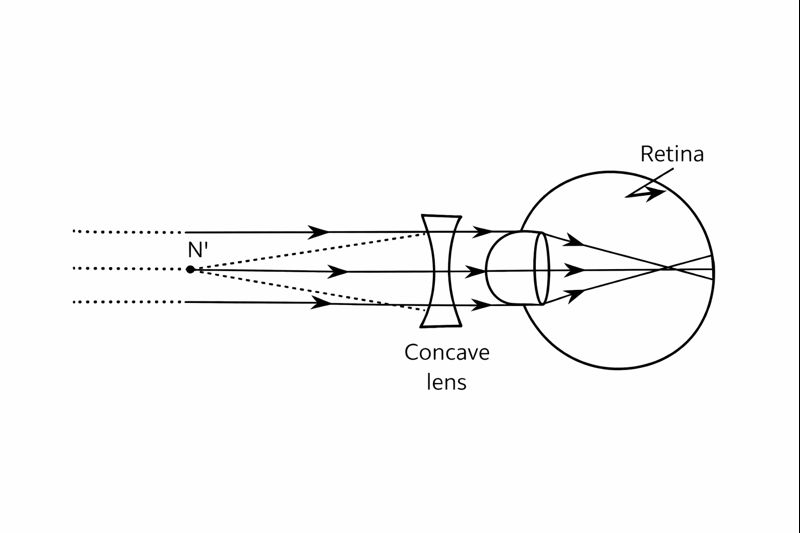
A concave lens should be used in order to correct this vision anomaly. Referring to the given figure, the concave lens will form the object and project it forward onto the retina.
Q.3 What are the distances of the far-point and near-point of a human eye with normal vision?
Answer:
The near-point distance for the human eye is the minimal distance that an object has to be in order for it to be seen clearly without any exertion. For a normal eye, it is 25 cm.
The far-point distance for the human eye is the maximum distance that objects can be seen clearly without any exertion. For a normal eye, the far-point is at an infinite distance.
Q.4 A student sitting in the last row cannot read the blackboard. What kind of defect does he have, and how can it be treated?
Answer:
If a student sees distant objects poorly, then he or she is affected by myopia (nearsightedness). Myopia can be treated with a concave lens that helps the focusing of distant objects on retinas.
Q.5 What is the change in the image distance in the eye when the object is far away?
Answer:
The eye size is constant, hence there is no variation in image distance.
When the object moves farther away, the eye increases the focal length of the lens such that the image gets formed continuously on the retina. Consequently, the image distance remains uniform.
Q.6 Why do stars twinkle?
Answer:
Stars are ordinarily far distant and are perceived as a light source with an infinitesimal area. Their light has to pass through the atmosphere of the Earth where it refracts owing to the different altitudes of varying air density.
Hence, the stars seem to be twinkling as the brightness of stars fluctuates.
Q.7 Why do planets not twinkle?
Answer:
The planets are a lot nearer to the Earth and they give the light source of a broad nature. When the light from a planet passes through the atmosphere, it is refracted over the various parts of the planet and the variations in brightness are such that they all cancel each other out.
This is why planets do not show the twinkling effect.
Q.8 Why does the Sun look reddish at dawn?
Answer:
At dawn, the sunlight has a longer path through the atmosphere. The blue or shorter wavelengths scatter while the red or longer wavelengths go through and reach our eyes.
Consequently, the Sun appears reddish at dawn and dusk.
Q.9 Why is the sky dark for an astronaut instead of blue?
Answer:
In space, the atmosphere is nonexistent to scatter sunlight. Because no scattering occurs, the eyes do not get any light that has been diffused.
Thus, an astronaut perceives the sky as dark or black rather than blue.
Q.10 Draw a ray diagram to illustrate the correction of hypermetropia. If the near point of a hypermetropic eye is given, determine the power of the lens required to correct this defect. Assume that the near point of a normal human eye is 25 cm.
Answer:
A person with hypermetropia can see objects that are far away very clearly but cannot see the objects that are close up at all. This is because the image of the nearby object is formed by the eye lens behind the retina instead of the retina itself owing to the crossing power of the eye lens which is insufficient.
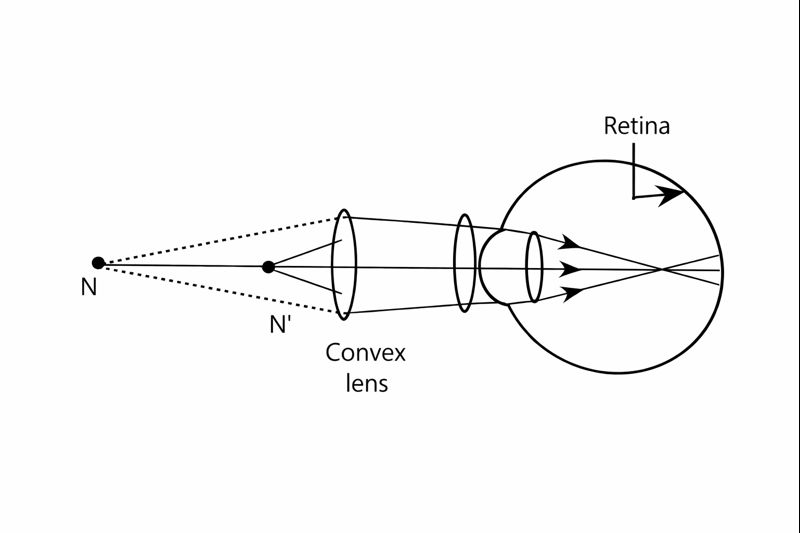
Hypermetropia is a condition that can be remedied to an extent by using convex (converging) lenses with the appropriate power. The convex lens before the eye takes the falling beam of divergent rays and converges them so that when they pass through the eye lens, the rays meet at the retinal point. Consequently, the person has a very clear vision of the nearby objects.
The ray diagram illustrates the case where the installation of the convex lens in front of the eye provides an overlap between the image and the retina, thus rectifying the problem of hypermetropia.
Object distance, u = −25 cm
Image distance, v = −1 m = −100 cm
Focal length = f
Using the lens formula:
1/v − 1/u = 1/f
Substituting the values:
1/−100 − 1/−25 = 1/f
⇒ 1/f = 1/25 − 1/100
⇒ 1/f = (4 − 1) / 100
⇒ 1/f = 3/100
⇒ f = 100/3 cm = 33.33 cm = 0.33 m
Power of the lens:
P = 1/f (where f is in metres)
⇒ P = 1/0.33
⇒ P = +3 D
Links for Other Chapter-wise NCERT Solutions Class 10 Science
Students can also explore chapter-wise NCERT Solutions for Class 10 Science to strengthen their preparation and revise other important topics systematically.
FAQs
1. How is hypermetropia corrected according to NCERT Solutions?
Hypermetropia is the defect of vision that is corrected with a convex lens. The lens causes the rays of light to come together and thus the image is formed on the retina, so the very close objects can be seen without any trouble.
2. What is the human eye and how does it work?
The human eye is a natural opto-mechanical apparatus, and it symbolizes the principal means of vision for mankind. Initially, the light traverses through the cornea, afterwards through the pupil and the lens of the eye. Subsequently a real and inverted image is projected onto the retina. Then, the brain receives the image and displays it as an upright one.
3. What are the common defects of vision explained in Chapter 10?
Among common defects of vision are myopia (nearsightedness), hyperopia (farsightedness), and presbyopia. In fact, these defects are due to an improper change in the curvature either of the lens or that of the eyeball and treated by supplying proper lenses.
4. What causes the blue color of the sky during the daytime?
The splitting of light is the main factor that leads to the blue color of the sky. Air particles scatter the light much more for the shorter wavelength (blue) than for the longer wavelength (red, yellow, etc.) thus the sky turns blue.
5. What is the reason that stars give the impression of twinkling at night?
Stars are considered to be the twinklers and this phenomenon is actually the result of light refraction through the atmosphere. The light of the star is bent several times before it finally arrives at us, as it passes through the different density layers of the atmosphere – the light is constantly changing in brightness and position, thus giving the effect of twinkling.