

- Science Chapter 8 Class 10 - Quick Overview on Heredity And Evolution
- Download PDF of NCERT Solutions For Class 10 Science Chapter 8 Heredity And Evolution
- Class 10 Science Chapter 8 Heredity and Evolution - Quick Overview of Topics
- Chapter 8 Heredity and Evolution – Important Topics
- Benefits of NCERT Solutions for Class 10 Science Chapter 8 Heredity and Evolution
- Conclusion
- Class 10 Questions And Answers Help You Prepare For Exams Effectively?
- Links for Other Chapter-wise NCERT Solutions Class 10 Science
- FAQs
Science Chapter 8 Class 10 – Quick Overview on Heredity And Evolution
Heredity is synonymous with the transmission of characteristics from one generation to the next. Evolution is a slow and gradual process whereby the more advanced living beings are a result of the development of less complex ones through the passage of many generations over a very long period of time. Students in this chapter get to know about the different types of variations that exist, the principles of heredity that determine the changing patterns of inheritance, and the role of continuous variations in the process of evolution.
Heredity is defined as the transfer of features from parents to their offspring. The parents’ traits are passed down through genes, which are the fundamental units of heredity. Genes are distinct portions of the DNA molecule that are responsible for producing specific proteins or RNA by conveying their respective instructions.
Genetics deals with the study of genes, heredity, and variations, and is the subdivision of biology that throws light on the matter of how traits are passed from one organism to another and how diversity is created in living beings.
Besides, you may also go for NCERT Solutions Class 10 Science to get the resources for the other chapters which will help you in overall preparation. Such solutions are helpful in making the students understand the concepts clearly and in solving the questions correctly. Every answer is based on simple and understandable language that allows the learning process to become more effective. You have the option to download the NCERT Solutions PDF and be ready for your exam with structured and trustworthy explanations.
Download PDF of NCERT Solutions For Class 10 Science Chapter 8 Heredity And Evolution
Class 10 Science Chapter 8 Heredity and Evolution – Quick Overview of Topics
Class 10 Science Chapter 8 NCERT Solutions for Heredity and Evolution -Quick Overview of Detailed Structure of Topics and Subtopics Covered.
| Main Topic | Subtopics |
|---|---|
| Accumulation of Variation During Reproduction |
|
| Mendel’s Law of Inheritance of Traits |
|
| Sex Determination |
|
| Acquired and Inherited Traits |
|
| Fossils |
|
| Evolution by Stages |
|
Chapter 8 Heredity and Evolution – Important Topics
The Class 10 NCERT Solutions are very helpful for students who want to review quickly the important points of the chapter. The main topics in Chapter 8: Heredity and Evolution, which are significant for the exam are given below.
Mendel’s Experiments and Laws of Inheritance
This subject encompasses the experiments conducted by Gregor Mendel and his studies on pea plants and the fundamental rules of inheritance, which include the law of dominance, law of segregation, and law of independent assortment, are being discussed. Through the implementation of monohybrid and dihybrid crosses, students gain insight into the mechanism of traits transmission from parent to progeny.
Sex Determination
This section illustrates the chromosomal basis of sex determination. It explains the difference between XX and XY chromosomes and presents genetic and environmental sex determination in different organisms.
Evolution and Speciation
The learner is introduced to the very famous theory of Charles Darwin—theory of evolution by natural selection. The topic describes how new species come about during the process of speciation and points out the role of e.g. mutation, genetic drift, and migration as evolution factors.
Acquired and Inherited Traits
This section tells about the distinction of acquired traits versus inherited traits. Inherited traits are shown to be passed on from one generation to another and their role in evolution is illustrated with appropriate examples.
Evolutionary Relationships
The fossils, homologous structures, and molecular biology are pointed out as the sources of the evidence for evolution. Besides, students are introduced to the notion of common ancestry and they perceive evolutionary relationships through the Tree of Life and phylogenetic classification.
Benefits of NCERT Solutions for Class 10 Science Chapter 8 Heredity and Evolution
ToppersSky’s NCERT Solutions for Class 10 Science Chapter 8 Heredity and Evolution provide students with a number of benefits such as:
- Thorough explanations and stepwise solutions for any topic from Chapter 8.
- Solutions with a primary focus on the accuracy, clarity, and understanding of the concept.
- Concepts like evidence supporting evolution through fossils, homologous organs, and molecular evidence have been well covered.
- Explanations made simple and precise that enable students to easily grasp the most complicated concepts.
- Acquired and inherited traits are extensively discussed with their differences and role of evolution mentioned.
- Tackling various problems contributes significantly to the development of cognitive as well as problem-solving skills.
- In mathematics, for instance, the learners can take advantage of detailed solutions to communicate their answers during tests in a way that is both understandable and right.
Conclusion
The ToppersSky NCERT Solutions for Class 10 Science Chapter 8 – Heredity and Evolution are an indispensable tool for Class 10 students. The solutions made the teaching and learning of science concepts easier by considering complex ideas as smaller, easy-to-understand parts. The lucid explanations enable students to grasp very well the NCERT concepts regarding inheritance and evolution. The students who use ToppersSky resources can not only raise their academic performance but also develop real curiosity about Class 10 Science Chapter 8 – Heredity and Evolution, thus, making learning more effective and enjoyable.

Class 10 Questions And Answers Help You Prepare For Exams Effectively?
Q.1 If the population of asexually reproducing species has 10% of trait A and 60% of trait B, then it is more likely that the first trait is the one with higher percentage.
Answer:
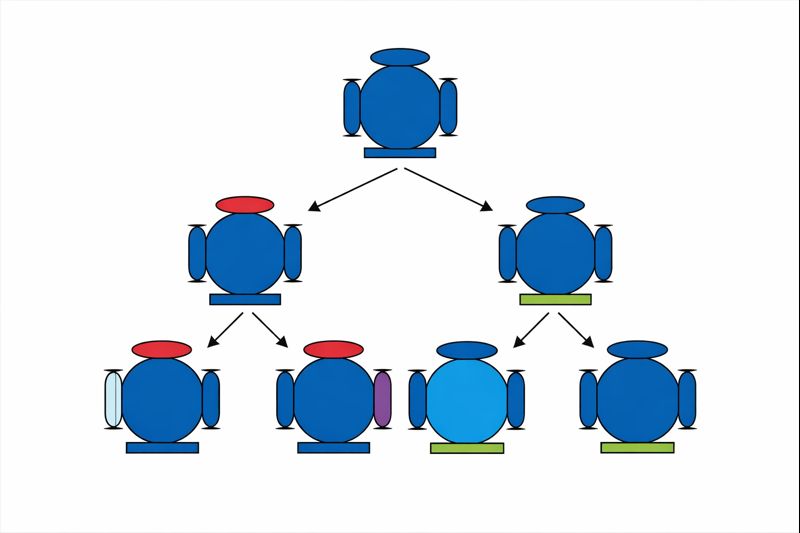
This cloning process implies that the genetic material resulting from meiosis or genetic recombination is not required. There might not be any mutations involved, but very tiny changes in DNA replication can still occur and be inherited by the next generations along the same line, hence the development of new traits.A trait happening to a greater extent in the population is the one that has been there longer and has gotten passed on through many more generations. This is the reason that trait B, which occurs in 60% of the population, as opposed to merely 10% for trait A, is the one that is most probable trait B which has arisen earlier.
Chatgpt
Q.2 By what means does the genetic variation within a species contribute to the prevention of extinction?
Answer:
The variety of living things gives the organisms the power to resist and to undergo the changes in the environment. For instance, if the environment suddenly gets too hot or is disturbed, the survival among the individuals of the population may vary. Lucky for the individuals with the right traits, they can adapt to the new environment and therefore create next generations. A good example is that some bacteria may have acquired a characteristic that makes them heat-resistant so they can live in the hot habitat while others perish. In the end, it is the survivors that will transmit their genes and make sure that the species continues to exist. In this way, diversity of life works as a factor that increases the chances of survival of a species.
Q.3 How do Mendel’s experiments demonstrate that traits can be either dominant or recessive?
Answer:
Mendel conducted his studies using pea plants as his experimental material and he made monohybrid crosses between the parental plants that were having contrasting traits, for example, tall and short plants. Initially, he picked pure seed plants of tall and pure seed plants of dwarf and all plants of the first generation turned out to be tall. This indicated that the tall trait was dominant. In the meantime, the first-generation plants were permitted to self-pollinate and in the subsequent generation the tall and dwarf plants appeared again. This gave proof that the dwarfism trait was receded and shown only in a homozygous condition. Therefore, Mendel was sure that the traits could be either dominant or recessive.
Q.4 In what manner do the experiments of Mendel demonstrate the independent inheritance of traits?
Answer:
Mendel carried out dihybrid crosses, taking two traits at a time into account, for instance, seed shape and seed color. When he crossed round yellow seeds with wrinkled green seeds, all plants in the first generation showed round yellow seeds. On self-pollination of this generation, four different combinations appeared in the ratio 9:3:3:1. This included new combinations not seen in the parent generation. This result showed that traits for different characters are inherited independently of each other.
Q.5 Why are traits acquired during the lifetime of an individual not inherited?
Answer:
Inherited characteristics are transmitted from parents to their children via germ cells. The traits that a human being acquires during his/her life are the product of environmental factors or personal interactions and are accompanied by alterations in the somatic cells rather than in the germ cells. Such changes do not affect the genetic constitution of the reproductive cells and therefore, the changes will not be passed on to the subsequent generation.
Q.6 From a genetic standpoint, what is the concern about the very few existing tigers?
Answer:
The genetic makeup of a small population is not very diverse. A species with low genetic variations is less likely to obtain the necessary qualities that will give it a chance to survive in the case of diseases or changes in the environment. Thus, it becomes more likely that the species may die out. Its remaining genetic material will be gone forever if that population goes extinct.
Q.7 What things can lead to the creation of a new species?
Answer:
The term speciation is applied to a process where new species arise from old ones. New species may be created by genetic drift, natural selection, big changes in the DNA, and reproductive isolation among others. Slowly but surely, these elements caused the genetic splitting of the organism groups.
Q.8 Do you think geographical isolation was a major factor in the evolution of self-pollinating plants? Discuss your points?
Answer:
Geographical isolation is not considered a major impediment to self-pollinating plants. The plants are considered to be capable of fertilizing themselves and do not require any other plants or external agents The pollen is transferred from one part of the same plant to another. Thus, geographical barriers are not effective in completely eliminating the mating opportunities among such plants.
Q.9 Is geographical isolation going to be an important factor in the splitting of species among organisms that reproduce asexually? Give an explanation?
Answer:
Geographical isolation doesn’t play an important role in the speciation of asexual organisms. An individual can self-reproduce, so the main differences are caused by mistakes in DNA replication rather than by the interbreeding between different populations. Therefore, the physical separation of the organisms does not significantly affect their speciation.
Q.10 Give an example of characteristics being used to determine how close two species are in evolutionary terms.
Answer:
By looking at shared traits passed down from a common ancestor, one can determine the evolutionary relationships. A case in point is feathers, which were characteristic of both dinosaurs and present-day birds. Dinosaurs had feathers primarily for keeping warm while birds underwent another stage in which they were able to fly with feathers. This trait points to birds being descended from lizard-like ancestors and it proves that at some stage reptiles and birds were closely related evolutionarily.
Links for Other Chapter-wise NCERT Solutions Class 10 Science
FAQs
1. In what ways do NCERT Solutions for Class 10 Science Chapter 8 make students comprehend the topic of heredity and evolution?
The NCERT Solutions for Class 10 Science Chapter 8 provided a lot of visuals and a gradual but certain route to the fundamental concepts of genetics, e.g. the laws of inheritance as postulated by Mendel, variations, speciation, and the theory of natural selection. The solutions are presented in a manner consistent with the CBSE 2025-26 syllabus, which not only facilitates their comprehension but also guarantees the development of a distinct and ready-for-exam understanding of the principles of inheritance and evolution among the students.
2. How do the NCERT Solutions clarify the matter of human sex determination in the Class 10 exams?
The NCERT Solutions present sex determination as a process of chromosomal contributions from both parents. In the case of the female, her chromosomes are XX while for the male, the chromosomes are XY. The joining of an ovum (X) with a sperm cell that has an X results in a girl (XX); if the sperm with Y is chosen then it is a boy (XY). This process is explained systematically to match the CBSE exam pattern.
3. Why are acquired traits not passed on to offspring as per the solution steps in this chapter?
Acquired traits occur due to environmental influences and affect only somatic (non-reproductive) cells. Since genetic information is inherited only through germ cells (sperm and egg), these acquired changes are not encoded in DNA and thus not transmitted to the next generation, as detailed in NCERT Solutions for Chapter 8.
4. How can students differentiate between homologous and analogous organs when using NCERT Solutions?
Homologous organs possess a common origin and structure but are different in their functions (for example, human arm and cat leg), whereas analogous organs are similar in their functions but differ in the case of their origin and structure (for example, the wings of the bird and the wings of the butterfly). The use of comparative diagrams, together with structure-function tables, as directed in NCERT Solutions, does help a lot in distinguishing these organs.
5. What common errors should students avoid when answering heredity and evolution questions using NCERT Solutions?
- Do not misinterpret dominant traits as always visible in every generation.
- Avoid confusing acquired with inherited traits.
- Make sure to follow each step when constructing genetic crosses or evolutionary explanations.
- Draw labeled diagrams where required, as suggested in the NCERT Solutions methodology for full marks.