


Many Class 10 students spend hours reading textbooks, notes, and study materials, yet struggle to remember important concepts during exams. This usually happens not because the content is “hard”, but because just reading is not always enough for proper long term learning. When people compare active recall vs passive reading, they often notice the study style matters more than the number of hours they sit with books.
Also, finding the best study method for Class 10 students is kind of crucial since board exams don’t only test knowledge; they also check how fast you can retrieve that knowledge. In this Blog, we will talk about Active recall vs Passive reading a little, point out what each one does good or does poorly maybe and show students how to use sharper learning tactics to boost their preparation and confidence, a bit.
What Is Passive Reading?
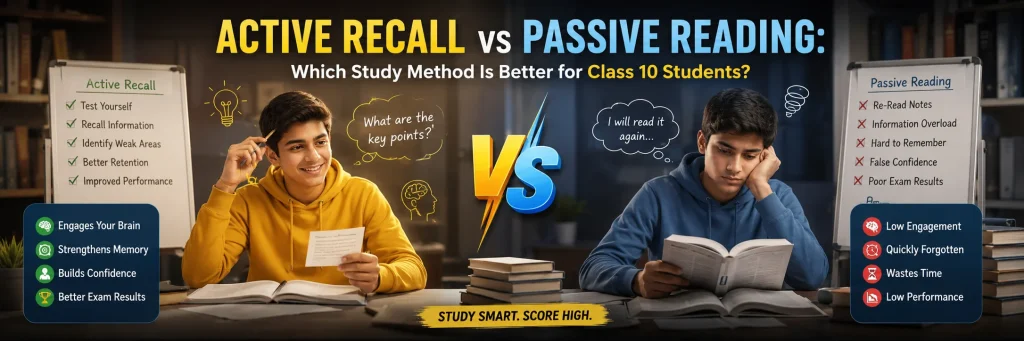
Passive Reading is a very popular studying technique practised by many students. It consists of re-reading books, notes, highlighted parts, or summaries.
Students find themselves productive while reading the same chapter several times. Nonetheless, being familiar with the content does not mean remembering it. Though the chapter may be easy to read, it usually proves hard to remember during tests.
The examples of passive reading are as follows:
- Re-reading notes
- Highlighting parts of texts and not checking them
- Watching solutions without completing questions
- Revising chapters without self-assessment
Though passive reading is useful for getting an initial comprehension of the subject matter, it is less efficient for retaining information in memory.
What Is Active Recall?
The active recall study method is a learning technique that leans into retrieving information from memory instead of just skimming it over and over.
So rather than, you know, sitting there and repeating an entire chapter like a broken record, students tend to put themselves on the spot, sort of prompting that mental retrieval, right? They attempt to answer questions, work through the problems, or explain those ideas from scratch without peeking at their notes. It’s more like a quick, slightly uncomfortable challenge.
They attempt to answer questions, work through the problems, or explain those ideas from scratch without peeking at their notes. It’s more like a quick, slightly uncomfortable challenge.
You can spot active recall in things like the following:
- Doing chapter-wise quizzes
- Answering questions using memory, not notes
- Practising sample papers
- Making flashcards
- Writing quick little summaries after studying (so you check what stuck)
- Teaching a concept to someone else, or talking it out aloud
The brain gets stronger at remembering things when it is basically pushed to pull out knowledge again, like forced retrieval, you know. This is why Active Recall is widely considered one of the most effective study techniques for students preparing for exams.
Active Recall vs Passive Reading: Key Differences
The biggest difference is that Active Recall sort of pushes the brain into remembering the information, while passive reading mostly just lets students be exposed to it over and over in a more easy-going way.
Why Active Recall Improves Memory and Learning
The human brain tends to memorize facts better through constant usage. Whenever the brain recalls data from memory, the neural connections are reinforced, and future recall becomes easier.
There are several advantages associated with active recall :
1. Better retention: Students often hang onto the concepts for longer, mostly because they keep pulling the information back into mind over and over, instead of reading it once, sort of, and then just moving on.
2. Faster revision: Because the information ends up stored in a more solid way, going back through it later feels quicker and more efficient, especially as exam day gets closer.
3. Identifies weak spots: Students spot right away what they haven’t really grabbed yet, those areas where understanding is a bit thin, and then they can direct attention to it instead of guessing.
4. Builds confidence: With regular self-tests, students feel less anxious about exams since they get used to recalling details while under pressure, and it doesn’t seem so strange anymore.
5. Improves Academic Performance: Studies plus lived practice both kind of point to the same idea: learners who routinely test themselves seem to do better in exams than students who just depend on reading without any checking.
So, active recall becomes really useful, especially while preparing for board exams, where you need that quick mental retrieval.
How can Class 10 students use Active Recall effectively?
Students don’t really need fancy tools to start with active recall. A few small changes in the daily routines of study can make a big difference, like surprisingly fast.
1. After reading a chapter: Just close the book for a moment and write down whatever you remember. Don’t stress if it’s not perfect or a hundred percent right. This easy habit kind of trains memory and sort of exposes where the comprehension is thin so you can circle back to what to revisit later.
2. Use quizzes regularly: Chapter-wise quizzes are one of the easiest ways to make active recall happen. They kind of force students to pull the information back out of memory, rather than just keep rereading the lesson again and again.
3. Solve questions without looking at notes: Try the questions on your own first before you check the solutions. This kind of independent attempt builds a stronger recall pathway. Even if you get stuck, that struggle helps.
4. Practice sample papers: Mock tests feel close to actual exams, and they also improve memory, along with time management skills. When you do this often, retrieval becomes smoother during real exams.
5. Create Quick Revision Notes: Resources such as class 10 science notes can help students organize information and revise important concepts more efficiently.
6. Find the Best Time to Study: Every student has a different way of learning, and it’s not always the same rhythm. Figuring out the best time to study can help your focus a lot and make active recall sessions feel more useful, not just busy.
If students stick to these tactics over time, they can boost their ability to remember what they need during exams quite a bit.
How ToppersSky Helps With Active Learning
Active learning is all about understanding, recalling, and applying concepts – not just reading them. ToppersSky is designed to help students build these habits through interactive learning tools. Its Animated Learning videos explain concepts step by step, making difficult topics easier to understand and remember. Monthly quizzes encourage students to test their knowledge regularly, helping them identify weak areas and improve over time.
For quick revision, Mind Maps, Notes, and PDFs organize important concepts in a simple and easy-to-review format. When students have doubts, the Doubt Solver and Q-Sky AI provide instant support, ensuring learning never stops.
By combining concept-based learning, regular practice, revision, and performance tracking, ToppersSky helps Class 10 students study actively, retain concepts for longer, and prepare confidently for their board exams.
Tips on Building Stronger Study Habits
Getting good results in exams depends not only on study methods but also on staying consistent. Most students should make a realistic timetable, revise on a regular basis, and do practice questions often, I mean frequently. It also helps to take short breaks now and then , keep a healthy routine, and focus more on really understanding the ideas rather than just repeating memorized answers. This kind of approach can actually boost learning outcomes a lot.
Using active recall alongside smart review techniques kind of balances everything out ,and it can support long term academic progress.
Conclusion
When comparing Active Recall versus Passive Reading, Active Recall, it clearly gives stronger benefits for memory retention, confidence, and exam outcomes. Passive Reading might help students get a rough understanding of a topic at first, but it usually isn’t enough for real exam preparation by itself, you know.
Students who keep self testing, working through questions, and joining regular quizzes tend to remember more facts and also score better. So if Class 10 students pair Active Recall with well organized study materials and steady practice, they can prepare more effectively and face board exams with much better confidence.
FAQs
1. What’s the difference between Active Recall and Passive Reading?
Active Recall is about pulling the info back from memory, while Passive Reading is just re-reviewing things again and again, without really testing what you understand.
2. Is Active Recall really the best study method for Class 10 students?
Active Recall is often treated as one of the most effective study techniques, because it boosts memory retention and also helps with how well students perform in exams.
3. How can students do Active Recall at home?
Students can do self-testing, quizzes, flash cards, sample papers, and even summary writing to practice Active Recall.
4. Does Active Recall help with board exam preparation?
Yes. It supports longer retention, highlights weaker topics, and gives more belief and calm during exam days.
5. Can passive reading still be useful?
Yes, passive reading can help during initial learning, especially for understanding concepts, but it should be paired with active recall for better results.