


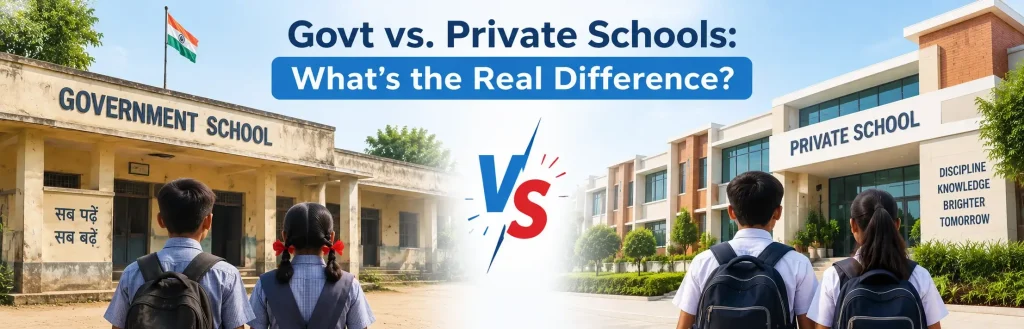
One of the first things to consider in education is choosing a school. Some students go to government schools, while other students choose private schools. But does one type always provide better education? Not necessarily. The real difference depends on teaching quality, facilities, affordability, learning environment, and student participation.
Let’s understand Government vs. Private Schools in a simple, practical way.
Government Schools: Affordable Education for Students
Public schools are mostly managed and funded by the government. These schools offer education at relatively lower costs, thus serving as an important choice for people of various financial backgrounds. Many institutions also receive support through government education programmes.
1. Affordable Education
One of the biggest advantages is affordability. Parents generally do not have to pay the high tuition fees often associated with private institutions. This makes schooling accessible to a wider section of society.
2. Qualified Teachers
Government schools recruit teachers through established processes. Teachers follow the prescribed curriculum and help students understand subjects according to academic requirements.
3. Focus on the Curriculum
The government schools tend to adhere to the syllabus provided by their education boards. Revision and practice of the textbooks are extremely important for students appearing in board exams.
4. Diverse Learning Environment
These institutions tend to enroll children from various social and economic backgrounds, thus allowing them to study in the presence of peers from various backgrounds.
5. Typical Problems
Perhaps there may be certain issues within the public schools, such as classroom congestion, absence of facilities, or extracurricular activities. However, each institution has its own set of conditions.
Private Schools: More Facilities and Structured Learning
Private schools are run by private organizations/individuals and are generally fee-based institutions for education. Their facilities and teaching quality may vary depending on the institution.
1. Modern Facilities
Many of the private schools have smart classrooms, computer labs, libraries, laboratories, game rooms, and sports facilities.
2. Smaller Classes in Some Schools
Certain private institutions maintain comparatively smaller class sizes. This may allow teachers to give more individual attention, although class strength differs from school to school.
3. Extra Activities
In addition, private schools arrange extracurricular activities such as playing games, debate, music, arts, public speaking, and technology-related activities.
4. Regular Assessments
Many schools conduct frequent tests, assignments, projects, and revision activities to track student progress.
5. Higher Fees
The greatest challenge for most families will be cost. The costs involved in schooling will include tuition, transportation, activities, uniforms, books, and other expenses.
Government Schools vs Private Schools: Key Differences
The difference between government and private schools can be seen in several areas, such as fees, facilities, management, class size, and extracurricular activities. The education in government institutions is less expensive than private institutions that offer better facilities and activities for their students. The quality of education provided by both government and private schools can differ.
A school with expensive facilities may not automatically provide better teaching. Similarly, a government school with fewer resources can still have dedicated teachers and hardworking students.
What Really Matters for Students?
When comparing government and private schools, students and parents should look beyond the school label. Teaching quality, safety, discipline, teacher support, educational resources, and academic performance are more important factors.
Every student learns differently. Some benefit from classroom discussions, while others need extra practice and revision at home. A class 10 learning app can support classroom learning with chapter-wise practice, revision resources, important questions, and interactive learning.
Before choosing a school, parents should assess its facilities, teachers, learning environment, and how well it matches the student’s learning style and study routine. Ultimately, quality schooling combined with effective self-study can support better academic outcomes.
Conclusion
The debate around government and private school education is not simply about choosing one side. Both have their advantages and disadvantages. Government schools could make education cheaper, whereas private schools can provide more facilities to the learner and systematic learning. In the end, all of these depend upon the student’s study, good teachers, good parents, practice, and right attitude.
The best school is not always the one with the biggest building – it is the one where a student gets the opportunity and motivation to learn, grow, and move forward.
Also Read: Animated Learning or Traditional Study – What’s Better?
Frequently Asked Questions
1. Is a government school superior to a private school?
Neither is always better. It all depends on the teacher’s quality, the fees, facilities, security, and the learning requirements of the learner.
2. Are government schools affordable?
Yes, public school generally more affordable and easier to access for families on a budget.
3. Do private schools provide better education?
Not all private schools provide good teachers and facilities, and even higher fees do not mean good learning.
4. What should parents check before choosing a school?
Parents need to evaluate teachers, costs, distance, security, facilities, academic assistance, class size, and extracurricular activities.