


- Why Should Students Check the RBSE Class 9 Syllabus?
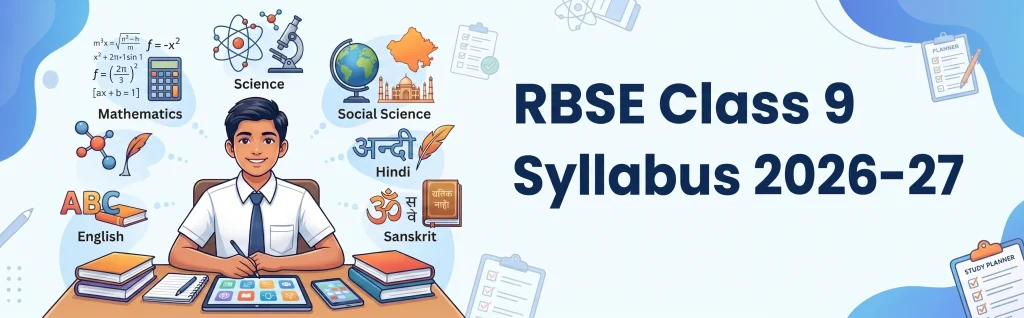
- RBSE Class 9 Subjects (2026-27)
- RBSE Class 9 Mathematics Syllabus 2026-27
- RBSE Class 9 Science Syllabus 2026-27
- RBSE Class 9 Social Science Syllabus 2026-27
- RBSE Class 9 English Syllabus 2026-27
- RBSE Class 9 Hindi Syllabus 2026-27
- RBSE Class 9 Sanskrit Syllabus 2026-27
- Conclusion
Starting Class 9 is an exciting step for every student. At this stage, subjects become more detailed, concepts become deeper, and students begin preparing for the academic challenges ahead. Many teachers also consider Class 9 as the year that builds the foundation for Class 10 board exams. One mistake that many students make is starting their preparation without checking the latest syllabus. As a result, they spend time studying topics that may not be important for exams while missing chapters that carry more weight.
That’s why knowing the RBSE Class 9 Syllabus (2026-27) is important. It gives students a clear idea of what they need to study throughout the year and helps them stay organized from day one.
In this blog, we’ll take a look at the complete subject-wise syllabus of RBSE Class 9 in a simple and easy-to-understand format.
Why Should Students Check the RBSE Class 9 Syllabus?
Imagine starting a journey without knowing the destination. Studying without knowing the syllabus feels exactly the same.
The syllabus acts like a guide that tells students what topics they need to focus on during the academic session. It also helps them plan their studies in a smarter way.
When students know the syllabus:
- They can create a better study schedule.
- They avoid unnecessary topics.
- Revision becomes easier before exams.
- They feel more confident throughout the year.
- Instead of studying everything randomly, students can focus on learning the right topics at the right time.
RBSE Class 9 Subjects (2026-27)
Students studying in RBSE Class 9 usually have the following subjects:
- Hindi
- English
- Mathematics
- Science
- Social Science
- Sanskrit (Optional)
- Computer or other optional subjects (depending on the school)
Each subject plays a different role in helping students build knowledge and develop important skills.
RBSE Class 9 Mathematics Syllabus 2026-27
Mathematics is often a subject that students either love or fear. The good news is that Maths becomes much easier when concepts are understood clearly and practiced regularly.
| Chapter No. | Chapter Name (English) | अध्याय का नाम (हिंदी) | Marks |
|---|---|---|---|
| Chapter 1 | Number System | संख्या पद्धति | 8 |
| Chapter 2 | Polynomials | बहुपद | 7 |
| Chapter 3 | Linear Equations in Two Variables | दो चरों वाले रैखिक समीकरण | 7 |
| Chapter 4 | Coordinate Geometry | निर्देशांक ज्यामिति | 6 |
| Chapter 5 | Introduction to Euclid’s Geometry | यूक्लिड की ज्यामिति का परिचय | 3 |
| Chapter 6 | Lines and Angles | रेखाएँ एवं कोण | 6 |
| Chapter 7 | Triangles | त्रिभुज | 6 |
| Chapter 8 | Quadrilaterals | चतुर्भुज | 6 |
| Chapter 9 | Circles | वृत्त | 7 |
| Chapter 10 | Heron’s Formula | हीरोन का सूत्र | 8 |
| Chapter 11 | Surface Areas and Volumes | पृष्ठीय क्षेत्रफल एवं आयतन | 12 |
| Chapter 12 | Statistics | सांख्यिकी | 10 |
Study Tip: Don’t wait until exams to practice Maths. Solving a few questions every day can make a huge difference.
RBSE Class 9 Science Syllabus 2026-27
Science is one of the most interesting subjects in Class 9 because it helps students understand how things work in real life.
The syllabus includes topics from Physics, Chemistry, and Biology.
| Chapter No. | Chapter Name (English) | अध्याय का नाम (हिंदी) | Marks |
|---|---|---|---|
| 1 | Matter in Our Surroundings | हमारे आस-पास के पदार्थ | 7 |
| 2 | Is Matter Around Us Pure? | हमारे आस-पास के पदार्थों की शुद्धता | 6 |
| 3 | Atoms and Molecules | परमाणु एवं अणु | 9 |
| 4 | Structure of the Atom | परमाणु की संरचना | 8 |
| 5 | The Fundamental Unit of Life | जीवन की मौलिक इकाई | 12 |
| 6 | Tissues | ऊतक | 14 |
| 7 | Motion | गति | 9 |
| 8 | Force and Laws of Motion | बल तथा गति के नियम | 7 |
| 9 | Gravitation | गुरुत्वाकर्षण | 6 |
| 10 | Work and Energy | कार्य तथा ऊर्जा | 6 |
| 11 | Sound | ध्वनि | 8 |
| 12 | Improvement in Food Resources | खाद्य संसाधनों में सुधार | 8 |
Study Tip: Focus on understanding concepts rather than memorizing definitions. Science becomes much easier when you understand the logic behind each topic.
RBSE Class 9 Social Science Syllabus 2026-27
Social Science is one of the most interesting subjects in Class 9 because it helps students understand the world around them. From learning about important historical events and India’s geography to understanding democracy and economics, this subject covers a wide range of topics that are relevant even in everyday life.
The RBSE Class 9 Social Science syllabus is divided into four sections – History, Geography, Political Science, and Economics. Together, these subjects help students develop analytical thinking, awareness about society, and a better understanding of how the country and the world function.
For RBSE Class 9 SST, the marks are distributed by book/section in the syllabus:
- History – 27 Marks
- Geography – 27 Marks
- Political Science – 27 Marks
- Economics – 19 Marks
| Subject | Chapter No. | Chapter Title | Key Topics | Marks |
|---|---|---|---|---|
| History (India and the Contemporary World-I) | 1 | The French Revolution (फ्रांसीसी क्रांति) | French Society, Constitutional Monarchy, Republic, Reign of Terror, Rights and Equality | 6 |
| 2 | Socialism in Europe and the Russian Revolution (यूरोप में समाजवाद और रूसी क्रांति) | Liberals, Radicals, Socialism, Russian Revolution, USSR | 7 | |
| 3 | Nazism and the Rise of Hitler (नात्सीवाद और हिटलर का उदय) | Weimar Republic, Hitler’s Rise, Nazi Ideology, Holocaust | 6 | |
| 4 | Forest Society and Colonialism (वन्य समाज और उपनिवेशवाद) | Deforestation, Commercial Forestry, Forest Laws, Bastar Rebellion | 4 | |
| 5 | Pastoralists in the Modern World (आधुनिक विश्व के चरवाहे) | Nomadic Communities, Colonial Impact, Grazing Lands, Pastoral Life | 4 | |
| Geography (Contemporary India-I) | 1 | India – Size and Location (भारत – आकार और स्थिति) | Location, Size, India’s Neighbours, India’s Global Position | 3 |
| 2 | Physical Features of India (भारत का भौतिक स्वरूप) | Himalayas, Northern Plains, Peninsular Plateau, Coastal Plains, Islands | 5 | |
| 3 | Drainage (अपवाह) | River Systems, Drainage Basins, Lakes, River Pollution | 4 | |
| 4 | Climate (जलवायु) | Monsoon, Seasons, Rainfall, Factors Affecting Climate | 5 | |
| 5 | Natural Vegetation and Wildlife (प्राकृतिक वनस्पति तथा वन्य प्राणी) | Forest Types, Biodiversity, Wildlife, Biosphere Reserves | 5 | |
| 6 | Population (जनसंख्या) | Population Distribution, Population Growth, Density, Demographic Changes | 5 | |
| Political Science (Democratic Politics-I) | 1 | What is Democracy? Why Democracy? (लोकतंत्र क्या? लोकतंत्र क्यों?) | Features of Democracy, Importance of Democracy, Democratic Values | 5 |
| 2 | Constitutional Design (संविधान निर्माण) | Constitution, South Africa, Constituent Assembly, Preamble | 6 | |
| 3 | Electoral Politics (चुनावी राजनीति) | Elections, Constituencies, Voting Process, Election Commission | 6 | |
| 4 | Working of Institutions (संस्थाओं का कामकाज) | Parliament, Prime Minister, President, Judiciary | 5 | |
| 5 | Democratic Rights (लोकतांत्रिक अधिकार) | Fundamental Rights, Constitutional Remedies, Human Rights Commission | 5 | |
| Economics | 1 | The Story of Village Palampur (पालमपुर गाँव की कहानी) | Farming, Production Activities, Land Use, Rural Economy | 3 |
| 2 | People as Resource (संसाधन के रूप में लोग) | Education, Health, Human Capital, Employment | 5 | |
| 3 | Poverty as a Challenge (निर्धनता: एक चुनौती) | Poverty Line, Causes of Poverty, Poverty Alleviation Programmes | 6 | |
| 4 | Food Security in India (भारत में खाद्य सुरक्षा) | Food Security, Buffer Stock, Public Distribution System (PDS) | 5 |
RBSE Class 9 English Syllabus 2026-27
English is more than just a subject – it helps students improve their vocabulary, communication skills, and confidence. The RBSE Class 9 English syllabus includes two NCERT books: Beehive and Moments.
Students are encouraged to focus on reading comprehension, grammar, writing skills, and literature. Understanding the lessons instead of memorizing answers can make English much more enjoyable.
| Area of Learning | Marks |
|---|---|
| Reading | 20 |
| Writing | 18 |
| Grammar | 12 |
| Text Book: Beehive | 35 |
| Supplementary Book: Moments | 15 |
| Total | 100 |
Beehive (Main Reader)
| Chapter No. | Chapter Name | Importance Level |
|---|---|---|
| 1 | The Fun They Had | Medium |
| 2 | The Sound of Music | High |
| 3 | The Little Girl | Medium |
| 4 | A Truly Beautiful Mind | High |
| 5 | The Snake and the Mirror | Medium |
| 6 | My Childhood | High |
| 7 | Packing | Medium |
| 8 | Reach for the Top | High |
| 9 | The Bond of Love | Medium |
| 10 | Kathmandu | Medium |
| 11 | If I Were You | High |
Moments (Supplementary Reader)
| Chapter No. | Chapter Name | Importance Level |
| 1 | The Lost Child | High |
| 2 | The Adventures of Toto | Medium |
| 3 | Iswaran the Storyteller | Medium |
| 4 | In the Kingdom of Fools | High |
| 5 | The Happy Prince | High |
| 6 | Weathering the Storm in Ersama | Medium |
| 7 | The Last Leaf | High |
| 8 | A House Is Not a Home | High |
| 9 | The Accidental Tourist | Medium |
| 10 | The Beggar | High |
RBSE Class 9 Hindi Syllabus 2026-27
Hindi is an important subject in Class 9 because it helps students improve their reading, writing, grammar, and communication skills. The RBSE Class 9 Hindi syllabus is divided into two prescribed books – क्षितिज भाग-1 and कृतिका भाग-1.
Through stories, poems, essays, and literary works, students get an opportunity to understand language more deeply while also learning important life lessons. Regular reading and writing practice can help students perform well in both literature and grammar sections.
| Section | Component | Marks Weightage |
|---|---|---|
| A | Reading Comprehension (अपठितबोध) | 15 Marks |
| B | Creative Writing (रचना) | 15 Marks |
| B | Practical Grammar (व्यावहारिक व्याकरण) | 15 Marks |
| C | Kshitij Part-1 (क्षितिज भाग-1) | 40 Marks |
| C | Kritika Part-1 (कृतिका भाग-1) | 15 Marks |
| Total | 100 Marks |
क्षितिज भाग-1 (Kshitij Part-1)
| Chapter No. | Chapter Name |
| 1 | दो बैलों की कथा |
| 2 | ल्हासा की ओर |
| 3 | उपभोक्तावाद की संस्कृति |
| 4 | साँवले सपनों की याद |
| 5 | नाना साहब की पुत्री देवी मैना को भस्म कर दिया गया |
| 6 | प्रेमचंद के फटे जूते |
कृतिका भाग-1 (Kritika Part-1)
| Chapter No. | Chapter Name |
| 1 | इस जल प्रलय में |
| 2 | मेरे संग की औरतें |
| 3 | रीढ़ की हड्डी |
| 4 | माटी वाली |
| 5 | किस तरह आखिरकार मैं हिंदी में आया |
RBSE Class 9 Sanskrit Syllabus 2026-27
Sanskrit is one of the oldest languages in the world and an important subject in the RBSE Class 9 curriculum. Studying Sanskrit helps students improve their understanding of grammar, vocabulary, sentence formation, and ancient Indian literature. The subject not only strengthens language skills but also introduces students to valuable moral teachings and cultural heritage.
The RBSE Class 9 Sanskrit syllabus is divided into different sections, including reading comprehension, grammar, writing skills, and prescribed textbook chapters. Students who regularly practice grammar rules and translation exercises often find Sanskrit much easier to score in compared to other subjects.
| Area of Learning | Marks |
|---|---|
| अपठित अवबोधनम् (Reading Comprehension) | 15 |
| रचनात्मक कार्यम् (Writing Skills) | 15 |
| व्याकरणम् (Grammar) | 15 |
| पाठ्यपुस्तक – शेमुषी (भाग-1) | 40 |
| पूरक पठनम् / Supplementary Reading | 15 |
| Total | 100 |
शेमुषी (भाग-1) – Chapter-Wise Syllabus
| Chapter No. | Chapter Name | Marks Weightage |
| 1 | भारतीवसन्तगीति: | Included in Shhemushi (40 Marks) |
| 2 | स्वर्णकाक: | Included in Shhemushi (40 Marks) |
| 3 | गोदोहनम् | Included in Shhemushi (40 Marks) |
| 4 | सूक्तिमौक्तिकम् | Included in Shhemushi (40 Marks) |
| 5 | भ्रान्तो बाल: | Included in Shhemushi (40 Marks) |
| 6 | लौहतुला | Included in Shhemushi (40 Marks) |
| 7 | सिकतासेतु: | Included in Shhemushi (40 Marks) |
| 8 | जटायो: शौर्यम् | Included in Shhemushi (40 Marks) |
| 9 | पर्यावरणम् | Included in Shhemushi (40 Marks) |
| 10 | वाङ्मन: प्राणस्वरूपम् | Included in Shhemushi (40 Marks) |
Conclusion
The RBSE Class 9 Syllabus (2026-27) is much more than just a list of chapters. It is a roadmap that helps students stay focused and prepare effectively throughout the year. Class 9 is often overlooked because students are more concerned about Class 10 board exams. However, the truth is that many Class 10 concepts are built on the foundation created in Class 9. The stronger your basics are now, the easier your future studies will become.
Instead of waiting for exams to come closer, start your preparation early. Cover chapters one by one, revise regularly, and practice questions whenever possible. Most importantly, don’t study just to complete the syllabus. Study to understand concepts. When learning becomes meaningful, good marks follow naturally.
FAQs
1. Is the RBSE Class 9 syllabus difficult?
Not really. The syllabus is manageable if students study regularly and understand concepts instead of relying only on memorization.
2. Which subject requires the most practice in Class 9?
Mathematics generally requires the most regular practice, while Science needs conceptual understanding and revision.
3. Is Class 9 important for Class 10 Board Exams?
Yes. Many topics taught in Class 9 form the foundation of Class 10 subjects, especially Maths and Science.
4. Can I score good marks by studying only from NCERT books?
Yes. NCERT textbooks are the primary study material for RBSE students and should be completed thoroughly.
5. What is the best way to prepare for RBSE Class 9 exams?
Follow the syllabus, make a study timetable, revise regularly, solve practice questions, and focus on understanding concepts rather than memorizing answers.