


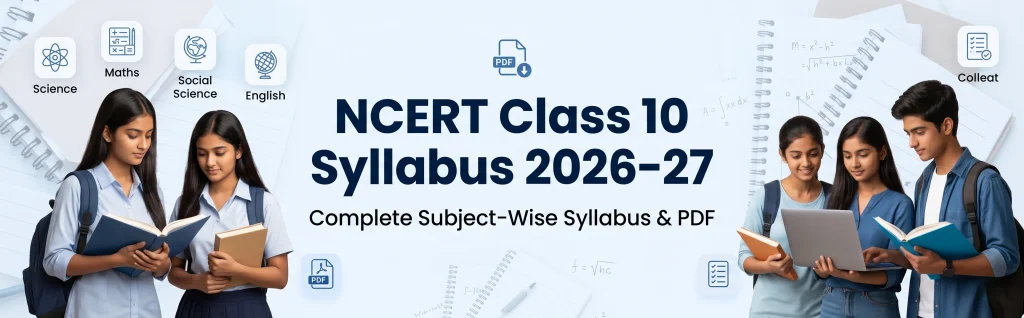
The NCERT Class 10 Syllabus (2026 – 27) is the perfect guide for students preparing for their Class 10th board exams. It clearly outlines all subjects – Science, Maths, Social Science, and Languages – so you know exactly what to study and what to focus on.
Following a structured Class 10 Course based on the latest syllabus helps make your preparation more organized and stress-free. The Class 10th Syllabus is designed chapter-wise, making it easier to track your progress and complete the syllabus on time. And, if you use the syllabus smartly – along with notes, practice questions, and regular revision – you can improve your understanding and score better in exams. It’s not just about studying more, but studying the right topics in the right way.
NCERT Class 10 Science Syllabus
The NCERT Syllabus for Class 10 Science includes important chapters like Chemical Reactions, Acids & Bases, Life Processes, and more. It helps you understand concepts in a simple and practical way. If you study the syllabus along with Class 10th Science Solutions, it becomes easier to practice questions and clear your doubts. This way, you can prepare better and score good marks in your board exams.
| Chapters | English Medium | Hindi Medium | Topics Covered |
|---|---|---|---|
| Chapter 1 | Chemical Reactions and Equations | रासायनिक अभिक्रियाएँ एवं समीकरण | • Chemical reactions • Types of chemical reactions • Writing chemical equations • Balancing chemical reactions • Effects in daily life |
| Chapter 2 | Acids, Bases, and Salts | अम्ल, क्षार एवं लवण | • Properties of acids and bases • Indicators • Common acids and bases • Neutralisation • Salts and their uses |
| Chapter 3 | Metals and Non-Metals | धातु एवं अधातु | • Physical properties • Chemical properties • Reactivity series • Corrosion and prevention |
| Chapter 4 | Carbon and Its Compounds | कार्बन एवं उसके यौगिक | • Allotropes of carbon • Physical & chemical properties • Types of compounds • Uses of carbon compounds |
| Chapter 5 | Life Processes | जीव प्रक्रियाएँ | • Nutrition • Respiration • Transportation • Excretion |
| Chapter 6 | Control and Coordination | नियंत्रण एवं समन्वय | • Human nervous system • Reflex actions • Sense organs • Hormones and functions |
| Chapter 7 | How do Organisms Reproduce? | जीव जनन कैसे करते हैं | • Modes of reproduction • Asexual reproduction • Sexual reproduction • Reproductive health |
| Chapter 8 | Heredity | अनुवांशिकता | • Traits and inheritance • Variation in traits • Basics of genetics • Importance of heredity |
| Chapter 9 | Light – Reflection and Refraction | प्रकाश – परावर्तन तथा अपवर्तन | • Nature of light • Reflection • Refraction • Image formation |
| Chapter 10 | The Human Eye and the Colourful World | मानव नेत्र तथा रंगीन संसार | • Structure of human eye • Eye defects • Dispersion of light • Rainbows and colours |
| Chapter 11 | Electricity | विद्युत | • Electric circuits • Conductors & insulators • Effects of current • Safety measures |
| Chapter 12 | Magnetic Effects of Electric Current | विद्युत धारा के चुंबकीय प्रभाव | • Magnetic fields • Electromagnets • Working of electric bell • Uses of electromagnets |
| Chapter 13 | Our Environment | हमारा पर्यावरण | • Ecosystems • Pollution • Conservation • Waste management |
NCERT Class 10 Maths Syllabus
The NCERT Class 10 Maths Syllabus gives a clear idea of all the important chapters you need to prepare for your board exams. It includes topics like Real Numbers, Polynomials, Trigonometry, and more, helping you build a strong foundation. By studying the syllabus along with Class 10th Maths Solutions, you can practice better and understand concepts easily. This makes your preparation more effective and helps you score good marks in exams.
| Chapters | English Medium | Hindi Medium | Key Topics |
|---|---|---|---|
| Chapter 1 | Real Numbers | वास्तविक संख्याएँ | Fundamental Theorem of Arithmetic, Revisiting Irrational Numbers |
| Chapter 2 | Polynomials | बहुपद | Zeroes of a polynomial, Relationship between zeroes and coefficients |
| Chapter 3 | Pair of Linear Equations in Two Variables | रेखिक समीकरणों का युग्म | Graphical method, Elimination & Substitution methods |
| Chapter 4 | Quadratic Equations | द्विघात समीकरण | Factorisation method, Nature of roots |
| Chapter 5 | Arithmetic Progressions | अंकगणितीय प्रगति | nth term of AP, Sum of first n terms |
| Chapter 6 | Triangles | त्रिभुज | Similarity criteria, Properties of triangles |
| Chapter 7 | Coordinate Geometry | निर्देशांक ज्यामिति | Distance formula, Section formula |
| Chapter 8 | Introduction to Trigonometry | त्रिकोणमिति का परिचय | Trigonometric ratios, Identities, Specific angles |
| Chapter 9 | Applications of Trigonometry | त्रिकोणमिति के अनुप्रयोग | Heights and distances |
| Chapter 10 | Circles | वृत्त | Tangent to a circle, Number of tangents from a point |
| Chapter 11 | Areas Related to Circles | वृत्तों से संबंधित क्षेत्रफल | Area of sector and segment |
| Chapter 12 | Surface Areas and Volumes | पृष्ठीय क्षेत्रफल और आयतन | Surface area and volume of solids |
| Chapter 13 | Statistics | सांख्यिकी | Mean, Median, Mode of grouped data |
| Chapter 14 | Probability | प्रायिकता | Theoretical probability |
NCERT Class 10 Social Science Syllabus
The NCERT Class 10 Social Science Syllabus covers key subjects like History, Geography, Political Science, and Economics. Firstly, it helps students understand important concepts about society, resources, and governance simply. Moreover, by following the syllabus along with Class 10th Social Science Solutions, you can easily revise chapters and practice important questions. As a result, your preparation becomes stronger. Ultimately, this helps you perform better in board exams.
| Subject | Chapter No. | Chapter Title | Key Topics |
|---|---|---|---|
| History (India and the Contemporary World-II) | 1 | The Rise of Nationalism in Europe | French Revolution, Unification of Germany & Italy, Nationalism, Imperialism |
| 2 | Nationalism in India | Gandhi, Non-Cooperation, Civil Disobedience, Role of social groups | |
| 3 | The Making of a Global World | Pre-modern world, Industrialisation, Globalisation | |
| 4 | The Age of Industrialisation | Pre-industrial era, Factory system, Industrialisation in colonies | |
| 5 | Print Culture and The Modern World | Development of print, Print in Europe & India, Social impact | |
| Geography (Contemporary India) | 1 | Resources and Development | Types of resources, Resource planning, Land use, Soil types |
| 2 | Forest and Wildlife Resources | Biodiversity, Conservation, Flora & Fauna | |
| 3 | Water Resources | Water scarcity, River projects, Rainwater harvesting | |
| 4 | Agriculture | Farming types, Cropping patterns, Major crops | |
| 5 | Minerals and Energy Resources | Types of minerals, Energy sources, Conservation | |
| 6 | Manufacturing Industries | Industry types, Distribution, Pollution control | |
| 7 | Lifelines of the National Economy | Transport, Communication, Trade, Tourism, Infrastructure | |
| Political Science (Democratic Politics) | 1 | Power Sharing | Belgium & Sri Lanka, Types of power sharing |
| 2 | Federalism | Meaning, Features, Federalism in India | |
| 3 | Gender, Religion, and Caste | Gender issues, Communalism, Caste system | |
| 4 | Political Parties | Types of parties, Challenges | |
| 5 | Outcomes of Democracy | Accountability, Development, Inequality | |
| Economics (Understanding Economic Development) | 1 | Development | Development goals, Indicators |
| 2 | Sectors of the Indian Economy | Primary, Secondary, Tertiary sectors, Employment | |
| 3 | Money and Credit | Formal & informal credit, Self Help Groups | |
| 4 | Globalisation and the Indian Economy | Liberalisation, MNCs, Impact on India | |
| 5 | Consumer Rights | Consumer movement, Rights & laws |
NCERT Class 10 Hindi Syllabus
The NCERT Class 10 Hindi Syllabus focuses on improving reading, writing, and grammar skills through literature and language practice. It includes prose, poetry, and grammar topics that help students understand concepts clearly. By studying regularly and using Class 10th Hindi solutions, you can practice questions and improve your writing skills. This will help you perform better and score good marks in exams.
| खंड | पाठ / कविता का नाम | लेखक / कवि |
|---|---|---|
| काव्य खंड | उद्धव, तुम ही जोति जगाना…, मन की बात ही मौन रही, हमारे हरि हरिल की लकड़ी, हरे हैं राजनां पौधे आए | सूरदास |
| राम-लक्ष्मण-परशुराम संवाद | तुलसीदास | |
| आत्मकथ्य | जयशंकर प्रसाद | |
| उत्साह | सूर्यकांत त्रिपाठी ‘निराला’ | |
| यह दंतुरित मुस्कान | नागार्जुन | |
| संगाकर | मंगलेश डबराल | |
| गद्य खंड | नेताजी का चश्मा | स्वयं प्रकाश |
| बालगोबिन भगत | रामवृक्ष बेनीपुरी | |
| लखनवी अंदाज | यशपाल | |
| एक कहानी यह भी | मन्नू भंडारी | |
| नौबतखाने में इबादत | यतींद्र मिश्र | |
| संस्कृति | भदंत आनंद कौसल्यायन |
Class 10 NCERT Syllabus Hindi (Book 2 – Kritika Part 2)
| पाठ का नाम | लेखक |
|---|---|
| माता का आँचल | शिवपूजन सहाय |
| साना साना हाथ जोड़ि | मधु कांकरिया |
| मैं क्यों लिखता हूँ | अज्ञेय |
NCERT Class 10 English Syllabus
The NCERT Class 10 English Syllabus is designed to build strong reading, writing, and communication skills. It includes prose, poetry, grammar, and writing sections that are important for board exams. With the help of Class 10th English solutions, students can understand chapters easily and practice effectively. This makes preparation smoother and helps in scoring better marks.
NCERT Syllabus Class 10 for Literature Reader First Flight
Prose
| S.No. | Chapter Name |
|---|---|
| 1 | A Letter to God |
| 2 | Nelson Mandela: Long Walk to Freedom |
| 3 | Two Stories about Flying |
| 4 | From the Diary of Anne Frank |
| 5 | Glimpses of India |
| 6 | Mijbil the Otter |
| 7 | Madam Rides the Bus |
| 8 | The Sermon at Benares |
| 9 | The Proposal |
Footprints Without Feet (Supplementary Reader)
| S.No. | Title | Topics |
|---|---|---|
| 1 | A Triumph of Surgery | Pet care and clever deception |
| 2 | The Thief’s Story | Trust and change |
| 3 | The Midnight Visitor | Smart spy work |
| 4 | A Question of Trust | Irony in theft |
| 5 | Footprints without Feet | Science fiction (invisibility) |
| 6 | The Making of a Scientist | Hard work and curiosity |
| 7 | The Necklace | Vanity and truth |
| 8 | Bholi | Education and self-respect |
| 9 | The Book That Saved the Earth | Science fiction and humor |
How to Download the NCERT Class 10 Syllabus for 2026-27 Board Exams?
Students can easily download the latest syllabus from the official NCERT website by following a few simple steps:
1. Visit the official NCERT website at ncert.nic.in.
2. On the homepage, go to the Search option and type “Syllabus.”
3. Click on “Syllabus for Secondary and Higher Secondary Classes.”
4. Select “Class X Syllabus” for your required subject
5. The syllabus PDF will open on your screen
Download and save it for future reference.
Also Read: Common Mistakes that Reduce Marks Even When Answers are Right
Frequently Asked Questions
1. How many subjects are there in NCERT Class 10?
NCERT Class 10 mainly includes 5 core subjects: Maths, Science, Social Science, English, and Hindi (or another language subject depending on the board).
2. Is Class 10 board easy or hard?
Class 10 board exams are moderate in difficulty. With proper understanding of concepts and regular practice, students can score high marks easily.
3. Are NCERT books enough for Class 10 board exams?
Yes, NCERT books are more than enough for CBSE Class 10 boards. Most questions are directly or indirectly based on NCERT concepts and exercises.
4. Is the NCERT syllabus the same for CBSE Class 10?
Yes, CBSE follows the NCERT syllabus for Class 10. The exam pattern and questions are designed based on NCERT textbooks and guidelines.
5. How to prepare effectively using the NCERT Class 10 syllabus?
Start by understanding the complete syllabus, make a proper study plan, focus on NCERT textbooks, and practice regularly. For better understanding, you can also use animated learning apps like ToppersSky, which provide 2D/3D video lessons, quizzes, and revision tools to make learning easier and more engaging.